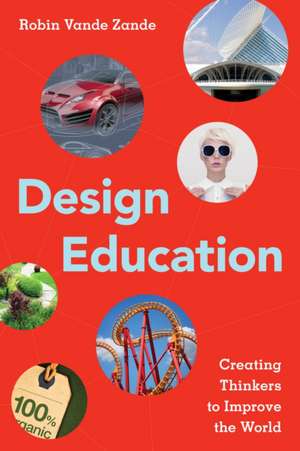
Design Education: Creating Thinkers to Improve the World
Autor Robin Vande Zandeen Limba Engleză Hardback – 15 dec 2016
Designers utilize research methods, technology, sketching, and the construction of prototypes. The basis of these techniques, systems, and tools may be taught to Prek-12 students. Students need lifelong skills that build their creativity and problem-solving capabilities to better understand the world and themselves and use visual communication to advance their abilities to express ideas.
Design is a study about life and can touch on all school subjects, making it a valuable interdisciplinary study. Students are able to directly apply thinking strategies and learning about facts, figures, and concepts at the same time they are crafting meaningful ideas about the importance, influence, and social implications of everyday items and the potential to improve the world.
Preț: 505.57 lei
Preț vechi: 689.02 lei
-27%
Puncte Express: 758
Carte tipărită la comandă
Livrare economică 09-23 noiembrie
Livrare prin curier în România Termenul estimat este afișat lângă disponibilitate.
Transport gratuit pentru acest produs Plată online sau ramburs, în funcție de opțiunile comenzii.
Retur gratuit în 14 zile Comandă securizată și suport în română.
Specificații
ISBN-13: 9781475820140
ISBN-10: 1475820143
Pagini: 230
Ilustrații: 82 b/w photos; 17 textboxes
Dimensiuni: 160 x 230 x 20 mm
Greutate: 0.52 kg
Editura: Bloomsbury Publishing
Colecția National Art Educators Association
Locul publicării:New York, United States
ISBN-10: 1475820143
Pagini: 230
Ilustrații: 82 b/w photos; 17 textboxes
Dimensiuni: 160 x 230 x 20 mm
Greutate: 0.52 kg
Editura: Bloomsbury Publishing
Colecția National Art Educators Association
Locul publicării:New York, United States
Cuprins
Preface
Acknowledgements
Introduction: Why Teach Design?
Chapter One: Design Education is a Study about Life
Chapter Two: What We Can Learn from Designers That We Can use in Our Classrooms
Chapter Three: How to Implement Design Education into Your Art Program
Chapter Four: Framework of the Practices, Principles and Strategies for Teaching Design
Chapter Five: Curricular Aspects; Units and Design Lessons
Chapter Six: Concepts to Teach: Individual Physical, Emotional, and Intellectual Health Societal Health- Social Responsibility and Economics
Chapter Seven: Design Lesson Methods and Topics for Elementary Students
Chapter Eight: Design Lesson Methods and Topics for Middle School Students
Chapter Nine: Design Lesson Methods and Topics for High School Students
References
Appendix
About the Author
Acknowledgements
Introduction: Why Teach Design?
Chapter One: Design Education is a Study about Life
Chapter Two: What We Can Learn from Designers That We Can use in Our Classrooms
Chapter Three: How to Implement Design Education into Your Art Program
Chapter Four: Framework of the Practices, Principles and Strategies for Teaching Design
Chapter Five: Curricular Aspects; Units and Design Lessons
Chapter Six: Concepts to Teach: Individual Physical, Emotional, and Intellectual Health Societal Health- Social Responsibility and Economics
Chapter Seven: Design Lesson Methods and Topics for Elementary Students
Chapter Eight: Design Lesson Methods and Topics for Middle School Students
Chapter Nine: Design Lesson Methods and Topics for High School Students
References
Appendix
About the Author
Recenzii
Robin Vande Zande uses this book to stimulate thinking about design, how it influences our societal values, and how to share design based thinking with students in a reflective, observant, and practical way. It inspires, educates and creates a solid case for the teaching of design education to all students of all ages. The book challenges readers, teachers and educators to think about design and evaluate the art of the everyday based on a solid understanding of design concepts.
Children are growing up to live and work in a rapidly changing and increasingly technological world. Design thinking, allied to creativity and problem solving, are ever more essential tools for young people to develop and therefore good design teaching is ever more important. This book is indispensable contribution to this important area of education and should be a constant companion to all those teaching it.
This book opens up a discussion of design education for children and youth. It illustrates socially significant ways to build design education in schools and strengthen the connections between art and design education. Attending to the interdependence of the two fields will aid student learning about the vast production and influence of visual and material culture in their lives.
Finally, a comprehensive look at the power of a design education. Vande Zande has compiled a pivotal text to engage teachers and students from all disciplines; to educate them on the successful, joyful and fulfilling aspects of an art, architecture and design based education. This book will undoubtedly lead the way for many generations of design-thinkers.
Teaching design through art education and through interdisciplinary design teams is more relevant today than it has ever been. Robin Vande Zande shows us how to think about and plan our lessons in ways that engage students in problem solving for daily living. I have used her methods to provide rich learning experiences in designing better products and community environments that my students will never forget. At a time when our students face the competition of a global economy and our curriculum calls for greater depth of knowledge, Design Education: Creating Thinkers to Improve the World is a well-timed answer for innovative educators and administrators who are looking for inspiration and guidance while building a project-based high school curriculum.
In this book Robin Vande Zande challenges and expands the existing visual arts education, and rightly so. Design knowledge and competence is of vital importance in shaping the world. Creativity, entrepreneurial skills, innovation capacity, problem solving and information gathering skills, are key competitive advantages not just for the future designer, but as Vande-Zande points out, for any citizen in making sustainable consumer choices and in building healthy communities. This book is a step towards and a guide for educators to create a new mindset in education.
In a compelling narrative Robin Vande Zande's book merges history and theory with pertinent lesson plans full of focused activities and questions. It is a much-needed textbook that thoroughly communicates the wealth of design knowledge educators need in order to bring critical life skills into the 21st century classroom. I'm confident that this book will not only help clarify and solidify the teaching methods necessary for meaningful design education but will also help broaden the very definition of design in the future.
Children are growing up to live and work in a rapidly changing and increasingly technological world. Design thinking, allied to creativity and problem solving, are ever more essential tools for young people to develop and therefore good design teaching is ever more important. This book is indispensable contribution to this important area of education and should be a constant companion to all those teaching it.
This book opens up a discussion of design education for children and youth. It illustrates socially significant ways to build design education in schools and strengthen the connections between art and design education. Attending to the interdependence of the two fields will aid student learning about the vast production and influence of visual and material culture in their lives.
Finally, a comprehensive look at the power of a design education. Vande Zande has compiled a pivotal text to engage teachers and students from all disciplines; to educate them on the successful, joyful and fulfilling aspects of an art, architecture and design based education. This book will undoubtedly lead the way for many generations of design-thinkers.
Teaching design through art education and through interdisciplinary design teams is more relevant today than it has ever been. Robin Vande Zande shows us how to think about and plan our lessons in ways that engage students in problem solving for daily living. I have used her methods to provide rich learning experiences in designing better products and community environments that my students will never forget. At a time when our students face the competition of a global economy and our curriculum calls for greater depth of knowledge, Design Education: Creating Thinkers to Improve the World is a well-timed answer for innovative educators and administrators who are looking for inspiration and guidance while building a project-based high school curriculum.
In this book Robin Vande Zande challenges and expands the existing visual arts education, and rightly so. Design knowledge and competence is of vital importance in shaping the world. Creativity, entrepreneurial skills, innovation capacity, problem solving and information gathering skills, are key competitive advantages not just for the future designer, but as Vande-Zande points out, for any citizen in making sustainable consumer choices and in building healthy communities. This book is a step towards and a guide for educators to create a new mindset in education.
In a compelling narrative Robin Vande Zande's book merges history and theory with pertinent lesson plans full of focused activities and questions. It is a much-needed textbook that thoroughly communicates the wealth of design knowledge educators need in order to bring critical life skills into the 21st century classroom. I'm confident that this book will not only help clarify and solidify the teaching methods necessary for meaningful design education but will also help broaden the very definition of design in the future.