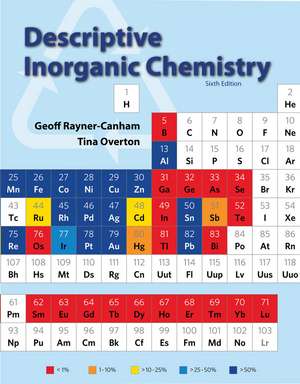
Descriptive Inorganic Chemistry
Autor Geoff Rayner-Canham, Tina Overtonen Limba Engleză Hardback – 10 mar 2014
Descoperim în această a șasea ediție a lucrării Descriptive Inorganic Chemistry o rafinare a metodologiei pedagogice care a consacrat textul drept un standard în domeniu. Schimbările majore față de ediția precedentă vizează în special extinderea secțiunilor dedicate aplicațiilor biologice și introducerea unor noi instrumente de asistență pentru rezolvarea problemelor complexe. Suntem de părere că această actualizare consolidează puntea dintre teoria chimică și relevanța sa practică în procesele industriale și problemele de mediu actuale.
Comparabil cu Inorganic Chemistry de Catherine Housecroft în rigurozitatea prezentării elementelor, volumul de față se distinge printr-o abordare mai puțin matematică, fiind optimizat pentru studenții care doresc o înțelegere conceptuală solidă înainte de aprofundarea formalismelor abstracte. De asemenea, dacă ne raportăm la Introduction to Modern Inorganic Chemistry, 6th edition de R.A. Mackay, lucrarea lui Geoff Rayner-Canham și Tina Overton pune un accent mai puternic pe corelațiile din interiorul Tabelului Periodic ca instrument de predicție a comportamentului chimic.
Structura celor 24 de capitole reflectă o progresie logică: primele opt capitole stabilesc fundamentele teoretice — de la structura electronică și legăturile covalente până la termodinamică și sisteme de solvenți — urmate de o analiză sistematică a grupurilor de elemente. Această organizare permite o navigare facilă între proprietățile metalelor alcaline, halogenilor sau metalelor de tranziție, finalizând cu o incursiune în chimia organometalică și a elementelor rare. În contextul operei lui Geoff Rayner-Canham, care a explorat frecvent istoria științei în lucrări precum Allies of Pioneering Women Chemists, această ediție păstrează amprenta sa caracteristică, integrând evoluția istorică a conceptelor chimice pentru a oferi profunzime procesului de învățare.
Preț: 1522.46 lei
Preț vechi: 1856.66 lei
-18%
Carte disponibilă
Livrare economică 16-30 mai
Specificații
ISBN-10: 1464125570
Pagini: 720
Ilustrații: black & white illustrations, black & white line drawings, colour line drawings, black & white tables, diagrams, figures
Dimensiuni: 206 x 261 x 30 mm
Greutate: 1.55 kg
Ediția:Revizuită
Editura: W. H. Freeman
Colecția W. H. Freeman
Locul publicării:New York, United States
V-ar putea interesa
-
 Inorganic ChemistryMark Weller-27%Preț: 1304.99 lei1787.67 lei
 -
 -13%Preț: 285.41 lei329.70 lei
 -
 -21%Preț: 492.11 lei619.35 lei
 -
 Bioinorganic ChemistryDieter Rehder-23%Preț: 361.44 lei466.84 lei
 -
 -30%Preț: 1450.84 lei2080.03 lei
 -
 Lithium: Technology, Performance & SafetyFrancisco L Tabarés-30%Preț: 1121.52 lei1605.77 lei
 -
 -15%Preț: 610.01 lei717.66 lei
 -
 Allgemeine und Anorganische ChemieMichael Binnewies-11%Preț: 670.33 lei753.18 lei
 -
 Etude des Systèmes Li-Air Non Aqueux RéversiblesVincent Giordani-15%Preț: 522.90 lei615.17 lei
 -
 Pile à combustible SOFCCyril Gaudillere-18%Preț: 569.52 lei694.54 lei
 -
 Preț: 210.32 lei
 -
 Compendium der metallurgischen ChemieCarl A. M. BallingPreț: 310.93 lei
 -
 Luminescence de L''Ion Ytterbium: Bilan Et PerspectivesJean SablayrollesPreț: 375.12 lei
 -
 Preț: 466.02 lei
 -
 -19%Preț: 531.15 lei655.73 lei
 -
 -19%Preț: 455.51 lei562.36 lei
 -
 -19%Preț: 528.67 lei652.68 lei
 -
 Preț: 481.11 lei
 -
 Physico-Chimie Des Substances HumiquesCollectif-19%Preț: 467.72 lei577.43 lei
 -
 -19%Preț: 463.82 lei572.63 lei
 -
 Poudres mcralyCollectif-19%Preț: 462.83 lei571.39 lei
 -
 -19%Preț: 544.73 lei672.50 lei
De ce să citești această carte
Această ediție este ideală pentru studenții la chimie care caută o resursă echilibrată, unde accentul cade pe înțelegerea proprietăților elementelor și a relațiilor dintre ele, mai degrabă decât pe calcule matematice intensive. Cititorul câștigă o perspectivă clară asupra modului în care chimia anorganică modelează lumea modernă, de la biologie la industrie, beneficiind de un suport didactic îmbunătățit pentru examene.
Despre autor
Geoff Rayner-Canham este un distins profesor de chimie, recunoscut pentru contribuțiile sale atât în chimia anorganică descriptivă, cât și în istoria femeilor în știință, temă abordată în volume precum Pioneers of the London School of Medicine for Women (1874-1947). Tina Overton este o expertă în educație chimică, premiată pentru metodele sale inovatoare de predare. Împreună, cei doi autori au creat texte fundamentale, inclusiv ediții internaționale precum Allgemeine und Anorganische Chemie, adaptând rigurozitatea științifică la nevoile pedagogice ale studenților contemporani, promovând o învățare activă și contextualizată.
Cuprins
2. The Structure of the Periodic Table
3. Covalent Bonding and Molecular Spectroscopy
4. Metallic Bonding, Alloys, and Composites
5. Ionic Bonding and Solid State Behaviour
6. Why Compounds Exist - Inorganic Thermodynamics
7. Solvent Systems and Acid-Base Behavior
8. Oxidation and Reduction
9. Periodic Patterns
10. Hydrogen
11. The Group 1 Elements: The Alkali Metals
12. The Group 2 Elements: The Alkaline Earth Metals
13. The Group 13 Elements
14. The Group 14 Elements
15. The Group 15 Elements: The Pnictogens
16. The Group 16 Elements: The Chalcogens
17. The Group 17 Elements: The Halogens
18. The Group 18 Elements: The Noble Gases
19. Transition Metal Complexes
20. Properties of the 3d Transition Metals
21. Properties of the 4d and 5d Transition Metals
22. The Group 12 Elements
23. Organometallic Chemistry
24. The Rare Earth and Actinoid Elements
Notă biografică
Tina Overton is Professor of Chemistry Education at the University of Hull, UK. She is deeply engaged in chemical education research, and has published extensively on the topics of critical thinking, context and problem-based learning, and the development of problem-solving skills. She has been awarded the Royal Society of Chemistry's HE Teaching Award, Tertiary Education Award and Nyholm Prize, and is a National Teaching Fellow and Senior Fellow of the Higher Education Academy.
Caracteristici
Best-selling introduction to the subject
Now with more study tools and problem-solving help
Expanded coverage of biological applications
With further web support
Caracteristici noi
* the greenhouse effect
* ionic solvents and green chemistry
* carbon nanotubes or graphene
* ADP and ATP
* fluoridation of water and tooth decay?
* the danger of radon
* why is zinc so biologically important?
* lasers or nuclear power
New Worked Examples encourage the development of problem-solving skills with representative examples that guide students to the solution step-by-step.
New Discoveries have been added to show that descriptive inorganic chemistry is alive and well as the 21st century progresses.
Updated Biological Aspects sections, at the end of chapters, help increase the book's appeal to the many life sciences students who take the course.
Updated Videos of inorganic chemical compounds and reactions (via the BCS).
Comparative Predominance Diagrams have been added, where appropriate, to provide a visual display of which species of an element or ion are present under specific conditions.
For additional chapter-by-chapter changes, please see attached.