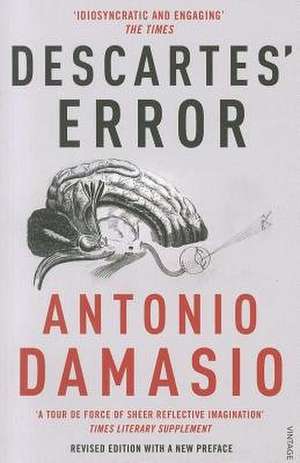
Descartes' Error
Autor Antonio Damasioen Limba Engleză Paperback – 6 iul 2006
Descoperim în Descartes' Error lucrarea de referință care a marcat, în 1995, o schimbare de paradigmă în neuroștiințe, aducând emoțiile din periferia cercetării direct în centrul mecanismelor raționalității. Suntem de părere că această ediție rămâne la fel de relevantă pentru curriculumul de psihologie cognitivă, oferind o critică riguroasă a dualismului minte-corp. Autorul pornește de la analiza cazului [Phineas Gage](case), muncitorul feroviar a cărui personalitate s-a schimbat radical după o leziune cerebrală, pentru a demonstra că absența emoțiilor nu conduce la o rațiune „pură”, ci la o incapacitate patologică de a lua decizii sociale corecte. Cartea este structurată în trei părți distincte: prima secțiune investighează datele clinice, a doua propune o explicație biologică prin faimoasa „Ipoteză a Markerului Somatic”, iar ultima parte explorează implicațiile filosofice ale unui creier „orientat către corp”. Apreciem modul în care Antonio Damasio integrează biologia supraviețuirii cu procesele cognitive complexe, o temă pe care o va rafina ulterior în lucrări precum The Strange Order Of Things sau Feeling and Knowing. Dacă în acele volume ulterioare se concentrează pe evoluția culturii și a conștiinței, aici găsim fundamentul neurologic al întregului său sistem de gândire. Acoperă aceeași arie tematică precum Emotional de Leonard Mlodinow, dar cu o abordare mult mai tehnică și ancorată în neurologia clinică. În timp ce Mlodinow oferă o perspectivă contemporană asupra modului în care sentimentele ne ghidează alegerile zilnice, Damasio construiește un argument științific dens despre structura creierului, oferind rigoarea necesară pentru a înțelege de ce eroarea lui Descartes a persistat atât de mult în știința occidentală.
Preț: 73.20 lei
Preț vechi: 91.99 lei
-20%
Carte disponibilă
Livrare economică 10-21 iulie
Livrare express 23-27 iunie pentru 40.49 lei
Specificații
ISBN-10: 0099501643
Pagini: 352
Ilustrații: Illustrations
Dimensiuni: 128 x 198 x 32 mm
Greutate: 0.25 kg
Editura: Vintage Publishing
Locul publicării:United Kingdom
V-ar putea interesa
-
 Manual of The Warrior of LightPaulo CoelhoPreț: 67.35 lei
 -
 Lost HorizonJames HiltonPreț: 102.05 lei
 -
 The ColourRose Tremain-20%Preț: 63.25 lei78.63 lei
 -
 Seduction of a Highland LassMaya BanksPreț: 53.44 lei
 -
 The Little Book of TalentDaniel CoylePreț: 127.15 lei
 -
 If You Meet the Buddha on the Road, Kill HimSheldon KoppPreț: 55.59 lei
 -
 AxiomaticGreg Egan-27%Preț: 57.56 lei78.67 lei
 -
 Astrology and the Evolution of Consciousness-Volume 1Maurice FernandezPreț: 143.29 lei
 -
 MasteryRobert GreenePreț: 200.82 lei
 -
 ChaosJames Gleick-20%Preț: 73.50 lei92.17 lei
 -
 Island of the Day BeforeUmberto Eco-19%Preț: 75.16 lei93.17 lei
 -
 Cloud Atlas (Movie Tie-In Edition)David MitchellPreț: 68.35 lei
 -
 Leading ChangeJohn P. KotterPreț: 177.72 lei
 -
 The World As I See ItAlbert EinsteinPreț: 66.79 lei
 -
 The Practicing MindThomas M. Sterner-21%Preț: 87.78 lei111.82 lei
 -
 Pluto: The Soul's Evolution Through Relationships, Volume 2Jeffrey Wolf GreenPreț: 211.74 lei
 -
 Understanding Karmic ComplexesPatricia L WalshPreț: 196.71 lei
 -
 Essays on Evolutionary AstrologyJeffrey GreenPreț: 155.68 lei
 -
 Fringe Science: Parallel Universes, White Tulips, and Mad ScientistsKevin R. GrazierPreț: 99.83 lei
 -
 Minimal GameAaron SleazyPreț: 101.02 lei
De ce să citești această carte
Această carte este esențială pentru oricine dorește să înțeleagă biologia din spatele deciziilor umane. Cititorul va câștiga o perspectivă nouă asupra modului în care corpul și mintea colaborează, învățând că sentimentele nu sunt obstacole în calea logicii, ci instrumente biologice de supraviețuire. Este o lectură fundamentală pentru studenții la psihologie, medicină sau filosofie, oferind argumente solide împotriva separării stricte între rațiune și emoție.
Despre autor
Antonio Damasio este profesor „Van Allen” și șeful departamentului de neurologie de la Centrul Medical al Universității din Iowa, fiind totodată profesor adjunct la Institutul Salk. Recunoscut de The New York Times drept unul dintre cei mai importanți neurologi ai lumii, Damasio și-a dedicat cariera studierii bazei neurologice a emoțiilor și conștiinței. Lucrarea sa, Descartes' Error, a fost nominalizată la Los Angeles Times Book Award și a fost tradusă în douăzeci și trei de limbi, consolidându-i statutul de pionier în domeniul neuroștiințelor afective.
Descriere
In the centuries since Descartes famously proclaimed, 'I think, therefore I am,' science has often overlooked emotions as the source of a person's true being. Even modern neuroscience has tended until recently to concentrate on the cognitive aspects of brain function, disregarding emotions. This attitude began to change with the publication of Descartes' Error.
Antonio Damasio challenged traditional ideas about the connection between emotions and rationality. In this wonderfully engaging book, Damasio takes the reader on a journey of scientific discovery through a series of case studies, demonstrating what many of us have long suspected: emotions are not a luxury, they are essential to rational thinking and to normal social behaviour.
Recenzii
Cuprins
PART I
Unpleasantness in Vermont 3
Gage's Brain Revealed 20
A Modern Phineas Gage 34
In Colder Blood 52
PART II
Assembling an Explanation 83
Biological Regulation and Survival 114
Emotions and Feelings 127
The Somatic-Marker Hypothesis 165
PART III
Testing the Somatic-Marker Hypothesis 205
The Body-Minded Brain 223
A Passion for Reasoning 245
Postscriptum 253
Notes and References 269
Further Reading 293
Acknowledgments 299
Index 301
Notă biografică
Extras
It is the summer of 1848. We are in New England. Phineas P Gage, twenty-five years old, construction foreman, is about to go from riches to rags. A century and a half later his downfall will still be quite meaningful.
Gage works for the Rutland &Burlington Railroad and is in charge of a large group of men, a "gang" as it is called, whose job it is to lay down the new tracks for the railroad's expansion across Vermont. Over the past two weeks the men have worked their way slowly toward the town of Cavendish; they are now at a bank of the Black River. The assignment is anything but easy because of the outcrops of hard rock. Rather than twist and turn the tracks around every escarpment, the strategy is to blast the stone and make way for a straighter and more level path. Gage oversees these tasks and is equal to them in every way. He is five-foot-six and athletic, and his movements are swift and precise. He looks like a young Jimmy Cagney, a Yankee Doodle dandy dancing his tap shoes over ties and tracks, moving with vigor and grace.
In the eyes of his bosses, however, Gage is more than just another able body. They say he is "the most efficient and capable" man in their employ.- This is a good thing, because the job takes as much physical prowess as keen concentration, especially when it comes to preparing the detonations. Several steps have to be followed, in orderly fashion. First, a hole must be drilled in the rock. After it is filled about halfway with explosive powder, a fuse must be inserted, and the powder covered with sand. Then the sand must be "tampedin," or pounded with a careful sequence of strokes from an iron rod. Finally, the fuse must be lit. If all goes well, the powder will explode into the rock; the sand is essential, for without its protection the explosion would be directed away from the rock. The shape of the iron and the way it is played are also important. Gage, who has had an iron manufactured to his specifications, is a virtuoso of this thing.
Now for what is going to happen. It is four-thirty on this hot afternoon. Gage has just put powder and fuse in a hole and told the man who is helping him to cover it with sand. Someone calls from behind, and Gage looks away, over his right shoulder, for only an instant. Distracted, and before his man has poured the sand in, Gage begins tamping the powder directly with the iron bar. In no time he strikes fire in the rock, and the charge blows upward in his face.
The explosion is so brutal that the entire gang freezes on their feet. It takes a few seconds to piece together what is going on. The bang is unusual, and the rock is intact. Also unusual is the whistling sound, as of a rocket hurled at the sky. But this is more than fireworks. It is assault and battery. The iron enters Gage's left cheek, pierces the base of the skull, traverses the front of his brain, and exits at high speed through the top of the head. The rod has landed more than a hundred feet away, covered in blood and brains. Phineas Gage has been thrown to the ground. He is stunned, in the afternoon glow, silent but awake. So are we all, helpless spectators.
"Horrible Accident" will be the predictable headline in the Boston Daily Courier and Daily Journal of September 20, a week later. "Wonderful Accident" will be the strange headline in the Vermont Mercury of September 22. "Passage of an Iron Rod Through the Head" will be the accurate headline in the Boston Medical and Surgical Journal. From the matter-of-factness with which they tell the story, one would think the writers were familiar with Edgar Allan Poe's accounts of the bizarre and the horrific. And perhaps they were, although this is not likely; Poe's gothic tales are not yet popular, and Poe himself will die the next year, unknown and impecunious. Perhaps the horrible is just in the air.
Noting how surprised people were that Gage was not killed instantly, the Boston medical article documents that "immediately after the explosion the patient was thrown upon his back"; that shortly thereafter he exhibited "a few convulsive motions of the extremities," and "spoke in a few minutes"; that "his men (with whom he was a great favourite) took him in their arms and carried him to the road, only a few rods distant (a rod is equivalent to 5 1/2 yards, or 16 1/2 feet), and sat him into an ox cart, in which he rode, sitting erect, a full three quarters of a mile, to the hotel of Mr. Joseph Adams"; and that Gage "got out of the cart himself, with a little assistance from his men."
Let me introduce Mr. Adams. He is the justice of the peace for Cavendish and the owner of the town's hotel and tavern. He is taller than Gage, twice as round, and as solicitous as his Falstaff shape suggests. He approaches Gage, and immediately has someone call for Dr. John Harlow, one of the town physicians. While they wait, I imagine, he says, "Come, come, Mr. Gage, what have we got here?" and, why not, "My, my, what troubles we've seen." He shakes his head in disbelief and leads Gage to the shady part of the hotel porch, which has been described as a "piazza." That makes it sound grand and spacious and open, and perhaps it is grand and spacious, but it is not open; it is just a porch. And there perhaps Mr. Adams is now giving Phineas Gage lemonade, or maybe cold cider.
An hour has passed since the explosion. The sun is declining and the heat is more bearable.