
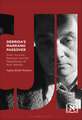
Derrida's Marrano Passover: Exile, Survival, Betrayal, and the Metaphysics of Non-Identity: Comparative Jewish Literatures
Autor Agata Bielik-Robsonen Limba Engleză Hardback – 12 ian 2023
By concentrating on Derrida's deliberate choice of marranismo, Bielik-Robson shows that it penetrates deep into the very core of his late thinking, constantly drawing on the literary works of Kafka, Celan, Joyce, Cixous and Valéry, and throws a new light on his early works, most of all: Of Grammatology, Dissemination and 'Différance'. She also offers a completely new interpretation of many of Derrida's works only seemingly non-related to the Marrano issue, like Glas, Given Time: Counterfeit Money, Death Penalty Seminar, and Specters of Marx. In these new readings, this book demonstrates that the Marrano Derrida is not a marginal auto-biographical figure overshadowed by Derrida the Philosopher: it is one and the same thinker who discovered marranismo as a literary trope of openness, offering up a new genre of philosophical story-telling which centers around Derrida's Marrano 'auto-fable'.


Preț: 584.38 lei
Preț vechi: 912.06 lei
-36%
Puncte Express: 877
Carte tipărită la comandă
Livrare economică 07-21 decembrie
Livrare prin curier în România Termenul estimat este afișat lângă disponibilitate.
Transport gratuit pentru acest produs Plată online sau ramburs, în funcție de opțiunile comenzii.
Retur gratuit în 14 zile Comandă securizată și suport în română.
Specificații
ISBN-13: 9781501392610
ISBN-10: 1501392611
Pagini: 296
Dimensiuni: 232 x 156 x 22 mm
Greutate: 0.58 kg
Editura: Bloomsbury Publishing
Colecția Bloomsbury Academic
Seria Comparative Jewish Literatures
Locul publicării:New York, United States
ISBN-10: 1501392611
Pagini: 296
Dimensiuni: 232 x 156 x 22 mm
Greutate: 0.58 kg
Editura: Bloomsbury Publishing
Colecția Bloomsbury Academic
Seria Comparative Jewish Literatures
Locul publicării:New York, United States
Cuprins
Acknowledgements
List of Abbreviations
Introduction: The Marrano Uncanny - The Last and the First of Jews
1. Betray, Betray Again, Betray Better: Marrano Theology of Survival
2. Secret Followers of the Hiding God: Marrano A-Theism
3. The Nameless Still Life: Marrano Metaphysics of Non-Presence
4. Two Serious Marranos: Derrida and Cixous (with Constant Reference to Poldy Bloom)
5. Ana-Community: Marrano 'Living Together'
Bibliography
List of Abbreviations
Introduction: The Marrano Uncanny - The Last and the First of Jews
1. Betray, Betray Again, Betray Better: Marrano Theology of Survival
2. Secret Followers of the Hiding God: Marrano A-Theism
3. The Nameless Still Life: Marrano Metaphysics of Non-Presence
4. Two Serious Marranos: Derrida and Cixous (with Constant Reference to Poldy Bloom)
5. Ana-Community: Marrano 'Living Together'
Bibliography
Recenzii
No one has ever tracked the figure of the Marrano through Derrida's entire corpus-and particularly the figure of Derrida himself as Marrano-with the degree of erudition, sophistication, insightfulness, and fidelity that Agata Bielik-Robson has in this new work. It will be impossible to read Derrida on questions of religion, the secret, testimony, confession, exile, and identity, to name just a few, without taking this magnificent, magisterial book along as one's guide.
Marrano is a denigrating insult-pig!-of those who feigned to be Christians in order to avoid persecution as Jews. A despised and hidden figure of non-identity at the origins of the modern world, the marrano position as neither Jewish nor Christian nor atheist became, for Jacques Derrida, an intimately personal but also richly theoretical sign of a distinctly modern mode of subjectivity as singular, historical life beyond identity and homogenization. It is the great merit of this book to show how Derrida's admiration for, even devotion to the marrano's interminable infidelities informed his search for the excesses of life, both human and divine, that can never be contained by the politics or the metaphysics of identity. In Bielik-Robson's deft hands, the marrano becomes a precursor antidote to the twin social pathologies of identitarianism and homogenization that plague our world, while Derrida is approached in an ingenious, original way, as a kind of vitalist driven by faith in the irrepressible possibilities of mortal, historical life. This is an engaging, erudite study of Derrida's vast corpus and its abiding capacity to help us sur-vive, to live beyond, the dominant paradigms of globalized modernity.
Brilliant, beautiful and radically independent. I have long awaited such a lucid and comprehensive treatment of Derrida's scattered confessions of marranism. This exquisite exposition of marrano experience is equally at home in Derrida and kindred stories that Derrida did not know.
Bielik-Robson's readings of Derrida early and late provide pathbreaking insights. She unfolds with unprecedented allusiveness Derrida's project of reinscribing the departed God within the sheltering crypt of the living human being, thus ensuring a certain sur-vie, not a messianic promise but a way of negotiating the infinite play of perjury and forgiveness, of knowing and unknowing. Summing Up: Highly recommended.
Marrano is a denigrating insult-pig!-of those who feigned to be Christians in order to avoid persecution as Jews. A despised and hidden figure of non-identity at the origins of the modern world, the marrano position as neither Jewish nor Christian nor atheist became, for Jacques Derrida, an intimately personal but also richly theoretical sign of a distinctly modern mode of subjectivity as singular, historical life beyond identity and homogenization. It is the great merit of this book to show how Derrida's admiration for, even devotion to the marrano's interminable infidelities informed his search for the excesses of life, both human and divine, that can never be contained by the politics or the metaphysics of identity. In Bielik-Robson's deft hands, the marrano becomes a precursor antidote to the twin social pathologies of identitarianism and homogenization that plague our world, while Derrida is approached in an ingenious, original way, as a kind of vitalist driven by faith in the irrepressible possibilities of mortal, historical life. This is an engaging, erudite study of Derrida's vast corpus and its abiding capacity to help us sur-vive, to live beyond, the dominant paradigms of globalized modernity.
Brilliant, beautiful and radically independent. I have long awaited such a lucid and comprehensive treatment of Derrida's scattered confessions of marranism. This exquisite exposition of marrano experience is equally at home in Derrida and kindred stories that Derrida did not know.
Bielik-Robson's readings of Derrida early and late provide pathbreaking insights. She unfolds with unprecedented allusiveness Derrida's project of reinscribing the departed God within the sheltering crypt of the living human being, thus ensuring a certain sur-vie, not a messianic promise but a way of negotiating the infinite play of perjury and forgiveness, of knowing and unknowing. Summing Up: Highly recommended.