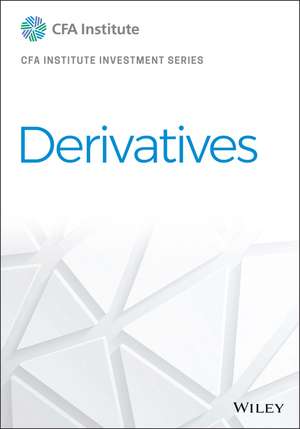
Derivatives
Autor Cfa Instituteen Limba Engleză Hardback – 24 noi 2021
Preț: 590.68 lei
Preț vechi: 829.54 lei
-29%
Puncte Express: 886
Carte indisponibilă temporar
Doresc să fiu notificat când acest titlu va fi disponibil:
Se trimite...
Specificații
ISBN-13: 9781119850571
ISBN-10: 1119850576
Pagini: 896
Dimensiuni: 184 x 260 x 50 mm
Greutate: 1.47 kg
Ediția:1st Edition
Editura: Wiley
Locul publicării:Hoboken, United States
ISBN-10: 1119850576
Pagini: 896
Dimensiuni: 184 x 260 x 50 mm
Greutate: 1.47 kg
Ediția:1st Edition
Editura: Wiley
Locul publicării:Hoboken, United States
Notă biografică
CFA Institute is the global association of investment professionals that sets the standard for professional excellence and credentials. The organization is a champion for ethical behavior in investment markets and a respected source of knowledge in the global financial community. The end goal: to create an environment where investors' interests come first, markets function at their best, and economies grow. CFA Institute has more than 170,000 members in 160+ countries and territories, including 163,000 CFA(r); charterholders, and 150+ member societies. For more information, visit www.cfainstitute.org.
Cuprins
Foreword Preface Acknowledgments About the CFA Institute Investment Series Chapter 1: Derivative Markets and Instruments Learning Outcomes * Derivatives: Introduction, Definitions, and Uses * The Structure of Derivative Markets * Types of Derivatives: Introduction, Forward Contracts * Types of Derivatives: Futures * Types of Derivatives: Swaps * Contingent Claims: Options * Contingent Claims: Credit Derivatives * Types of Derivatives: Asset-Backed Securities and Hybrids * Derivatives Underlyings * The Purposes and Benefits of Derivatives * Criticisms and Misuses of Derivatives * Elementary Principles of Derivative Pricing Chapter 2: Basics of Derivative Pricing and Valuation Learning Outcomes * Introduction * Basic Derivative Concepts, Pricing the Underlying * The Principle of Arbitrage * Pricing and Valuation of Forward Contracts: Pricing vs. Valuation; Expiration; Initiation * Pricing and Valuation of Forward Contracts: Between Initiation and Expiration; Forward Rate Agreements * Pricing and Valuation of Futures Contracts * Pricing and Valuation of Swap Contracts * Pricing and Valuation of Options * Lower Limits for Prices of European Options * Put-Call Parity, Put-Call-Forward Parity 10.1. Put-Call-Forward Parity * Binomial Valuation of Options * American Option Pricing Summary Problems Chapter 3: Pricing and Valuation of Forward Commitments Learning Outcomes * Introduction to Pricing and Valuation of Forward Commitments * Carry Arbitrage * Pricing Equity Forwards and Futures * Pricing Fixed-Income Forward and Futures Contracts * Pricing and Valuing Swap Contracts * Pricing and Valuing Currency Swap Contracts * Pricing and Valuing Equity Swap Contracts Summary Problems Chapter 4: Valuation of Contingent Claims Learning Outcomes * Introduction and Principles of a No- Arbitrage Approach to Valuation * Binomial Option Valuation Model * One- Period Binomial Model * Binomial Model: Two- Period (Call Options) * Binomial Model: Two- Period (Put Options) * Binomial Model: Two- Period (Role of Dividends & Comprehensive Example) * Interest Rate Options & Multiperiod Model * Black-Scholes-Merton (BSM) Option Valuation Model, Introduction and Assumptions of the BSM Model * BSM Model: Components * BSM Model: Carry Benefits and Applications * Black Option Valuation Model and European Options on Futures * Interest Rate Options * Swaptions * Option Greeks and Implied Volatility: Delta * Gamma * Theta * Vega * Rho * Implied Volatility Summary Problems Chapter 5: Credit Default Swaps Learning Outcomes * Introduction * Basic Definitions and Concepts * Important Features of CDS Markets and Instruments, Credit and Succession Events, and Settlement Proposals * Basics of Valuation and Pricing * Applications of CDS * Valuation Differences and Basis Trading Summary Problems Chapter 6: Introduction to Commodities and Commodity Derivatives Learning Outcomes * Introduction * Commodity Sectors * Life Cycle of Commodities * Valuation of Commodities * Commodities Futures Markets: Participants * Commodity Spot and Futures Pricing * Theories of Futures Returns * Components of Futures Returns * Contango, Backwardation, and the Roll Return * Commodity Swaps * Commodity Indexes Summary References Problems Chapter 7: Currency Management: An Introduction Learning Outcomes * Introduction * Review of Foreign Exchange Concepts * Currency Risk and Portfolio Risk and Return * Strategic Decisions in Currency Management: Overview * Strategic Decisions in Currency Management: Spectrum of Currency Risk * Strategic Decisions in Currency Management: Formulating a Currency Management Program * Active Currency Management: Based on Economic Fundamentals, Technical Analysis, and the Carry Trade * Active Currency Management: Based on Volatility Trading * Currency Management Tools: Forward Contracts, FX Swaps, and Currency Options * Currency Management Strategies * Hedging Multiple Foreign Currencies * Currency Management Tools and Strategies: A Summary * Currency Management for Emerging Market Currencies Summary References Problems Chapter 8: Options Strategies Learning Outcomes * Introduction * Position Equivalencies * Covered Calls and Protective Puts * Investment Objectives of Protective Puts * Equivalence to Long Asset/Short Forward Position * Risk Reduction Using Covered Calls and Protective Puts * Spreads and Combinations * Straddle * Implied Volatility and Volatility Skew * Investment Objectives and Strategy Selection * Uses of Options in Portfolio Management * Hedging an Expected Increase in Equity Market Volatility Summary Problems Chapter 9: Swaps, Forwards, and Futures Strategies Learning Outcomes * Managing Interest Rate Risk with Swaps * Managing Interest Rate Risk with Forwards, Futures, and Fixed- Income Futures * Managing Currency Exposure * Managing Equity Risk * Volatility Derivatives: Futures and Options * Volatility Derivatives: Variance Swaps * Using Derivatives to Manage Equity Exposure and Tracking Error * Using Derivatives in Asset Allocation * Using Derivatives to Infer Market Expectations Summary Problems Chapter 10: Introduction to Risk Management Learning Outcomes * Introduction * The Risk Management Process * The Risk Management Framework * Risk Governance . An Enterprise View * Risk Tolerance * Risk Budgeting * Identification of Risk . Financial and Non- Financial Risk * Identification of Risk . Interactions Between Risks * Measuring and Modifying Risk . Drivers and Metrics * Methods of Risk Modification . Prevention, Avoidance, and Acceptance * Methods of Risk Modification . Transfer, Shifting, Choosing a Method for Modifying Summary Problems Chapter 11: Measuring and Managing Market Risk Learning Outcomes * Introduction * Estimating VaR * The Parametric Method of VaR Estimation * The Historical Simulation Method of VaR Estimation * The Monte Carlo Simulation Method of VaR Estimation * Advantages and Limitations of VaR and Extensions of VaR * Other Key Risk Measures . Sensitivity Risk Measures; Sensitivity Risk Measures * Scenario Risk Measures * Sensitivity and Scenario Risk Measures and VaR * Using Constraints in Market Risk Management * Applications of Risk Measures * Pension Funds and Insurers Summary References Problems Chapter 12: Risk Management for Individuals Learning Outcomes * Introduction * Human Capital, Financial Capital, and Economic Net Worth * A Framework for Individual Risk Management * The Individual Balance Sheet * Individual Risk Exposures * Life Insurance: Uses, Types, and Elements * Life Insurance: Pricing, Policy Cost Comparison, and Determining Amount Needed * Other Types of Insurance * Annuities: Types, Structure, and Classification * Annuities: Advantages and Disadvantages of Fixed and Variable Annuities * Risk Management Implementation: Determining the Optimal Strategy and Case Analysis * The Effect of Human Capital on Asset Allocation and Risk Reduction Summary References Problems Chapter 13: Case Study in Risk Management: Private Wealth Learning Outcomes * Introduction and Case Background * Identification and Analysis of Risk Exposures: Early Career Stage * Risk Management Recommendations: Early Career Stage * Risk Management Considerations Associated with Home Purchase * Identification and Analysis of Risk Exposures: Career Development Stage * Risk Management Recommendations: Career Development Stage * Identification and Analysis of Risk Exposures: Peak Accumulation Stage * Assessment of and Recommendations concerning Risk to Retirement * Identification and Analysis of Retirement Objectives, Assets, and Drawdown Plan: Retirement Stage * Income and Investment Portfolio Recommendations: Retirement Stage Summary Problems Chapter 14: Integrated Cases in Risk Management: Institutional Learning Outcomes * Introduction * Financial Risks Faced by Institutional Investors * Environmental and Social Risks Faced by Institutional Investors References Glossary About the Editors and Authors Index