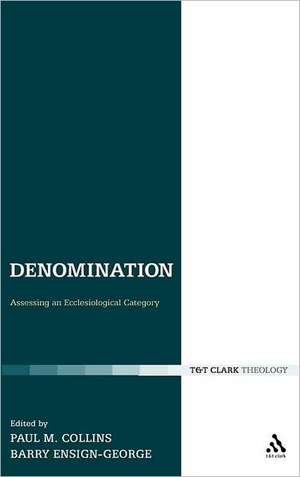
Denomination: Assessing an Ecclesiological Category: Ecclesiological Investigations
Editat de Rev Dr Paul M. Collins, Rev Barry A. Ensign-Georgeen Limba Engleză Hardback – 16 iun 2011
| Toate formatele și edițiile | Preț | Express |
|---|---|---|
| Paperback (1) | 263.17 lei 6-8 săpt. | |
| Bloomsbury Publishing – 20 dec 2012 | 263.17 lei 6-8 săpt. | |
| Hardback (1) | 795.22 lei 6-8 săpt. | |
| Bloomsbury Publishing – 16 iun 2011 | 795.22 lei 6-8 săpt. |
Din seria Ecclesiological Investigations
- 26%
 Preț: 976.81 lei
 - 26%
 Preț: 916.06 lei
 - 26%
 Preț: 976.57 lei
 -
 Preț: 264.01 lei
 -
 Preț: 264.30 lei
 - 26%
 Preț: 262.89 lei
 - 23%
 Preț: 198.46 lei
 - 17%
 Preț: 266.48 lei
 - 26%
 Preț: 265.33 lei
 - 26%
 Preț: 264.69 lei
 - 18%
 Preț: 201.94 lei
 - 17%
 Preț: 264.88 lei
 - 26%
 Preț: 265.07 lei
 - 26%
 Preț: 263.17 lei
 -
 Preț: 265.83 lei
 - 17%
 Preț: 266.37 lei
 - 26%
 Preț: 245.50 lei
 - 26%
 Preț: 246.03 lei
 - 26%
 Preț: 246.89 lei
 - 21%
 Preț: 263.72 lei
 - 26%
 Preț: 266.96 lei
 - 21%
 Preț: 265.26 lei
 -
 Preț: 265.55 lei
Preț: 795.22 lei
Preț vechi: 924.66 lei
-14%
Puncte Express: 1193
Preț estimativ în valută:
140.74€ • 164.48$ • 122.19£
140.74€ • 164.48$ • 122.19£
Carte tipărită la comandă
Livrare economică 19 februarie-05 martie
Preluare comenzi: 021 569.72.76
Specificații
ISBN-13: 9780567131317
ISBN-10: 0567131319
Pagini: 192
Dimensiuni: 156 x 234 x 20 mm
Greutate: 0.45 kg
Editura: Bloomsbury Publishing
Colecția T&T Clark
Seria Ecclesiological Investigations
Locul publicării:London, United Kingdom
ISBN-10: 0567131319
Pagini: 192
Dimensiuni: 156 x 234 x 20 mm
Greutate: 0.45 kg
Editura: Bloomsbury Publishing
Colecția T&T Clark
Seria Ecclesiological Investigations
Locul publicării:London, United Kingdom
V-ar putea interesa
-
 -34%Preț: 705.76 lei1076.67 lei
 -
 -34%Preț: 1170.92 lei1778.29 lei
 -
 The Ecumenical Movement & the Making of the European CommunityLucian Leustean-34%Preț: 723.11 lei1090.86 lei
 -
 Leadership in the Church for a People of HopeDr Mervyn DaviesPreț: 196.65 lei
 -
 The Trinity: A Guide for the PerplexedRev Dr Paul M. Collins-18%Preț: 169.16 lei206.83 lei
 -
 Partaking in Divine Nature: Deification and CommunionRev Dr Paul M. Collins-17%Preț: 264.39 lei319.24 lei
 -
 Ecclesial Repentance: The Churches Confront Their Sinful PastsDr Jeremy M. Bergen-17%Preț: 267.90 lei321.16 lei
 -
 Lutheran TheologyRev'd Dr Steven D. Paulson-18%Preț: 171.06 lei208.48 lei
 -
 God's Not DeadRice BroocksPreț: 89.33 lei
 -
 Reformation – A world in turmoilAndrew AtherstonePreț: 75.98 lei
 -
 Christian Inculturation in IndiaPaul M. Collins-29%Preț: 842.82 lei1194.07 lei
 -
 Dignity and DestinyJohn F KilnerPreț: 235.66 lei
 -
 Why Isn't God Nice?: Trusting His Awful GoodnessKurt BrunerPreț: 61.65 lei
 -
 Supreme Court Confirmation Hearings and Constitutional ChangePaul M. CollinsPreț: 293.91 lei
 -
 The Bad Christian's ManifestoDave TomlinsonPreț: 74.95 lei
 -
 The Edge of Words: God and the Habits of LanguageThe Right Reverend and Right Honourable Lord Williams of Oystermouth Rowan Williams-32%Preț: 123.22 lei182.53 lei
 -
 Christology in Cultural PerspectiveColin J. D. GreenePreț: 289.60 lei
 -
 Preț: 87.63 lei
 -
 Why Everything Matters: The Gospel in EcclesiastesPhilip RykenPreț: 54.20 lei
 -
 Preț: 67.64 lei
Cuprins
Introduction Paul M. Collins\ 'Denomination as Ecclesiological Category: Sketching an Assessment' Barry Ensign-George (Reformed/Presbyterian)\Anglican 'Denomination: An Anglican Appraisal' Paul Avis\Baptist: 'The Ecumenical Dimensions of Baptist Denominational Identity' Steven R. Harmon\Lutheran: 'The Lutheran Church: Church, Confession, Congregation, Denomination' Gesa Thiessen\Methodist: 'United Methodism: Its Identity as Denomination' Russell Richey\Orthodox: 'The Orthodox Church on Denomination' Elena Vishnevskaya\Pentecostal: 'The Denomination in Classical and Global Pentecostal Ecclesiology:
A Historical and Theological Contribution' Wolfgang Vondey\Quaker: 'Denomination beyond the North Atlantic Ecclesial World' Ann Riggs\Reformed/Presbyterian: 'Presbyterianism and Denomination' Amy Plantinga Pauw\'Is there a future for denominationalism? Reflections from the perspective of Roman Catholic ecclesiology and from the perspective of the future of the ecumenical movement' Peter de Mey\'Afterword: A Global Perspective' Kirsteen Kim
A Historical and Theological Contribution' Wolfgang Vondey\Quaker: 'Denomination beyond the North Atlantic Ecclesial World' Ann Riggs\Reformed/Presbyterian: 'Presbyterianism and Denomination' Amy Plantinga Pauw\'Is there a future for denominationalism? Reflections from the perspective of Roman Catholic ecclesiology and from the perspective of the future of the ecumenical movement' Peter de Mey\'Afterword: A Global Perspective' Kirsteen Kim
Recenzii
'With the collapse of classical ecumenism and the emergence of new divisions in the church, the time is ripe for a fresh theological look at the contentious issue of denominationalism. This volume tackles the thorny issues cleanly and forthrightly. Both those who are repelled by the whole idea of denominationalism and those who want to retrieve and fix it will find this splendid volume invaluable in thinking through their positions.' - William J. Abraham, Perkins School of Theology, Southern Methodist University, USA.
'What is a denomination? Does it differ from a convention, fellowship, synod, or church? Is it primarily a sociological or a theological term? Denominational consciousness stands for particularity relative to the whole church. The premier ecclesiologists who discuss the nature, function, and relevance this term in an ecumenical age display the diversity of their denominational points of view. As denominations wane in the West and never quite take hold in cultures that do not share the history that generated them, will the gifts that each preserves for the whole church be lost? These analysts throw distinctive light on these issues and by so doing relativize the narrowness of denominational consciousness and help expand the vision of the larger church in which the denominations participate. This topic and these superb treatments of it provide a unique entrée into the ecumenical vision that people from all the denominations will appreciate. As a whole the book represents a quiet, conversational but brilliant essay in comparative ecclesiology that no course in ecumenism can neglect.' - Roger Haight, S. J., Scholar in Residence, Union Theological Seminary, USA.
... an important collection... looking at the issue of denominationalism from theological, ecumenical and sociological perspectives... Highly recommended.
As the blurb states, this book will indeed be a text for my next course on "Unity in Division". It offers challenging perspectives on bringing theological perspectives to the social realities which shape many churches in today's western world- and beyond.
The core of the book is in the first two chapters with what remains being elaboration or rejection of the category in a variety of traditions including Baptist, Lutheran, United Methodist, Pentecostal, Presbyterian and Roman Catholic. Although all of this is interesting, the real interest is in the dialectic of the first two chapters which constitute a sharp if amicable stand-off between Barry Ensign-George of the Presbyterian Church and Paul Avis of the Church of England.
'What is a denomination? Does it differ from a convention, fellowship, synod, or church? Is it primarily a sociological or a theological term? Denominational consciousness stands for particularity relative to the whole church. The premier ecclesiologists who discuss the nature, function, and relevance this term in an ecumenical age display the diversity of their denominational points of view. As denominations wane in the West and never quite take hold in cultures that do not share the history that generated them, will the gifts that each preserves for the whole church be lost? These analysts throw distinctive light on these issues and by so doing relativize the narrowness of denominational consciousness and help expand the vision of the larger church in which the denominations participate. This topic and these superb treatments of it provide a unique entrée into the ecumenical vision that people from all the denominations will appreciate. As a whole the book represents a quiet, conversational but brilliant essay in comparative ecclesiology that no course in ecumenism can neglect.' - Roger Haight, S. J., Scholar in Residence, Union Theological Seminary, USA.
... an important collection... looking at the issue of denominationalism from theological, ecumenical and sociological perspectives... Highly recommended.
As the blurb states, this book will indeed be a text for my next course on "Unity in Division". It offers challenging perspectives on bringing theological perspectives to the social realities which shape many churches in today's western world- and beyond.
The core of the book is in the first two chapters with what remains being elaboration or rejection of the category in a variety of traditions including Baptist, Lutheran, United Methodist, Pentecostal, Presbyterian and Roman Catholic. Although all of this is interesting, the real interest is in the dialectic of the first two chapters which constitute a sharp if amicable stand-off between Barry Ensign-George of the Presbyterian Church and Paul Avis of the Church of England.