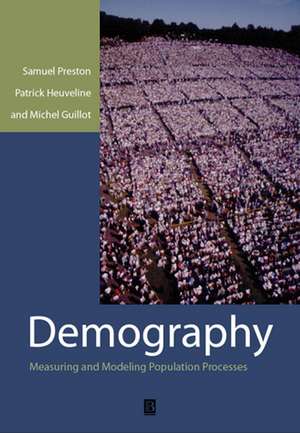
Demography
Autor Preston, Guillot, Heuvelineen Limba Engleză Paperback – 18 sep 2000
Observăm că literatura academică de specialitate duce adesea lipsă de un volum care să pună în legătură directă rigoarea teoretică a modelelor matematice cu aplicabilitatea lor imediată în sociologie și geografie. Demography vine să completeze exact acest gol, oferind o structură pedagogică ce pornește de la principiile de bază pentru a construi un cadru analitic solid necesar înțelegerii dinamicii populațiilor. Ne-a atras atenția modul în care autorii, Samuel Preston, Patrick Heuveline și Michel Guillot, reușesc să transforme concepte complexe în instrumente de lucru accesibile pentru studenți, fără a simplifica excesiv rigoarea științifică. Merită menționat că acest volum acoperă aceeași arie tematică precum Demography: An Introduction to Population Studies de Richard K. Thomas, dar se diferențiază printr-o abordare mult mai tehnică și analitică, fiind axată pe demonstrarea metodelor și mai puțin pe aspectele de politică socială. În timp ce alte lucrări se concentrează pe contextul istoric, textul de față prioritizează procedurile și modelele formale. Ritmul este unul dens, specific unui manual universitar de referință, iar structura în 320 de pagini asigură o parcurgere eficientă a celor mai importante tehnici de măsurare a fertilității, mortalității și migrației. Reținem acest titlu ca pe o resursă fundamentală pentru oricine dorește să stăpânească limbajul cifrelor în studiile de populație.
Preț: 300.64 lei
Carte disponibilă
Livrare economică 30 noiembrie-14 decembrie
Livrare express 13-19 noiembrie pentru 36.70 lei
Specificații
ISBN-10: 1557864519
Pagini: 308
Dimensiuni: 170 x 244 x 17 mm
Greutate: 0.54 kg
Ediția:New.
Editura: Wiley
Locul publicării:Chichester, United Kingdom
V-ar putea interesa
-
 Preț: 105.12 lei
-
 Demography: A Very Short IntroductionSarah Harper-19%Preț: 57.36 lei70.82 lei
-
 How Population Change Will Transform Our WorldSarah Harper-18%Preț: 76.65 lei93.40 lei
-
 -28%Preț: 312.96 lei434.72 lei
-
 -23%Preț: 504.32 lei654.96 lei
-
 Medieval HeresyMalcolm LambertPreț: 327.12 lei
-
 Early Modern EuropeJames B CollinsPreț: 435.81 lei
-
 -14%Preț: 1070.62 lei1244.90 lei
-
 Methods and Models in DemographyColin NewellPreț: 308.19 lei
-
 Die CharitéJohanna Bleker-9%Preț: 750.33 lei824.53 lei
-
 -9%Preț: 1091.47 lei1199.42 lei
-
 Luxus und IntegrationWerner Paravicini-8%Preț: 393.51 lei427.73 lei
-
 Die Cambridge School der politischen IdeengeschichteMartin MulsowPreț: 142.45 lei
-
 Stärke statt MachtHaim OmerPreț: 261.03 lei
-
 Preț: 288.49 lei
-
 Frente Al Fracaso. Raisuni, de Silvestre a Burguete.Rafael LopezriendaPreț: 135.33 lei
Public țintă
beginning students in demography in departments of geography, sociology, and population studiesDe ce să citești această carte
Recomandăm această carte studenților la sociologie, geografie sau politici publice care au nevoie de o introducere tehnică și clară în analiza demografică. Cititorul câștigă o înțelegere profundă a modului în care se măsoară schimbările umane, trecând de la simple statistici la modele predictive. Este instrumentul ideal pentru a deprinde metodele riguroase utilizate de profesioniștii din agențiile de statistică și cercetare socială.
Descriere
Notă biografică
Patrick Heuveline is Assistant Professor of Sociology and Research Associate of the Population Research Center at the University of Chicago. His recent work applies demographic analysis to such diverse topics as the Cambodian genocide and the HIV/AIDS pandemic.
Michel Guillot is a Post-Doctoral Fellow at the Harvard Center for Population and Development Studies, where his research focuses on formal demography and mortality in developing countries. He has a Ph.D. in Demography and Sociology from the University of Pennsylvania.
Cuprins
List of Boxes viii
List of Tables x
List of Figures xii
Preface xiv
Acknowledgments xv
1 Basic Concepts and Measures 1
1.1 Meaning of "Population" 1
1.2 The Balancing Equation of Population Change 2
1.3 The Structure of Demographic Rates 3
1.4 Period Rates and Person-years 5
1.5 Principal Period Rates in Demography 7
1.6 Growth Rates in Demography 8
1.7 Estimating Period Person-years 15
1.8 The Concept of a Cohort 16
1.9 Probabilities of Occurrence of Events 18
2 Age-specific Rates and Probabilities 21
2.1 Period Age-specific Rates 21
2.2 Age-standardization 24
2.3 Decomposition of Differences between Rates or Proportions 28
2.4 The Lexis Diagram 31
2.5 Age-specific Probabilities 32
2.6 Probabilities of Death Based on Mortality Experience of a Single Calendar Year 35
3 The Life Table and Single Decrement Processes 38
3.1 Period Life Tables 42
3.2 Strategies for Choosing a Set of N a X Values And/or for Making The N M X ¿ N Q X Conversion 44
3.3 The Very Young Ages 47
3.4 The Open-ended Age Interval 48
3.5 Review of Steps for Period Life Table Construction 48
3.6 Interpreting the Life Table 51
3.7 The Life Table Conceived as a Stationary Population 53
3.8 Mortality as a Continuous Process 59
3.9 Life Table Construction Revisited 61
3.10 Decomposing a Difference in Life Expectancies 64
3.11 Adaptation of the Life Table for Studying Other Single Decrement Processes 65
Appendix 3.1 Life Table Relationships in Continuous Notation 69
4 Multiple Decrement Processes 71
4.1 Multiple Decrement Tables for a Real Cohort 71
4.2 Multiple Decrement Life Tables for Periods 73
4.3 Some Basic Mathematics of Multiple Decrement Processes 78
4.4 Associated Single Decrement Tables from Period Data 80
4.5 Cause-specific Decomposition of Differences in Life Expectancies 84
4.6 Associated Single Decrement Tables from Current Status Data 86
4.7 Stationary Populations with Multiple Sources of Decrement 89
5 Fertility and Reproduction 92
5.1 Period Fertility Rates 93
5.2 Decomposition of Period Fertility 99
5.3 Cohort Fertility 101
5.4 Birth Interval Analysis 106
5.5 Reproduction Measures 113
6 Population Projection 117
6.1 Projections and Forecasts 117
6.2 Population Projection Methodology 118
6.3 The Cohort Component Method 119
6.4 Projections in Matrix Notation 129
6.5 Population Forecasts 131
6.6 The USBOC Projection of the US Population 133
6.7 Alternative Forecasting Methods 134
6.8 Accuracy and Uncertainty 135
6.9 Other Uses of Population Projections 136
7 The Stable Population Model 138
7.1 A Simplified Example of a Stable Population 138
7.2 Lotka's Demonstration of Conditions Producing a Stable Population 141
7.3 The Equations Characterizing a Stable Population 144
7.4 The "Stable Equivalent" Population 147
7.5 The Relation between the Intrinsic Growth Rate and the Net Reproduction Rate 150
7.6 The Effects of Changes in Fertility and Mortality on Age Structure, Growth Rates, Birth Rates, and Death Rates 155
7.7 The Momentum of Population Growth 161
7.8 Uses of the Stable Population Model in Demographic Estimation 167
8 Demographic Relations in Nonstable Populations 171
8.1 An Illustration 171
8.2 Relations in Continuous Age and Time 172
8.3 Extensions of the Basic Relations 176
8.4 Deconstructing the Age-specific Growth Rate 180
8.5 Age Structural Dynamics 182
8.6 Uses of Variable-r Methods in Demographic Estimation 184
9 Modeling Age Patterns of Vital Events 191
9.1 Model Age Patterns of Mortality 192
9.2 Age Patterns of Nuptiality 201
9.3 Age Patterns of Fertility 204
9.4 Model Age Patterns of Migration 208
10 Methods for Evaluating Data Quality 211
10.1 Statistical Methods for Identifying Coverage Errors 212
10.2 Statistical Methods for Evaluating Content Errors 214
10.3 Demographic Methods of Assessing Data Quality 215
11 Indirect Estimation Methods 224
11.1 Estimation of Child Mortality from Information on Child Survivorship: The Brass Method 224
11.2 Estimation of Adult Mortality Using Information on Orphanhood 233
11.3 The Sisterhood Method for Estimating Maternal Mortality 241
11.4 Estimating Mortality and Fertility from Maternity Histories 243
11.5 Indirect Estimation Methods Using Age Distributions at Two Censuses 246
12 Increment-Decrement Life Tables (Alberto Palloni, University of Wisconsin) 256
12.1 Introduction 256
12.2 Increment-Decrement Life Tables 257
12.3 Estimation of Increment-Decrement Life Tables 259
12.4 Formalization and Generalization of Relations 266
12.5 The Simplest Case: A Two-state System 270
12.6 Alternative Solutions: The Case of Constant Rates 271
12.7 Programs for the Calculation of Increment-Decrement Life Tables 271
References 273
Index 285