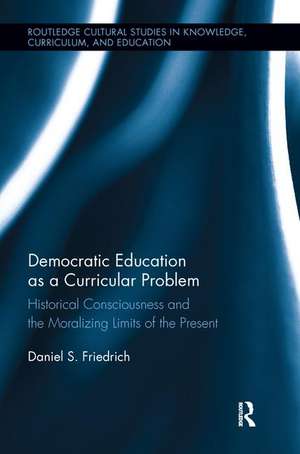
Democratic Education as a Curricular Problem: Historical Consciousness and the Moralizing Limits of the Present: Routledge Cultural Studies in Knowledge, Curriculum, and Education
Autor Daniel Friedrichen Limba Engleză Paperback – 18 noi 2016

Preț: 391.02 lei
Puncte Express: 587
Carte tipărită la comandă
Livrare economică 05-19 decembrie
Livrare prin curier în România Termenul estimat este afișat lângă disponibilitate.
Transport gratuit de la 400.00 lei Plată online sau ramburs, în funcție de opțiunile comenzii.
Retur gratuit în 14 zile Comandă securizată și suport în română.
Specificații
ISBN-13: 9781138286764
ISBN-10: 1138286761
Pagini: 168
Ilustrații: 1 Line drawings, black and white; 5 Halftones, black and white
Dimensiuni: 152 x 229 mm
Greutate: 0.45 kg
Ediția:1
Editura: Taylor & Francis
Colecția Routledge
Seria Routledge Cultural Studies in Knowledge, Curriculum, and Education
Locul publicării:Oxford, United Kingdom
ISBN-10: 1138286761
Pagini: 168
Ilustrații: 1 Line drawings, black and white; 5 Halftones, black and white
Dimensiuni: 152 x 229 mm
Greutate: 0.45 kg
Ediția:1
Editura: Taylor & Francis
Colecția Routledge
Seria Routledge Cultural Studies in Knowledge, Curriculum, and Education
Locul publicării:Oxford, United Kingdom
V-ar putea interesa
-
 Digital EducationM. ThomasPreț: 317.32 lei
 -
 Preț: 316.97 lei
 -
 Preț: 184.62 lei
 -
 -28%Preț: 187.01 lei261.41 lei
 -
 New Literacies: Everyday Practices and Social LearningColin Lankshear-26%Preț: 201.65 lei271.23 lei
 -
 Preț: 256.01 lei
 -
 -15%Preț: 426.80 lei502.11 lei
 -
 Creating the CurriculumDominic WysePreț: 371.53 lei
 -
 Preț: 443.26 lei
 -
 -15%Preț: 551.79 lei649.17 lei
 -
 Strategic Curriculum Change in Universities: Global TrendsPaul BlackmorePreț: 376.72 lei
 -
 Preț: 444.19 lei
 -
 -15%Preț: 471.85 lei555.12 lei
 -
 Shaping the College CurriculumLisa R LattucaPreț: 389.03 lei
 -
 Closing the Teaching GapDonald B. BartaloPreț: 310.25 lei
 -
 Taking the Pyp ForwardSteven Carber-19%Preț: 110.77 lei137.47 lei
Public țintă
Postgraduate and UndergraduateCuprins
Prologue: Democracy and the Normal 1. The Production of the Citizen as a Research Problem 2. Historical Consciousness as a Pedagogical Device in the Production of the Responsible Citizen 3. Legislating the Production of Responsible Citizens: Argentine Education Laws and the Framing of Darkness 4. The Mobilization of Historical Consciousness in the Narratives about the Last Dictatorship Presented in Textbooks and Other Didactic Materials 5. The Memoryscape in Buenos Aires: Re-Presentation, Memory and Pedagogy Concluding Thoughts: Re-Framing the Questions, Re-Reading the Curriculum
Descriere
By repositioning democratic education not as something that can be achieved by following a certain, proven process, but as an inherently paradoxical enterprise in its dealings with the tension between schooling as the intentional production of citizens and the uncertainties of democracy, an alternative way of reading the curriculum emerges. This book aims not at arriving at the right combination of theory, policy and praxis that will provide the democratic utopia, but at historicizing the discourses that have shaped the ways in which we think and act in the field of education.
Notă biografică
Daniel S. Friedrich is Assistant Professor in the Dept. of Curriculum and Teaching at Teachers College, Columbia University. Prof. Friedrich is currently interested in the travelling of teacher education reforms around the world. He has published articles in Comparative Education Review and the Journal of Curriculum Theorizing among others.