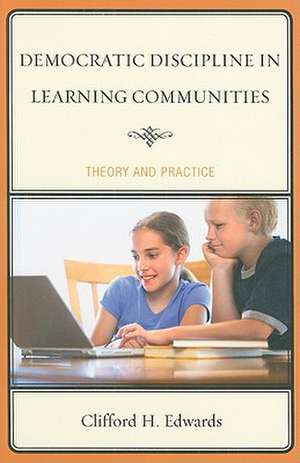
Democratic Discipline in Learning Communities: Theory and Practice
Autor Clifford H. Edwardsen Limba Engleză Paperback – 16 ian 2011
Preț: 210.70 lei
Preț vechi: 283.67 lei
-26%
Puncte Express: 316
Carte tipărită la comandă
Livrare economică 11-25 iunie
Specificații
ISBN-13: 9781607099857
ISBN-10: 1607099853
Pagini: 181
Dimensiuni: 156 x 231 x 11 mm
Greutate: 0.3 kg
Editura: Bloomsbury Publishing
Colecția R&L Education
Locul publicării:New York, United States
ISBN-10: 1607099853
Pagini: 181
Dimensiuni: 156 x 231 x 11 mm
Greutate: 0.3 kg
Editura: Bloomsbury Publishing
Colecția R&L Education
Locul publicării:New York, United States
Cuprins
Chapter 1- Attributes of Learning Communities
Chapter 2 - Authentic Fulfillment of Student Needs
Chapter 3 - Democratic Discipline and Student Empowerment
Chapter 4 - Democratic Discipline and Learning Motivation
Chapter 5 - Constructivist Theory, Cognitive Processing, and Learning Preferences
Chapter 6 - Inquiry Learning
Chapter 7 - Relationships and Communications in Learning Communities
Chapter 8 - Democratic Discipline in Learning Communities
Chapter 2 - Authentic Fulfillment of Student Needs
Chapter 3 - Democratic Discipline and Student Empowerment
Chapter 4 - Democratic Discipline and Learning Motivation
Chapter 5 - Constructivist Theory, Cognitive Processing, and Learning Preferences
Chapter 6 - Inquiry Learning
Chapter 7 - Relationships and Communications in Learning Communities
Chapter 8 - Democratic Discipline in Learning Communities
Recenzii
Uncooperative students have always been the bane of the dedicated teacher. Many solutions have been put forward, from ancient times to the present, for solving the problems of the disruptive and uninterested student. Yet little has changed over the centuries. The student just doesn't want to learn in most classrooms. Why? The root of the problem has gone largely unresolved. True learning most effectively occurs when there is a proper match between the student's needs and the curricular operandi. Dr. Edwards offers the most effective solution to date in the conduct of a learning community wherein learning finds its optimum environment. Under such circumstances the cause of discipline problems is greatly reduced. The classroom can become a joy to student and teacher.
School and community leaders recognize that one of the leading detriments to student learning and engagement is the increase in bullying and violence in today's schools. Teacher educator Edwards (formerly, Brigham Young Univ.) reinforces the theory that discipline and curriculum practices must be interrelated. Disciplinary problems often arise, he argues, because students are not sufficiently engaged. Therefore, learning communities should provide children with a sense of moral responsibility, commitment to the community, self-direction, and sense of efficacy. Historically, many discipline theories labeled "democratic" have failed. The organization and content of the book take the reader on an illuminating journey that provides a deeper understanding of the value of nonpunitive classroom procedures, even though many of the students will have experienced punishments and consequences in their schooling. Recommended. General readers, graduate students, research faculty, and professionals.
School and community leaders recognize that one of the leading detriments to student learning and engagement is the increase in bullying and violence in today's schools. Teacher educator Edwards (formerly, Brigham Young Univ.) reinforces the theory that discipline and curriculum practices must be interrelated. Disciplinary problems often arise, he argues, because students are not sufficiently engaged. Therefore, learning communities should provide children with a sense of moral responsibility, commitment to the community, self-direction, and sense of efficacy. Historically, many discipline theories labeled "democratic" have failed. The organization and content of the book take the reader on an illuminating journey that provides a deeper understanding of the value of nonpunitive classroom procedures, even though many of the students will have experienced punishments and consequences in their schooling. Recommended. General readers, graduate students, research faculty, and professionals.