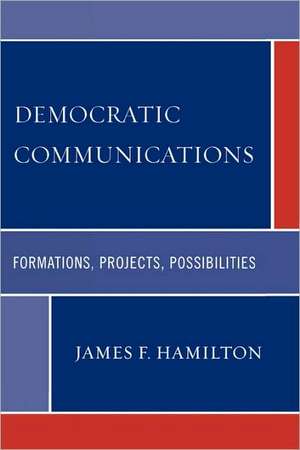
Democratic Communications: Formations, Projects, Possibilities: Critical Media Studies
Autor James F. Hamiltonen Limba Engleză Paperback – 16 aug 2009
This growing inability to adequately map this landscape demands that these lines be reconsidered. New ways must be formed for probing implications of these new media outlets for democratization and global-justice movements. This book reconstitutes the cultural and historical roots of this protean media landscape and assesses its relevance to democratic communications.
Using a comprehensively argued cultural and historical analysis, the book rethinks long-standing assumptions about alternative media and democratic communications. By providing greater understanding of historical resources, limitations, and possibilities, this book makes a key contribution not only to scholarship in this area, but also to this pressing social, political, and cultural issue.
Din seria Critical Media Studies
- 33%
 Preț: 356.82 lei
 - 29%
 Preț: 342.63 lei
 - 24%
 Preț: 304.50 lei
 - 27%
 Preț: 355.00 lei
 - 29%
 Preț: 345.39 lei
 - 23%
 Preț: 337.35 lei
 - 34%
 Preț: 676.82 lei
 - 35%
 Preț: 595.44 lei
 - 15%
 Preț: 616.45 lei
 - 33%
 Preț: 355.69 lei
 -
 Preț: 277.49 lei
 - 28%
 Preț: 382.83 lei
 - 33%
 Preț: 392.05 lei
 -
 Preț: 56.28 lei
 -
 Preț: 457.81 lei
 -
 Preț: 330.19 lei
 -
 Preț: 275.02 lei
 -
 Preț: 457.81 lei
 -
 Preț: 275.02 lei
 -
 Preț: 337.30 lei
 -
 Preț: 246.66 lei
 -
 Preț: 123.14 lei
 -
 Preț: 260.85 lei
Preț: 369.72 lei
Preț vechi: 485.11 lei
-24%
Puncte Express: 555
Carte tipărită la comandă
Livrare economică 20 noiembrie-04 decembrie
Livrare prin curier în România Termenul estimat este afișat lângă disponibilitate.
Transport gratuit de la 400.00 lei Plată online sau ramburs, în funcție de opțiunile comenzii.
Retur gratuit în 14 zile Comandă securizată și suport în română.
Specificații
ISBN-13: 9780739118672
ISBN-10: 0739118676
Pagini: 350
Dimensiuni: 154 x 232 x 25 mm
Greutate: 0.54 kg
Ediția:New.
Editura: Bloomsbury Publishing
Colecția Lexington Books
Seria Critical Media Studies
Locul publicării:New York, United States
ISBN-10: 0739118676
Pagini: 350
Dimensiuni: 154 x 232 x 25 mm
Greutate: 0.54 kg
Ediția:New.
Editura: Bloomsbury Publishing
Colecția Lexington Books
Seria Critical Media Studies
Locul publicării:New York, United States
V-ar putea interesa
-
 -31%Preț: 819.92 lei1192.28 lei
 -
 -31%Preț: 770.47 lei1121.53 lei
 -
 -11%Preț: 370.48 lei416.09 lei
 -
 The Metamorphosis of Leadership in a Democratic MexicoRoderic Ai Camp-31%Preț: 695.50 lei1008.22 lei
 -
 -31%Preț: 693.75 lei1007.16 lei
 -
 Japanese Politics TodayTakashi InoguchiPreț: 300.79 lei
 -
 Practicing DemocracyE. LuhtakallioPreț: 403.87 lei
 -
 Political Extremism in DemocraciesWilliam M DownsPreț: 402.59 lei
 -
 Silence and DemocracyJohn G. ZumbrunnenPreț: 271.92 lei
 -
 Empathy and DemocracyMichael E. MorrellPreț: 273.07 lei
 -
 Building Global Democracy?Jan Aart ScholtePreț: 289.78 lei
 -
 The Crisis of Russian DemocracyRichard SakwaPreț: 310.27 lei
 -
 Preț: 499.40 lei
 -
 The Uncivil WarDavid LebedoffPreț: 196.83 lei
 -
 The Return of the PublicDan HindPreț: 157.23 lei
 -
 The Future of PoliticsRobert CorfePreț: 138.47 lei
Cuprins
1 Preface
2 Acknowledgements
3 Introduction: The Problem of the Mainstream and the Alternative
Part 4 Part One-Market Formations
5 Introduction to Part One
Chapter 6 1. Providentialism and Rationalist Empiricism in Early Modern England
Chapter 7 2. The Emergence of Broadcasting and the Rationalization of Participation
Part 8 Part Two-Struggling Against the Market
9 Introduction to Part Two
Chapter 10 3. Philanthropy, Professionalization, and Social-Reform Communications
Chapter 11 4. Community Media Projects and the Containment of the Mass-Culture Critique
Chapter 12 5. Modernism and the Aestheticization of Dissent
Part 13 Part Three-Toward New Formations
14 Introduction to Part Three
Chapter 15 6. Market Radicalism and the Struggle of Participation
Chapter 16 7. Democratic Communications as Critical, Collective Education
17 Afterword: Utopia and Inspiration
18 Bibliography
19 Index
20 About the Author
2 Acknowledgements
3 Introduction: The Problem of the Mainstream and the Alternative
Part 4 Part One-Market Formations
5 Introduction to Part One
Chapter 6 1. Providentialism and Rationalist Empiricism in Early Modern England
Chapter 7 2. The Emergence of Broadcasting and the Rationalization of Participation
Part 8 Part Two-Struggling Against the Market
9 Introduction to Part Two
Chapter 10 3. Philanthropy, Professionalization, and Social-Reform Communications
Chapter 11 4. Community Media Projects and the Containment of the Mass-Culture Critique
Chapter 12 5. Modernism and the Aestheticization of Dissent
Part 13 Part Three-Toward New Formations
14 Introduction to Part Three
Chapter 15 6. Market Radicalism and the Struggle of Participation
Chapter 16 7. Democratic Communications as Critical, Collective Education
17 Afterword: Utopia and Inspiration
18 Bibliography
19 Index
20 About the Author
Recenzii
This book is splendidly chewy, offering both an absorbing array of historical specifics and arguments, and of conceptual challenges. It lends considerable muscle to the rapidly growing debate on social movements and their media.
There is no more thoughtful historian of the notion of alternative media than James Hamilton; his erudition and intelligence are on full display in Democratic Communications. This book should be read by every scholar committed to understanding the history and meaning of progressive media. If you think you already know what you're talking about when you discuss alternative media, reading Hamilton's book will make you think again; if you don't think much of the promise of alternative media, Hamilton will make you rethink that too.
Democratic Communications is a must-read for all students and scholars of media, and all activists interested in developing challenges to the mainstream media. The book adds historical depth and important new insights to old questions, and will forever change the way you think about 'alternative' media.
Democratic Communications is one of the most thoughtful and literate studies of alternative media to date. Hamilton's work carries us across the centuries, inviting reflection on what it means for media to serve public needs rather than private wealth. One is not only impressed with the rigor of his research but also with the breadth and subtlety of his analysis.
There is no more thoughtful historian of the notion of alternative media than James Hamilton; his erudition and intelligence are on full display in Democratic Communications. This book should be read by every scholar committed to understanding the history and meaning of progressive media. If you think you already know what you're talking about when you discuss alternative media, reading Hamilton's book will make you think again; if you don't think much of the promise of alternative media, Hamilton will make you rethink that too.
Democratic Communications is a must-read for all students and scholars of media, and all activists interested in developing challenges to the mainstream media. The book adds historical depth and important new insights to old questions, and will forever change the way you think about 'alternative' media.
Democratic Communications is one of the most thoughtful and literate studies of alternative media to date. Hamilton's work carries us across the centuries, inviting reflection on what it means for media to serve public needs rather than private wealth. One is not only impressed with the rigor of his research but also with the breadth and subtlety of his analysis.