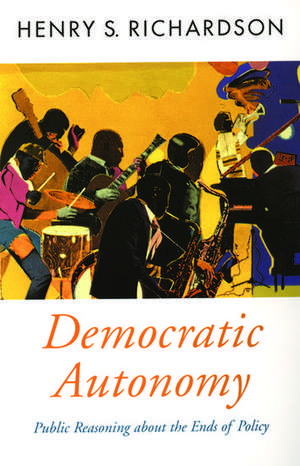
Democratic Autonomy: Public Reasoning about the Ends of Policy: Oxford Political Theory
Henry S. Richardsonen Limba Engleză Paperback – 8 ian 2004
Din seria Oxford Political Theory
- 14%
 Preț: 172.92 lei
 - 33%
 Preț: 868.28 lei
 - 32%
 Preț: 832.44 lei
 - 31%
 Preț: 583.14 lei
 - 30%
 Preț: 718.70 lei
 - 27%
 Preț: 533.72 lei
 - 20%
 Preț: 316.66 lei
 - 32%
 Preț: 848.77 lei
 - 30%
 Preț: 655.12 lei
 - 19%
 Preț: 615.34 lei
 - 30%
 Preț: 661.37 lei
 - 27%
 Preț: 396.92 lei
 - 20%
 Preț: 383.64 lei
 - 28%
 Preț: 465.78 lei
 - 27%
 Preț: 383.35 lei
 - 27%
 Preț: 383.02 lei
 - 16%
 Preț: 193.96 lei
 - 16%
 Preț: 166.43 lei
 - 27%
 Preț: 457.56 lei
 - 17%
 Preț: 346.23 lei
 - 12%
 Preț: 289.92 lei
 - 20%
 Preț: 307.98 lei
 - 28%
 Preț: 487.21 lei
 - 20%
 Preț: 273.16 lei
Preț: 223.39 lei
Preț vechi: 262.39 lei
-15%
Puncte Express: 335
Carte tipărită la comandă
Livrare economică 10-16 decembrie
Livrare prin curier în România Termenul estimat este afișat lângă disponibilitate.
Transport gratuit de la 400.00 lei Plată online sau ramburs, în funcție de opțiunile comenzii.
Retur gratuit în 14 zile Comandă securizată și suport în română.
Specificații
ISBN-13: 9780195150919
ISBN-10: 0195150910
Pagini: 328
Dimensiuni: 158 x 238 x 23 mm
Greutate: 0.45 kg
Ediția:Oxf Univ Pbk.
Editura: Oxford University Press
Colecția OUP USA
Seria Oxford Political Theory
Locul publicării:New York, United States
ISBN-10: 0195150910
Pagini: 328
Dimensiuni: 158 x 238 x 23 mm
Greutate: 0.45 kg
Ediția:Oxf Univ Pbk.
Editura: Oxford University Press
Colecția OUP USA
Seria Oxford Political Theory
Locul publicării:New York, United States
V-ar putea interesa
-
 Moral Entanglements: The Ancillary-Care Obligations of Medical ResearchersHenry S. Richardson-25%Preț: 574.52 lei764.79 lei
 -
 India in Transition: Freeing the EconomyJagdish Bhagwati-18%Preț: 328.65 lei401.98 lei
 -
 -27%Preț: 506.81 lei698.51 lei
 -
 -27%Preț: 472.47 lei645.53 lei
 -
 Macroeconomics at the Service of Public PolicyThomas J. Sargent-18%Preț: 271.14 lei331.05 lei
 -
 -19%Preț: 268.16 lei332.64 lei
 -
 Social Capital: Critical PerspectivesStephen Baron-27%Preț: 432.96 lei595.10 lei
 -
 -28%Preț: 404.64 lei565.58 lei
 -
 Ethics: Economics, & Politics: Principles of Public PolicyI. M. D. Little-18%Preț: 330.16 lei404.28 lei
 -
 The Oxford Handbook of the Welfare StateFrancis G. Castles-16%Preț: 317.28 lei375.68 lei
 -
 -30%Preț: 765.40 lei1095.18 lei
 -
 Approximating PrudenceA. Yuengert-15%Preț: 663.94 lei781.10 lei
 -
 -18%Preț: 1265.99 lei1543.89 lei
 -
 Colorado Powder Keg: Ski Resorts and the Environmental MovementMichael W. ChildersPreț: 345.78 lei
 -
 -23%Preț: 187.28 lei244.09 lei
 -
 Public Forces and Private Politics in American Big BusinessTimothy Werner-14%Preț: 720.28 lei837.54 lei
 -
 Transportation Systems AnalysisEnnio Cascetta-18%Preț: 1507.84 lei1838.83 lei
 -
 Congressional Limits on Military OperationsViolet L Turner-26%Preț: 502.36 lei676.05 lei
Recenzii
"Democratic Autonomy offers a sophisticated, closely argued account of democratic reasoning, both as a norm and as institutional practice. Richardson shows that we can hope to bridge even deep disagreements over ends through a process of principled compromise. He rebuts the naive view that legislatures delegate only narrow technical questions of means to administrative agencies. The author demonstrates that if we are serious about democracy, we must find ways of extending effective citizen participation into arenas now dominated by bureaucratic rule-making. This book is a must for all readers interested in the theory and practice of modern democracy."--William A. Galston, Director, Institute for Philosophy and Public Policy, University of Maryland
"In Democratic Autonomy Richardson applies his important work about deliberative practical reasoning and the "specification of ends" to a major problem in democratic theory and practice: How can a modern society that must depend on the expertise of administrative agencies still be a democracy, characterized by genuine self-rule? Written in a clear and accessible style, the book should be required reading, not only for theorists of democracy and public choice, but also for policy makers and legislators."--Martha Nussbaum, Ernst Freund Distinguished Service Professor of Law and Ethics, University of Chicago
"This wonderful book articulates an ideal of democratic rule grounded in the republican tradition of thought; details the practice of deliberation - incorporating a division of deliberative labour - that this ideal requires; and then illustrates the shape that this practice would dictate for every aspect of government, from the electoral to the bureaucratic. It is a fresh and invigorating contribution to democratic theory and deserves to have a transforming effect on the subject."--Philip Pettit, Princeton University
"This is a stunningly good book. Professor Richardson has enriched Democratic Autonomy with more concrete detail and a better-informed apprehension of how the modern administrative state actually functions, than one finds in most works of political philosophy. It is still philosophy, however, but in the best sense - a finely crafted rigorous argument about deliberation, freedom, and collective decision-procedures. As a result, it offers a more convincing vindication of the idea of popular self-government for modern society than any work of democratic theory published in recent years."-- Jeremy Waldron, Maurice & Hilda Friedman Professor of Law, and Director of the Center for Law and Philosophy, Columbia Law School
"In Democratic Autonomy Richardson applies his important work about deliberative practical reasoning and the "specification of ends" to a major problem in democratic theory and practice: How can a modern society that must depend on the expertise of administrative agencies still be a democracy, characterized by genuine self-rule? Written in a clear and accessible style, the book should be required reading, not only for theorists of democracy and public choice, but also for policy makers and legislators."--Martha Nussbaum, Ernst Freund Distinguished Service Professor of Law and Ethics, University of Chicago
"This wonderful book articulates an ideal of democratic rule grounded in the republican tradition of thought; details the practice of deliberation - incorporating a division of deliberative labour - that this ideal requires; and then illustrates the shape that this practice would dictate for every aspect of government, from the electoral to the bureaucratic. It is a fresh and invigorating contribution to democratic theory and deserves to have a transforming effect on the subject."--Philip Pettit, Princeton University
"This is a stunningly good book. Professor Richardson has enriched Democratic Autonomy with more concrete detail and a better-informed apprehension of how the modern administrative state actually functions, than one finds in most works of political philosophy. It is still philosophy, however, but in the best sense - a finely crafted rigorous argument about deliberation, freedom, and collective decision-procedures. As a result, it offers a more convincing vindication of the idea of popular self-government for modern society than any work of democratic theory published in recent years."-- Jeremy Waldron, Maurice & Hilda Friedman Professor of Law, and Director of the Center for Law and Philosophy, Columbia Law School