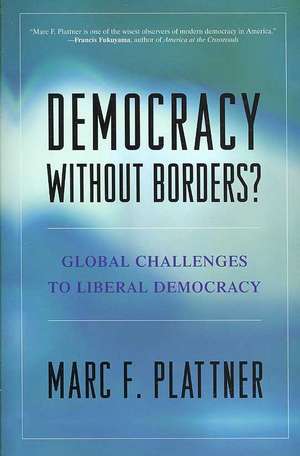
Democracy Without Borders?: Global Challenges to Liberal Democracy
Autor Marc F. Plattneren Limba Engleză Paperback – 9 noi 2007
This examination comes at a critical moment. After three decades of global advance, liberal democracy today is being challenged from many quarters. Among the reasons why its future looks cloudy is the popular election of candidates hostile to liberalism-in Palestine, Russia, Venezuela, and elsewhere. An investigation of the complex and tension-filled relationship between liberalism and majority rule is at the heart of this essential book.
Plattner's contention is that liberalism needs democracy and that liberal democracy needs the nation-state. He argues that transnational bodies like the European Union cannot overcome their "democratic deficit." Hence he recommends an approach that will enable the United States to promote international cooperation without sacrificing the fundamental elements of national sovereignty or American democracy.
Preț: 273.98 lei
Preț vechi: 378.80 lei
-28%
Puncte Express: 411
Carte tipărită la comandă
Livrare economică 26 noiembrie-10 decembrie
Livrare prin curier în România Termenul estimat este afișat lângă disponibilitate.
Transport gratuit de la 400.00 lei Plată online sau ramburs, în funcție de opțiunile comenzii.
Retur gratuit în 14 zile Comandă securizată și suport în română.
Specificații
ISBN-13: 9780742559264
ISBN-10: 0742559262
Pagini: 167
Dimensiuni: 150 x 226 x 16 mm
Greutate: 0.28 kg
Editura: Bloomsbury Publishing
Colecția Rowman & Littlefield
Locul publicării:New York, United States
ISBN-10: 0742559262
Pagini: 167
Dimensiuni: 150 x 226 x 16 mm
Greutate: 0.28 kg
Editura: Bloomsbury Publishing
Colecția Rowman & Littlefield
Locul publicării:New York, United States
Cuprins
Part 1 Introduction
Chapter 2 The Triumphs and Travails of Democracy
Chapter 3 The Democratic Moment
Part 4 The Twin Pillars of Liberal Democracy
Chapter 5 The Role of Human Rights
Chapter 6 The Links Between Liberalism and Democracy
Chapter 7 Why Liberalism became Democratic
Part 8 Liberal Democracy and the Nation-State
Chapter 9 Globalization and Self-Government
Chapter 10 Understanding the European Union
Chapter 11 Sovereignty and Democracy
Chapter 12 Two Kinds of Internationalism
Part 13 Conclusion
Chapter 14 The Democratic Moment Revisited
Chapter 2 The Triumphs and Travails of Democracy
Chapter 3 The Democratic Moment
Part 4 The Twin Pillars of Liberal Democracy
Chapter 5 The Role of Human Rights
Chapter 6 The Links Between Liberalism and Democracy
Chapter 7 Why Liberalism became Democratic
Part 8 Liberal Democracy and the Nation-State
Chapter 9 Globalization and Self-Government
Chapter 10 Understanding the European Union
Chapter 11 Sovereignty and Democracy
Chapter 12 Two Kinds of Internationalism
Part 13 Conclusion
Chapter 14 The Democratic Moment Revisited
Recenzii
Plattner offers helpful insights into democracy....Clearly written, this book ties together various arguments about the future prospects of liberal democracy today. Recommended.
Democracy Without Borders? traces a fascinating trajectory of thinking about democratic institutions and their fate in the contemporary world. Marc Plattner is one of the wisest observers of modern democracy in America, and as editor of the Journal of Democracy he has been on top of the academic discourse on this subject.
Democracy Without Borders? covers the spectrum from political philosophy to practical policy, and splendidly reveals the depth, breadth, and brilliance of Plattner's insight and analysis. Plattner's book is indispensable for anyone who cares about the fate of democracy in the present era.
Marc Plattner is one of the American authors who most strongly merit the attention of European readers. An eloquent defender of the sovereign state, he nonetheless avoids anti-European invective. He offers instead a searching analysis of European integration and its theoreticians, within the context of a most stimulating set of reflections on democracy and its role in world politics.
Plattner's book is an insightful reflection on liberalism, the democratic nation-state, and the European Union in relation to global democracy.
Cohesive and well-written
The most lucid and readable introduction imaginable to the debate over "the democracy project."
Plattner's compact volume assembles two decades' worth of essays into a cohesive and well-written investigation of the obstacles facing democracy promotion today and the conditions under which democracy can survive and thrive.
Plattner's analysis is measured and clearly articulated. Though not a polemicist-indeed, he goes out of his way to give all sides their due-Plattner does have strong opinions, which are reinforced by his ability to distinguish between facts and real trends on the one hand and superficial theorizing on the other....Plattner's reasoned and basically optimistic argument is particularly important at a moment of confusion about democracy's condition and schadenfreude over the failings of the Bush administration's efforts to bring freedom to the Middle East.
Not content merely to comment on European and American politics, Plattner suffuses his approach to the contemporary scene with a depth and subtlety acquired from a long study of political philosophy and political history. . . . The book's outline is clear, the writing is crisp, and the logic and argumentation are elegant and therefore compelling. Laymen, scholars, and policy makers should find this work accessible, persuasive and immensely useful.
This book is a lively, incisive tour of democracy's global fortunes, led by the ideal guide. Plattner infuses a rich presentation of key philosophical debates about contemporary democracy with bracing injections of real-life dilemmas and dangers.
Democracy Without Borders? traces a fascinating trajectory of thinking about democratic institutions and their fate in the contemporary world. Marc Plattner is one of the wisest observers of modern democracy in America, and as editor of the Journal of Democracy he has been on top of the academic discourse on this subject.
Democracy Without Borders? covers the spectrum from political philosophy to practical policy, and splendidly reveals the depth, breadth, and brilliance of Plattner's insight and analysis. Plattner's book is indispensable for anyone who cares about the fate of democracy in the present era.
Marc Plattner is one of the American authors who most strongly merit the attention of European readers. An eloquent defender of the sovereign state, he nonetheless avoids anti-European invective. He offers instead a searching analysis of European integration and its theoreticians, within the context of a most stimulating set of reflections on democracy and its role in world politics.
Plattner's book is an insightful reflection on liberalism, the democratic nation-state, and the European Union in relation to global democracy.
Cohesive and well-written
The most lucid and readable introduction imaginable to the debate over "the democracy project."
Plattner's compact volume assembles two decades' worth of essays into a cohesive and well-written investigation of the obstacles facing democracy promotion today and the conditions under which democracy can survive and thrive.
Plattner's analysis is measured and clearly articulated. Though not a polemicist-indeed, he goes out of his way to give all sides their due-Plattner does have strong opinions, which are reinforced by his ability to distinguish between facts and real trends on the one hand and superficial theorizing on the other....Plattner's reasoned and basically optimistic argument is particularly important at a moment of confusion about democracy's condition and schadenfreude over the failings of the Bush administration's efforts to bring freedom to the Middle East.
Not content merely to comment on European and American politics, Plattner suffuses his approach to the contemporary scene with a depth and subtlety acquired from a long study of political philosophy and political history. . . . The book's outline is clear, the writing is crisp, and the logic and argumentation are elegant and therefore compelling. Laymen, scholars, and policy makers should find this work accessible, persuasive and immensely useful.
This book is a lively, incisive tour of democracy's global fortunes, led by the ideal guide. Plattner infuses a rich presentation of key philosophical debates about contemporary democracy with bracing injections of real-life dilemmas and dangers.