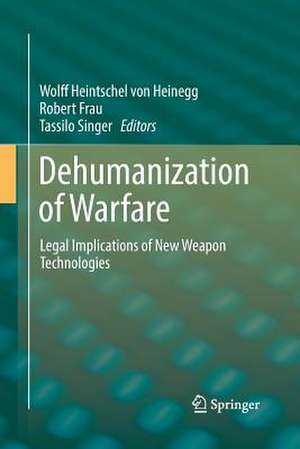
Dehumanization of Warfare: Legal Implications of New Weapon Technologies
Editat de Wolff Heintschel von Heinegg, Robert Frau, Tassilo Singeren Limba Engleză Paperback – 6 iun 2019
Preț: 957.87 lei
Preț vechi: 1168.14 lei
-18%
Puncte Express: 1437
Carte tipărită la comandă
Livrare economică 15-29 iunie
Specificații
ISBN-13: 9783319884028
ISBN-10: 3319884026
Pagini: 233
Ilustrații: X, 233 p. 14 illus., 10 illus. in color.
Dimensiuni: 155 x 235 mm
Greutate: 0.35 kg
Ediția:Softcover reprint of the original 1st ed. 2018
Editura: Springer International Publishing
Colecția Springer
Locul publicării:Cham, Switzerland
ISBN-10: 3319884026
Pagini: 233
Ilustrații: X, 233 p. 14 illus., 10 illus. in color.
Dimensiuni: 155 x 235 mm
Greutate: 0.35 kg
Ediția:Softcover reprint of the original 1st ed. 2018
Editura: Springer International Publishing
Colecția Springer
Locul publicării:Cham, Switzerland
Cuprins
Part I Dehumanization of Warfare and International Humanitarian Law.- Part II Ethical Challenges of Dehumanization.- Part III Unmanned Systems in Particular at Sea and Land.- Part IV Cyber Warfare.- Part V Specific Aspects of Dehumanization.
Notă biografică
Wolff Heintschel von Heinegg, European University Viadrina, Frankfurt/Oder, Germany
Robert Frau, European University Viadrina, Frankfurt/Oder, Germany
Tassilo Singer, University of Passau, Germany
Robert Frau, European University Viadrina, Frankfurt/Oder, Germany
Tassilo Singer, University of Passau, Germany
Textul de pe ultima copertă
This book addresses the technological evolution of modern warfare due to unmanned systems and the growing capacity for cyberwarfare. The increasing involvement of unmanned means and methods of warfare can lead to a total removal of humans from the navigation, command and decision-making processes in the control of unmanned systems, and as such away from participation in hostilities – the “dehumanization of warfare.” This raises the question of whether and how today’s law is suitable for governing the dehumanization of warfare effectively. Which rules are relevant? Do interpretations of relevant rules need to be reviewed or is further and adapted regulation necessary? Moreover, ethical reasoning and computer science developments also have to be taken into account in identifying problems. Adopting an interdisciplinary approach the book focuses primarily on international humanitarian law, with related ethics and computer science aspects included in the discussion and the analysis.
Caracteristici
Provides an overview of current discussion on autonomous weapons and cyberwarfare Offers a new approach that considers different new weapon technologies under the same legal rules Includes ethical and philosophical reasoning on new weapon technologies – a central part of the current discussions Offers insights into the status quo in robotics and digital forensics, fostering a common understanding of the challenges of new weapon technologies Written by leading experts, which guarantees the high quality of the contributions