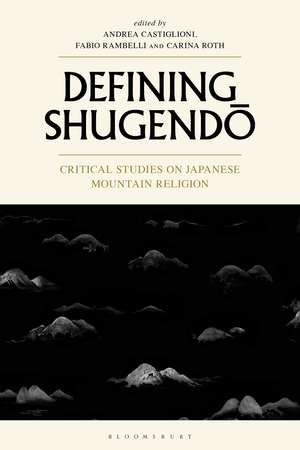
Defining Shugendo: Critical Studies on Japanese Mountain Religion
Editat de Andrea Castiglioni, Professor Fabio Rambelli, Carina Rothen Limba Engleză Paperback – 19 mai 2022
Defining Shugendo brings together leading international experts on Japanese mountain asceticism to discuss what has been an essential component of Japanese religions for more than a thousand years.
Contributors explore how mountains have been abodes of deities, a resting place for the dead, sources of natural bounty and calamities, places of religious activities, and a vast repository of symbols. The book shows that many peoples have chosen them as sites for ascetic practices, claiming the potential to attain supernatural powers there.
This book discusses the history of scholarship on Shugendo, the development process of mountain worship, and the religious and philosophical features of devotion at specific sacred mountains. Moreover, it reveals the rich material and visual culture associated with Shugendo, from statues and steles, to talismans and written oaths.
Preț: 215.47 lei
Preț vechi: 307.98 lei
-30%
Puncte Express: 323
Carte tipărită la comandă
Livrare economică 08-22 decembrie
Livrare prin curier în România Termenul estimat este afișat lângă disponibilitate.
Transport gratuit de la 400.00 lei Plată online sau ramburs, în funcție de opțiunile comenzii.
Retur gratuit în 14 zile Comandă securizată și suport în română.
Specificații
ISBN-13: 9781350191587
ISBN-10: 1350191582
Pagini: 304
Ilustrații: 24 bw illus
Dimensiuni: 152 x 232 x 20 mm
Greutate: 0.43 kg
Editura: Bloomsbury Publishing
Colecția Bloomsbury Academic
Locul publicării:London, United Kingdom
ISBN-10: 1350191582
Pagini: 304
Ilustrații: 24 bw illus
Dimensiuni: 152 x 232 x 20 mm
Greutate: 0.43 kg
Editura: Bloomsbury Publishing
Colecția Bloomsbury Academic
Locul publicării:London, United Kingdom
V-ar putea interesa
-
 -18%Preț: 1127.03 lei1374.42 lei
 -
 Nothing to Do with Islam?Townsend PeterPreț: 123.30 lei
 -
 Lao Tzu's Tao Te ChingChao-Hsiu ChenPreț: 138.44 lei
 -
 Ecologies of Faith in a Digital AgeStephen D. LowePreț: 189.13 lei
 -
 The New CreationAkram Al-MajidPreț: 339.27 lei
 -
 Divinely Praising Upon the Pearl of CreationNurjan MirahmadiPreț: 146.44 lei
 -
 The Bloomsbury Handbook of Japanese ReligionsErica Baffelli-46%Preț: 784.97 lei1458.62 lei
 -
 Spirits and Animism in Contemporary Japan: The Invisible EmpireProfessor Fabio Rambelli-33%Preț: 709.53 lei1053.37 lei
 -
 -32%Preț: 635.32 lei930.14 lei
 -
 The Sea and the Sacred in Japan: Aspects of Maritime ReligionProfessor Fabio Rambelli-24%Preț: 251.12 lei328.50 lei
 -
 A Buddhist Theory of Semiotics: Signs, Ontology, and Salvation in Japanese Esoteric BuddhismProfessor Fabio Rambelli-22%Preț: 338.22 lei434.37 lei
 -
 Buddhism and Iconoclasm in East Asia: A HistoryProfessor Fabio Rambelli-16%Preț: 279.42 lei331.53 lei
 -
 Open Mind, Open Heart 20th Anniversary EditionFather Thomas Keating, O.C.S.O.-41%Preț: 86.78 lei147.97 lei
 -
 Islamists and the Politics of the Arab UprisingsHendrik Kraetzschmar-14%Preț: 220.96 lei256.27 lei
 -
 The Path to Eternal TruthManjula Sudhindra RaoPreț: 49.45 lei
 -
 The Numerical And Time Correlations In The QuranSahal A. MohamedPreț: 76.20 lei
 -
 Th¿c t¿i hi¿n ti¿nT¿-kheo Viên MinhPreț: 67.99 lei
 -
 -24%Preț: 208.35 lei274.54 lei
 -
 -25%Preț: 183.19 lei243.84 lei
 -
 -20%Preț: 205.16 lei255.59 lei
 -
 The Quran With Tafsir Ibn Kathir Part 1 of 30Muhammad Saed Abdul-RahmanPreț: 156.50 lei
 -
 The Quran With Tafsir Ibn Kathir Part 5 of 30Muhammad Saed Abdul-RahmanPreț: 125.93 lei
 -
 Living ProofMichael AyersPreț: 106.17 lei
 -
 Talk to Yourself Like a BuddhistCynthia Kane-30%Preț: 79.38 lei112.67 lei
 -
 AllEinAlexander PorajPreț: 125.40 lei
Cuprins
1. Introduction
Part 1: Intellectual History of Shugendo Studies
2. A Critical History of the Study of Shugendo and Mountain Beliefs in Japan, Suzuki Masataka (Keio University, Japan)
Part 2: Constructed Topologies and Invented Chronologies
3. Shugendo within Japanese Buddhism, Hasegawa Kenji (Prefectural Museum of Tokushima, Japan)
4. Imagining an Ancient Tradition: Eighteenth-Century Narratives of Shugendo at Mount Togakushi, Caleb Carter (Kyushu University, Japan)
5. Otake Dainichi Nyorai and Haguro Shugendo: Unearthing a Lost History, Gaynor Sekimori (SOAS, University of London, UK)
6. Shugendo and Modernity Face to Face: The Daigoji Case, Hayashi Makoto (Aichi Gakuin University, Japan)
Part 3: Imagining the Founder, En no Gyoja, and Fictionalizing Shugendo
7. Between Companionship and Worship: A Reflection on En no Gyoja Statuary Past and Present, Carina Roth (University of Geneva, Switzerland)
8. En no Gyoja's Legitimization in the Context of Japanese Esoteric Buddhism, Kawasaki Tsuyoshi (Shujitsu University, Japan
9. The Description of Mountains in Minoodera engi, Niki Natsumi (National Institute of Technology, Akashi College, Japan)
10. Images of the Shugenja in Edo Popular Fiction, William Fleming (University of California, Santa Barbara, USA)
Part 4: Materiality and Visual Culture of Shugendo
11. The Cult and Statuary of Zao Gongen, Fujioka Yutaka (Osaka University, Japan)
12. Religious Culture in Transition: Mt. Fuji, Janine Sawada (Brown University, USA)
13. The Shape of Devotion: Mounds, Stelae, and Empowering Ritual Fasting, Andrea Castiglioni (Nagoya City University, Japan
14. Shugendo as Social Practice: Kumano Talismans and Inscribed Oaths in Premodern Japan, (Max Moerman (Barnard College, USA)
Bibliography
Index
Part 1: Intellectual History of Shugendo Studies
2. A Critical History of the Study of Shugendo and Mountain Beliefs in Japan, Suzuki Masataka (Keio University, Japan)
Part 2: Constructed Topologies and Invented Chronologies
3. Shugendo within Japanese Buddhism, Hasegawa Kenji (Prefectural Museum of Tokushima, Japan)
4. Imagining an Ancient Tradition: Eighteenth-Century Narratives of Shugendo at Mount Togakushi, Caleb Carter (Kyushu University, Japan)
5. Otake Dainichi Nyorai and Haguro Shugendo: Unearthing a Lost History, Gaynor Sekimori (SOAS, University of London, UK)
6. Shugendo and Modernity Face to Face: The Daigoji Case, Hayashi Makoto (Aichi Gakuin University, Japan)
Part 3: Imagining the Founder, En no Gyoja, and Fictionalizing Shugendo
7. Between Companionship and Worship: A Reflection on En no Gyoja Statuary Past and Present, Carina Roth (University of Geneva, Switzerland)
8. En no Gyoja's Legitimization in the Context of Japanese Esoteric Buddhism, Kawasaki Tsuyoshi (Shujitsu University, Japan
9. The Description of Mountains in Minoodera engi, Niki Natsumi (National Institute of Technology, Akashi College, Japan)
10. Images of the Shugenja in Edo Popular Fiction, William Fleming (University of California, Santa Barbara, USA)
Part 4: Materiality and Visual Culture of Shugendo
11. The Cult and Statuary of Zao Gongen, Fujioka Yutaka (Osaka University, Japan)
12. Religious Culture in Transition: Mt. Fuji, Janine Sawada (Brown University, USA)
13. The Shape of Devotion: Mounds, Stelae, and Empowering Ritual Fasting, Andrea Castiglioni (Nagoya City University, Japan
14. Shugendo as Social Practice: Kumano Talismans and Inscribed Oaths in Premodern Japan, (Max Moerman (Barnard College, USA)
Bibliography
Index
Recenzii
Defining Shugendo: Critical Studies on Japanese Mountain Religion [is] an essential and overdue contribution ... Each of [its] chapters is a doorway to new perspectives on this ancient religion.
[T]he contributions mark and outline the wide and complex area of Shugendo and its intersections with other (religious, political, cultural) domains. The destination is definitely worth the journey.
This book is a crucial contribution to our understanding of the intellectual, historical, and lived dimensions of Shugendo. Covering an impressive range of topics, the volume succeeds in foregrounding the site-specific, local nature of mountain practices without ever losing sight of their interactions with trans-local discourses and movements. For this reason, Defining Shugendo is a must-read for anyone interested in this tradition and in Japanese Religions more broadly."
Defining Shugendo covers a wide swath of religious and cultural modes and activities in Japan. This fine collection may finally succeed in convincing readers that Shugendo-at least as an expression of the amalgamation of various religious figures and practices-is truly a central part of Japanese culture that cannot be ignored, and indeed should be recognized as one of the major religious traditions in Japan.
[T]he contributions mark and outline the wide and complex area of Shugendo and its intersections with other (religious, political, cultural) domains. The destination is definitely worth the journey.
This book is a crucial contribution to our understanding of the intellectual, historical, and lived dimensions of Shugendo. Covering an impressive range of topics, the volume succeeds in foregrounding the site-specific, local nature of mountain practices without ever losing sight of their interactions with trans-local discourses and movements. For this reason, Defining Shugendo is a must-read for anyone interested in this tradition and in Japanese Religions more broadly."
Defining Shugendo covers a wide swath of religious and cultural modes and activities in Japan. This fine collection may finally succeed in convincing readers that Shugendo-at least as an expression of the amalgamation of various religious figures and practices-is truly a central part of Japanese culture that cannot be ignored, and indeed should be recognized as one of the major religious traditions in Japan.