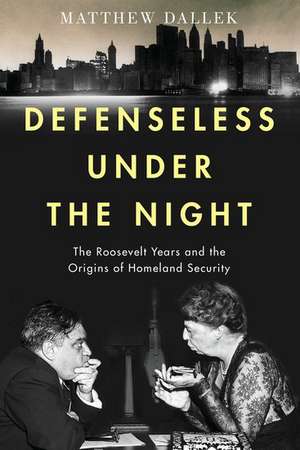
Defenseless Under the Night: The Roosevelt Years and the Origins of Homeland Security
Autor Matthew Dalleken Limba Engleză Paperback – 20 feb 2020
Preț: 209.66 lei
Puncte Express: 314
Carte disponibilă
Livrare economică 30 octombrie-04 noiembrie
Livrare prin curier în România Termenul estimat este afișat lângă disponibilitate.
Transport gratuit de la 400.00 lei Plată online sau ramburs, în funcție de opțiunile comenzii.
Retur gratuit în 14 zile Comandă securizată și suport în română.
Specificații
ISBN-13: 9780197503997
ISBN-10: 0197503993
Pagini: 360
Ilustrații: 24 illustrations
Dimensiuni: 231 x 155 x 23 mm
Greutate: 0.48 kg
Editura: Oxford University Press
Colecția OUP USA
Locul publicării:New York, United States
ISBN-10: 0197503993
Pagini: 360
Ilustrații: 24 illustrations
Dimensiuni: 231 x 155 x 23 mm
Greutate: 0.48 kg
Editura: Oxford University Press
Colecția OUP USA
Locul publicării:New York, United States
V-ar putea interesa
-
 Forgotten Voices of BurmaJulian Thompson-31%Preț: 96.11 lei140.03 lei
 -
 Humanitarians at War: The Red Cross in the Shadow of the HolocaustGerald Steinacher-19%Preț: 194.12 lei240.74 lei
 -
 -19%Preț: 103.74 lei128.24 lei
 -
 -19%Preț: 179.76 lei222.72 lei
 -
 -31%Preț: 2244.91 lei3253.07 lei
 -
 -28%Preț: 407.17 lei567.07 lei
 -
 The Oxford Illustrated History of World War TwoRichard Overy-19%Preț: 244.12 lei301.98 lei
 -
 Model Nazi: Arthur Greiser and the Occupation of Western PolandCatherine Epstein-10%Preț: 367.50 lei409.93 lei
 -
 Annihilation: A Global Military History of World War IIThomas Zeiler-24%Preț: 650.73 lei857.02 lei
 -
 Patton, Montgomery, RommelTerry BrightonPreț: 109.41 lei
 -
 Preț: 69.56 lei
 -
 Cheer Up, Mate!Alan WeeksPreț: 70.30 lei
 -
 Preț: 363.40 lei
 -
 A People's History of World War IIMarc FavreauPreț: 134.63 lei
 -
 Stalin's Secret War: the Nkvd on the Eastern FrontRupert ButlerPreț: 142.93 lei
Recenzii
Dallek's book is a good reminder of how far the impact of war reaches beyond the population of men and women in uniform.
Dallek provides us with a haunting account, one highly relevant to the anxiety-ridden nation of today.
Following sudden and unexpected assaults [on the United States], presidents of all ideological stripes typically call on the public not to be afraid. The tradition, as historian Matthew Dallek shows in a fascinating new book, 'Defenseless Under The Night: The Roosevelt Years and the Origins of Homeland Security,' goes back to the fear Americans felt in the 1930s.
The fascinating story of the rise and fall of the Office of Civilian Defense (OCD), America's first federal office of homeland security. FDR created the OCD less than six months before the Japanese attacked Pearl Harbor. Drawing from a broad range of primary and secondary sources, Dallek, Assistant Professor of Political Management at George Washington University, focuses his attention on the personalities at the top of the OCD as well as the politics surrounding its creation and development.
This is a great book. Rarely do readers get to experience the unique combination of fascinating history, contemporary relevance, drama, and intrigue in wonk-policy detail in a single, enjoyable work Dallek (GWU) takes readers through all of the touch points, which actually read like modern headlines in The New York Times: government propaganda, militarized civilian life, competing political visions for national defense, and the evolution of national security into the public consciousness.
Immensely readable `Defenseless' is a meticulous account of an epic battle that set Roosevelt, the first lady, against La Guardia, the mayor of New York, as the two created the country's first Office of Civilian Defense (OCD), the precursor to what we know today as the Department of Homeland Security They ignited an important conversation about liberalism and its role in times of crisis.
Matthew Dallek's powerful history of America's wartime needs from civil defense to homeland security is urgently needed now. Deeply researched, vividly written, this splendid book highlights Eleanor Roosevelt's prescient l940 effort to launch a movement for civil defense, citizen empowerment, human rights-and the widespread opposition to those goals - which reflect our ongoing political divisions.
Ever since 9/11, Americans have yearned for a return to an idyllic earlier time when no one in this country had to fear a rain of death from the sky. But in this fascinating book, Matthew Dallek reveals vividly that anxiety about terror from abroad began as early as 1938. He also gives readers a fresh appreciation of Eleanor Roosevelt, who viewed civil defense as an opportunity for social advance - an emphasis that has been discarded in today's concern with 'homeland security.'
Matthew Dallek's book represents political history at its very best. Informed by meticulous research, written in vivid prose, and full of shrewd insight, Defenseless Under the Night shows how the Roosevelt administration struggled to maintain the proper balance between protecting individual rights and ensuring the nation's security. It is an issue that is as relevant today as it was in the 1930s and 1940s.
An engaging and thoughtful portrait of the United States on the cusp of World War II. Dallek's book offers a gripping account of the little-studied civil defense program and its influence on American society. The conflicts among Dallek's rich main characters, including Eleanor Roosevelt and Fiorello LaGuardia, show that World War II was not just a fight against fascism abroad; it was also a struggle over the future of liberalism at home.
As Dallek shows compellingly here, the struggle to define security at home was...essential to shaping liberalism as we know it today. Dallek has a penchant for telling a great story, and his topic comes with two ideal protagonists.... Dallek's archival work is impressive.... [A] rich history of intra-liberal division.... It is impossible to read this book and not be impressed by the similarly elastic quality of the debates that took place over homeland defense in 1941 and after September 11, 2001.... [The book] makes a crucial intervention...by highlighting the struggle over those ideas during a similar historical period of insecurity.
As historian Matthew Dallek captures in his book...the origins of this contemporary struggle over liberty and security can be traced to the period of the late 1930s and early 1940s and the growing movement for 'home defense.'...For those interested in a fresh take on the home front politics of World War II
Dallek provides us with a haunting account, one highly relevant to the anxiety-ridden nation of today.
Following sudden and unexpected assaults [on the United States], presidents of all ideological stripes typically call on the public not to be afraid. The tradition, as historian Matthew Dallek shows in a fascinating new book, 'Defenseless Under The Night: The Roosevelt Years and the Origins of Homeland Security,' goes back to the fear Americans felt in the 1930s.
The fascinating story of the rise and fall of the Office of Civilian Defense (OCD), America's first federal office of homeland security. FDR created the OCD less than six months before the Japanese attacked Pearl Harbor. Drawing from a broad range of primary and secondary sources, Dallek, Assistant Professor of Political Management at George Washington University, focuses his attention on the personalities at the top of the OCD as well as the politics surrounding its creation and development.
This is a great book. Rarely do readers get to experience the unique combination of fascinating history, contemporary relevance, drama, and intrigue in wonk-policy detail in a single, enjoyable work Dallek (GWU) takes readers through all of the touch points, which actually read like modern headlines in The New York Times: government propaganda, militarized civilian life, competing political visions for national defense, and the evolution of national security into the public consciousness.
Immensely readable `Defenseless' is a meticulous account of an epic battle that set Roosevelt, the first lady, against La Guardia, the mayor of New York, as the two created the country's first Office of Civilian Defense (OCD), the precursor to what we know today as the Department of Homeland Security They ignited an important conversation about liberalism and its role in times of crisis.
Matthew Dallek's powerful history of America's wartime needs from civil defense to homeland security is urgently needed now. Deeply researched, vividly written, this splendid book highlights Eleanor Roosevelt's prescient l940 effort to launch a movement for civil defense, citizen empowerment, human rights-and the widespread opposition to those goals - which reflect our ongoing political divisions.
Ever since 9/11, Americans have yearned for a return to an idyllic earlier time when no one in this country had to fear a rain of death from the sky. But in this fascinating book, Matthew Dallek reveals vividly that anxiety about terror from abroad began as early as 1938. He also gives readers a fresh appreciation of Eleanor Roosevelt, who viewed civil defense as an opportunity for social advance - an emphasis that has been discarded in today's concern with 'homeland security.'
Matthew Dallek's book represents political history at its very best. Informed by meticulous research, written in vivid prose, and full of shrewd insight, Defenseless Under the Night shows how the Roosevelt administration struggled to maintain the proper balance between protecting individual rights and ensuring the nation's security. It is an issue that is as relevant today as it was in the 1930s and 1940s.
An engaging and thoughtful portrait of the United States on the cusp of World War II. Dallek's book offers a gripping account of the little-studied civil defense program and its influence on American society. The conflicts among Dallek's rich main characters, including Eleanor Roosevelt and Fiorello LaGuardia, show that World War II was not just a fight against fascism abroad; it was also a struggle over the future of liberalism at home.
As Dallek shows compellingly here, the struggle to define security at home was...essential to shaping liberalism as we know it today. Dallek has a penchant for telling a great story, and his topic comes with two ideal protagonists.... Dallek's archival work is impressive.... [A] rich history of intra-liberal division.... It is impossible to read this book and not be impressed by the similarly elastic quality of the debates that took place over homeland defense in 1941 and after September 11, 2001.... [The book] makes a crucial intervention...by highlighting the struggle over those ideas during a similar historical period of insecurity.
As historian Matthew Dallek captures in his book...the origins of this contemporary struggle over liberty and security can be traced to the period of the late 1930s and early 1940s and the growing movement for 'home defense.'...For those interested in a fresh take on the home front politics of World War II
Notă biografică
Matthew Dallek is Professor of Political Management at George Washington University. He is also the author of The Right Moment: Ronald Reagan's First Victory and the Decisive Turning Point in American Politics.
Cuprins
- Introduction: Guns and Butter
- Chapter One: "Ultimate Armageddon"
- Chapter Two: "No Pact, Treaty, Symbol, or Person"
- Chapter Three: "Two Fronts"
- Chapter Four: "The Problem of Home Defense"
- Chapter Five: "An American Plan"
- Chapter Six: London Burning
- Chapter Seven: "A Sweeping Conflagration of Insanity"
- Chapter Eight: "Heart and Soul"
- Chapter Nine: "We Can't All Run to Central Pk"
- Chapter Ten: "A Man Must Be Protected"
- Chapter Eleven: "Fair Game"
- Chapter Twelve: "The Liberal Approach"
- Chapter Thirteen: "All These Rights Spell Security'
- Conclusion: National Security Liberalism
- Notes
- Bibliography
- Index