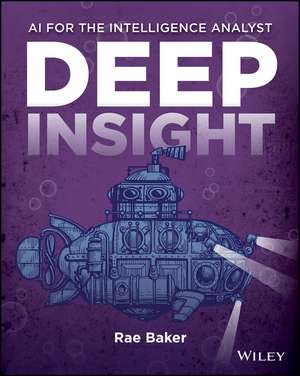
Deep Insight
Autor Rae L Bakeren Limba Engleză Paperback – 9 dec 2026
Deep Insight: AI for the Intelligence Analyst examines how artificial intelligence reshapes intelligence gathering and open source intelligence methodology. Written by Rae Baker, a Specialist Master at Deloitte and Senior OSINT Analyst within the Dynamic Adversary Intelligence team, this book focuses on core principles and methodology rather than specific tools that quickly become outdated. Baker frames AI as an accelerator for analyst workflows, helping practitioners streamline repetitive tasks and dedicate more time to substantive analysis.
Rather than cataloging individual AI tools, Deep Insight blends intelligence and OSINT concepts with real-world stories, thought experiments, and immersive scenarios designed to help analysts apply AI to their specific operational roadblocks. Each chapter connects AI capabilities directly to intelligence processes, showing how automation and machine learning techniques fit within established analytical frameworks and tradecraft. The structure builds progressively from foundational AI concepts to applied intelligence use cases.
Readers will also find:
- Methodology-focused guidance on integrating AI into existing OSINT collection and analysis processes without tool dependency
- Real-world scenarios and thought experiments illustrating how AI addresses common bottlenecks in intelligence workflows
- Frameworks for evaluating when AI augmentation adds value versus when human analytical judgment remains critical
- Practical approaches to automating repetitive intelligence tasks so analysts can focus on higher-order analytical work
- Strategies for applying AI responsibly within intelligence operations, including bias awareness and ethical considerations for analysts
Preț: 247.13 lei
Preț vechi: 308.91 lei
-20% Precomandă
Carte nepublicată încă
Specificații
Cuprins
Foreword by Chris Liapis xiii
Foreword by Will Burns xv
About the Author xvii
Acknowledgments xix
Introduction xxi
Chapter 1: Setting Sail 1
1.1 Mission 1
1.2 Understanding AI's Role in Intelligence 2
1.3 Introduction to Workflow Development 17
Chapter 2: Mapping the Depths 21
2.1 Mission 21
2.2 Matching AI Capabilities to Analyst Problems 22
2.3 Matching Tools to Real Users 25
2.4 Think Like the Adversary 30
Chapter 3: Casting the Nets 33
3.1 Mission 33
3.2 The Data Problem 34
3.3 What Analysts Need to Know About Data 37
3.4 Data Types and Sources 39
3.5 What Does Automating Collection Actually Mean? 42
3.6 Designing an AI Collection Workflow 46
Chapter 4: Diving Beneath the Surface 55
4.1 Mission 55
4.2 Organizing the Noise 56
4.3 What Is Machine Learning? 58
4.4 How Machine Learning Works 58
4.5 Types of Machine Learning 60
4.6 Why Machine Learning Matters to Analysts 63
Chapter 5: Interpreting the Sea 71
5.1 Mission 71
5.2 Decoding the Message 72
5.3 What Is Natural Language Processing? 73
5.4 Why Natural Language Processing Matters to Analysts 83
5.5 NLP Toolbox 85
Chapter 6: Steering the Ship 89
6.1 Mission 89
6.2 What Is a Prompt? 89
6.3 Why Prompts Matter in Intelligence Work 90
6.4 How AI Interprets Prompts 92
6.5 What Makes a Prompt Work 96
6.6 Advanced Prompting Techniques 102
Chapter 7: Adjusting the Sails 111
7.1 Mission 111
7.2 What Is Predictive Analysis? 112
7.3 How AI Enhances Predictive Analysis 116
7.4 Key Steps in Predictive Analysis for Intelligence Work 119
7.5 Using Predictive Analysis to Assess Risk and Forecast Threats 125
7.6 Case Studies in Predictive Analysis 132
Chapter 8: Staying the Course 137
8.1 Mission 137
8.2 Critical Thinking in AI Times 138
8.3 Ethical Issues in AI for Intelligence Work 143
8.4 The Human Cost of AI 174
Chapter 9: Anchoring Down 179
9.1 Mission 179
9.2 The Vibe Coding Problem 180
9.3 Why Python? 182
9.4 Building Your First Tool: Domain Analyzer 186
9.5 Poof, You Are Now a Developer (Not a Vibe Coder) 193
Chapter 10: Captain's Log 197
10.1 Mission 197
10.2 The Gunslinger's Hallway: Same Skills, Different Worlds 197
Chapter 11: Scanning the Horizon 207
11.1 Mission 207
11.2 Agentic AI 208
11.3 Multimodal AI 213
11.4 Large World Models 213
11.5 Quantum Computing and Security 214
11.6 Attribution and Contamination 217
Chapter 12: Plotting the Next Course 219
12.1 Mission Wrap-Up 219
12.2 What You Actually Built 220
12.3 Next Steps 221
Index 225