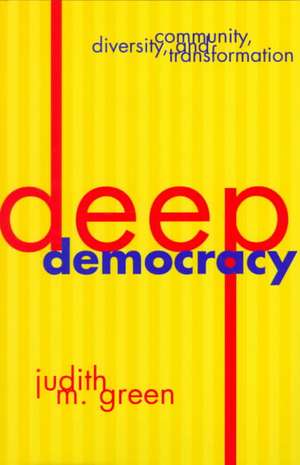
Deep Democracy: Community, Diversity, and Transformation
Autor Judith M. Greenen Limba Engleză Paperback – 13 oct 1999
Preț: 276.58 lei
Preț vechi: 363.28 lei
-24%
Puncte Express: 415
Carte tipărită la comandă
Livrare economică 28 noiembrie-12 decembrie
Livrare prin curier în România Termenul estimat este afișat lângă disponibilitate.
Transport gratuit de la 400.00 lei Plată online sau ramburs, în funcție de opțiunile comenzii.
Retur gratuit în 14 zile Comandă securizată și suport în română.
Specificații
ISBN-13: 9780847692712
ISBN-10: 084769271X
Pagini: 264
Dimensiuni: 150 x 228 x 18 mm
Greutate: 0.4 kg
Editura: Bloomsbury Publishing
Colecția Rowman & Littlefield
Locul publicării:New York, United States
ISBN-10: 084769271X
Pagini: 264
Dimensiuni: 150 x 228 x 18 mm
Greutate: 0.4 kg
Editura: Bloomsbury Publishing
Colecția Rowman & Littlefield
Locul publicării:New York, United States
V-ar putea interesa
-
 The Dictators Learning CurveWilliam J DobsonPreț: 116.27 lei
 -
 Narrative Politics: Stories and Collective ActionFrederick W. Mayer-31%Preț: 593.23 lei862.00 lei
 -
 -31%Preț: 773.24 lei1123.21 lei
 -
 Political Parties and Democratic Linkage: How Parties Organize DemocracyRussell J. Dalton-11%Preț: 351.97 lei397.26 lei
 -
 -14%Preț: 296.15 lei346.14 lei
 -
 On Thinking InstitutionallyHugh Heclo-17%Preț: 208.61 lei251.12 lei
 -
 On the People's TermsPhilip PettitPreț: 198.96 lei
 -
 The Democracy ProjectDavid Graeber-18%Preț: 65.18 lei79.62 lei
 -
 Preț: 499.40 lei
 -
 The Inner Enemies of DemocracyTzvetan TodorovPreț: 114.79 lei
 -
 Necessary IllusionsNoam ChomskyPreț: 117.55 lei
 -
 Rethinking Popular RepresentationO. TörnquistPreț: 399.29 lei
 -
 Myths, Politicians and MoneyB. GouldPreț: 340.43 lei
 -
 The Uncivil WarDavid LebedoffPreț: 196.83 lei
 -
 They Can't Represent Us!Marina SitrinPreț: 155.96 lei
 -
 Hatred of DemocracyJacques RancièrePreț: 104.31 lei
 -
 Of the People, by the PeopleRoger OsbornePreț: 111.17 lei
 -
 Preț: 116.69 lei
Cuprins
Chapter 1 Acknowledgments
Chapter 2 Introduction
Chapter 3 1. The Diverse Community or the Unoppressive City: Which Ideal for a Transformative Politics of Difference?
Chapter 4 2.Transformative Communication toward Democratic Communities: Pragmatism or Critical Theory?
Chapter 5 3.The Deeply Democratic Community: Reconstructing Dewey's Transformative Ideal
Chapter 6 4.Cosmopolitan Unity Amidst Diversity: Alain Locke's Transformative Vision of Deep Democracy
Chapter 7 5. Prophetic Pragmatism: King, West, and the Beloved Community
Chapter 8 6.Transforming World Capitalisms Through Radical Pragmatism: Economy, Law, and Democracy
Chapter 9 7.Deepening Democracy: Rebuilding the Public Square
Chapter 10 Bibliography
Chapter 11 Index
Chapter 12 About the Author
Chapter 2 Introduction
Chapter 3 1. The Diverse Community or the Unoppressive City: Which Ideal for a Transformative Politics of Difference?
Chapter 4 2.Transformative Communication toward Democratic Communities: Pragmatism or Critical Theory?
Chapter 5 3.The Deeply Democratic Community: Reconstructing Dewey's Transformative Ideal
Chapter 6 4.Cosmopolitan Unity Amidst Diversity: Alain Locke's Transformative Vision of Deep Democracy
Chapter 7 5. Prophetic Pragmatism: King, West, and the Beloved Community
Chapter 8 6.Transforming World Capitalisms Through Radical Pragmatism: Economy, Law, and Democracy
Chapter 9 7.Deepening Democracy: Rebuilding the Public Square
Chapter 10 Bibliography
Chapter 11 Index
Chapter 12 About the Author
Recenzii
Green argues for a concept of democracy that moves beyond the conflict between the individual and community, quietism and activism, multiculturalism and monoculturalism, and theory in opposition to practice. In a house of darkness-a world plagued by ethnic wars, class conflict, and sexual exploitation-a strenuously researched and masterfully argued account of what democracy should mean is a welcomed beacon.
In this carefully researched and well-written volume, Judith Green moves philosophy off the drawing board into the rough-and-tumble world where life and death decisions are made. Her key theme is location-specific action based on experimentation, pluralism, and radical democracy. And her goal is nothing less than the transformation of culture from the street corner to the global marketplace. In her hands, philosophy becomes a set of public tasks.
Judith Green has a powerful feel for the social, political and economic problems we face. Her book is a passionate plea for caring and intelligence in the way we treat others here and on the other side of the globe. In the best tradition of American philosophy, she presents concrete ideas for improving our practices.
A valuable addition to the sparse, but growing literature on how democratic theory and practice can be used to transform a society that has been plagued by racism, sexism, and class oppression.
Green's book touches on a number of interesting questions in democratic theory.
Deep Democracy is a refreshing and optimistic look at the usefulness of philosophy and philosopers, a well-researched study of theorists who model a commitment to human flourishing, a specific and well-grounded guidebook for building communities and recovering from "ontological rootlessness" and "existential nihilism", and an important call to philosophers to overcome their own theoretical differences and work toward "democratically deepening our hearts and minds" (xiii).
The need to give close attention to Deep Democracy has special urgency. Already an important contribution to democratic theory and pragmatic social thought, Deep Democracy holds significant potential in helping to guide the transformative democratic processes at work in the world today. The scholarship cotnained in these pages is formidable.
In this carefully researched and well-written volume, Judith Green moves philosophy off the drawing board into the rough-and-tumble world where life and death decisions are made. Her key theme is location-specific action based on experimentation, pluralism, and radical democracy. And her goal is nothing less than the transformation of culture from the street corner to the global marketplace. In her hands, philosophy becomes a set of public tasks.
Judith Green has a powerful feel for the social, political and economic problems we face. Her book is a passionate plea for caring and intelligence in the way we treat others here and on the other side of the globe. In the best tradition of American philosophy, she presents concrete ideas for improving our practices.
A valuable addition to the sparse, but growing literature on how democratic theory and practice can be used to transform a society that has been plagued by racism, sexism, and class oppression.
Green's book touches on a number of interesting questions in democratic theory.
Deep Democracy is a refreshing and optimistic look at the usefulness of philosophy and philosopers, a well-researched study of theorists who model a commitment to human flourishing, a specific and well-grounded guidebook for building communities and recovering from "ontological rootlessness" and "existential nihilism", and an important call to philosophers to overcome their own theoretical differences and work toward "democratically deepening our hearts and minds" (xiii).
The need to give close attention to Deep Democracy has special urgency. Already an important contribution to democratic theory and pragmatic social thought, Deep Democracy holds significant potential in helping to guide the transformative democratic processes at work in the world today. The scholarship cotnained in these pages is formidable.