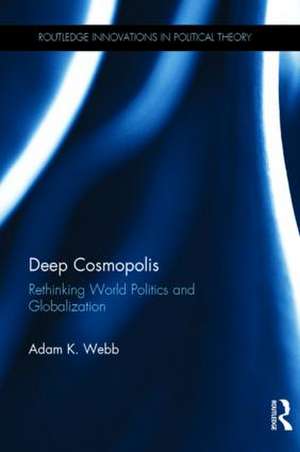
Deep Cosmopolis: Rethinking World Politics and Globalisation: Routledge Innovations in Political Theory
Autor Adam K. Webben Limba Engleză Hardback – 12 mai 2015
Too often, observers of globalization take for granted that the common ground across cultures is a thin layer of consumerism and perhaps human rights. If so, then anything deeper and more traditional would be placebound, and probably destined for the dustbin of history. But must this be so? Must we assume--as both liberals and traditionalists now tend to do--that one cannot be a cosmopolitan and take traditions seriously at the same time? This book offers a radically different argument about how traditions and global citizenship can meet, and suggests some important lessons for the contours of globalization in our own time.
Adam K. Webb argues that if we look back before modernity, we find a very different line of thinking about what it means to take the whole world as one s horizon. Digging into some fascinating currents of thought and practice in the ancient world, the Middle Ages, and the early modern period, across all major civilizations, Webb is able to reveal patterns of "deep cosmopolitanism," with its logic quite unlike that of liberal globalization today. In their more cosmopolitan moments, everyone from clerics to pilgrims to empire-builders was inclined to look for deep ethical parallels points of contact among civilizations and traditions. Once modernity swept aside the old civilizations, however, that promise was largely forgotten. We now have an impoverished view of what it means to embrace a tradition and even what kinds of conversations across traditions are possible. In part two, Webb draws out the lessons of deep cosmopolitanism for our own time. If revived, it has something to say about everything from the rise of new non-Western powers like China and India and what they offer the world, to religious tolerance, to global civil society, to cross-border migration. "
Deep Cosmopolis" traces an alternative strand of cosmopolitan thinking that cuts across centuries and civilizations. It advances a new perspective on world history, and a distinctive vision of globalization for this century which has the real potential to resonate with us all."
Din seria Routledge Innovations in Political Theory
-
 Preț: 335.13 lei
 - 18%
 Preț: 1294.14 lei
 - 18%
 Preț: 1317.65 lei
 - 18%
 Preț: 1249.58 lei
 -
 Preț: 461.15 lei
 - 18%
 Preț: 1300.43 lei
 - 18%
 Preț: 1294.89 lei
 - 18%
 Preț: 1414.37 lei
 - 18%
 Preț: 1245.19 lei
 -
 Preț: 473.93 lei
 -
 Preț: 469.25 lei
 - 18%
 Preț: 1252.93 lei
 - 15%
 Preț: 500.55 lei
 - 18%
 Preț: 1248.67 lei
 - 18%
 Preț: 1115.17 lei
 -
 Preț: 460.32 lei
 - 18%
 Preț: 1108.68 lei
 - 18%
 Preț: 1342.74 lei
 - 18%
 Preț: 1347.06 lei
 - 15%
 Preț: 428.70 lei
 - 18%
 Preț: 1258.30 lei
 - 18%
 Preț: 1296.67 lei
 - 18%
 Preț: 1253.07 lei
 -
 Preț: 460.32 lei
 -
 Preț: 464.56 lei
 - 18%
 Preț: 1247.84 lei
 -
 Preț: 461.58 lei
 -
 Preț: 465.84 lei
 -
 Preț: 440.93 lei
 - 18%
 Preț: 1286.99 lei
 - 18%
 Preț: 1255.87 lei
 - 18%
 Preț: 1263.19 lei
 -
 Preț: 366.59 lei
 - 15%
 Preț: 469.69 lei
 - 18%
 Preț: 1340.20 lei
 - 18%
 Preț: 1249.78 lei
 - 18%
 Preț: 1112.48 lei
 - 18%
 Preț: 1296.67 lei
 -
 Preț: 473.09 lei
 -
 Preț: 454.61 lei
 -
 Preț: 468.81 lei
 - 18%
 Preț: 1056.30 lei
Preț: 1250.55 lei
Preț vechi: 1525.06 lei
-18%
Carte tipărită la comandă
Livrare economică 01-15 decembrie
Specificații
ISBN-10: 1138891320
Pagini: 256
Ilustrații: 20 black & white illustrations, 15 black & white halftones, 5 black & white line drawings
Dimensiuni: 152 x 229 x 18 mm
Greutate: 0.5 kg
Ediția:1
Editura: Taylor & Francis
Colecția Routledge
Seria Routledge Innovations in Political Theory
Locul publicării:Oxford, United Kingdom
Public țintă
Postgraduate and UndergraduateCuprins
Recenzii
Notă biografică
Descriere
Too often, observers of globalization take for granted that the common ground across cultures is a thin layer of consumerism and perhaps human rights. If so, then anything deeper and more traditional would be placebound, and probably destined for the dustbin of history. But must this be so? Must we assume--as both liberals and traditionalists now tend to do--that one cannot be a cosmopolitan and take traditions seriously at the same time? This book offers a radically different argument about how traditions and global citizenship can meet, and suggests some important lessons for the contours of globalization in our own time.
Adam K. Webb argues that if we look back before modernity, we find a very different line of thinking about what it means to take the whole world as one s horizon. Digging into some fascinating currents of thought and practice in the ancient world, the Middle Ages, and the early modern period, across all major civilizations, Webb is able to reveal patterns of "deep cosmopolitanism," with its logic quite unlike that of liberal globalization today. In their more cosmopolitan moments, everyone from clerics to pilgrims to empire-builders was inclined to look for deep ethical parallels points of contact among civilizations and traditions. Once modernity swept aside the old civilizations, however, that promise was largely forgotten. We now have an impoverished view of what it means to embrace a tradition and even what kinds of conversations across traditions are possible. In part two, Webb draws out the lessons of deep cosmopolitanism for our own time. If revived, it has something to say about everything from the rise of new non-Western powers like China and India and what they offer the world, to religious tolerance, to global civil society, to cross-border migration. "
Deep Cosmopolis" traces an alternative strand of cosmopolitan thinking that cuts across centuries and civilizations. It advances a new perspective on world history, and a distinctive vision of globalization for this century which has the real potential to resonate with us all."