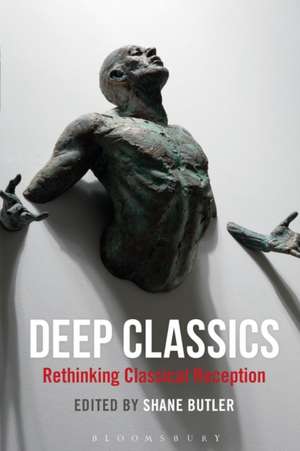
Deep Classics: Rethinking Classical Reception
Editat de Professor Shane Butleren Limba Engleză Paperback – 5 mai 2016
What does the study of the ancient past teach us about our encounters with our own more recent but still elusive memories? What do our always partial reconstructions of ancient sites tell us about the limits of our ability to know our own world, or to imagine our future? What does the reader of the lacunose and corrupted literatures of antiquity learn thereby about literature and language themselves? What does a shattered statue reveal about art, matter, sensation, experience, life? Does the way in which these vestiges of the past are encountered - sitting in a library, standing in a gallery, moving through a ruin - condition our responses to them and alter their significance? And finally, how has the contemplation of antiquity helped to shape seemingly unrelated disciplines, including not only other humanistic and scientific epistemologies but also non-scholarly modes and practices? In asking these and similar questions, Deep Classics makes a pointed intervention in the study of the classical tradition, now more widely known as 'reception studies'.
Preț: 196.45 lei
Preț vechi: 259.23 lei
-24%
Puncte Express: 295
Carte disponibilă
Livrare economică 07-21 noiembrie
Livrare prin curier în România Termenul estimat este afișat lângă disponibilitate.
Transport gratuit de la 400.00 lei Plată online sau ramburs, în funcție de opțiunile comenzii.
Retur gratuit în 14 zile Comandă securizată și suport în română.
Specificații
ISBN-13: 9781474260510
ISBN-10: 1474260519
Pagini: 360
Ilustrații: 30 bw illus
Dimensiuni: 154 x 232 x 20 mm
Greutate: 0.5 kg
Editura: Bloomsbury Publishing
Colecția Bloomsbury Academic
Locul publicării:London, United Kingdom
ISBN-10: 1474260519
Pagini: 360
Ilustrații: 30 bw illus
Dimensiuni: 154 x 232 x 20 mm
Greutate: 0.5 kg
Editura: Bloomsbury Publishing
Colecția Bloomsbury Academic
Locul publicării:London, United Kingdom
V-ar putea interesa
-
 -11%Preț: 123.65 lei138.92 lei
 -
 Guilt by Descent: Moral Inheritance and Decision Making in Greek TragedyN. J. Sewell-Rutter-13%Preț: 330.60 lei379.82 lei
 -
 Policing the Roman Empire: Soldiers, Administration, and Public OrderChristopher Fuhrmann-31%Preț: 822.24 lei1193.71 lei
 -
 Trouble in the West: Egypt and the Persian Empire, 525-332 BCStephen Ruzicka-31%Preț: 759.10 lei1101.11 lei
 -
 The Greek and Roman MythsPhilip Matyszak-16%Preț: 92.93 lei110.96 lei
 -
 Chronicle of the Roman EmperorsChris ScarrePreț: 148.70 lei
 -
 Latrinae et Foricae: Toilets in the Roman WorldBarry Hobson-37%Preț: 149.67 lei239.38 lei
 -
 The Roman Empire: Roots of ImperialismNeville MorleyPreț: 228.66 lei
 -
 Antony and CleopatraAdrian Goldsworthy-26%Preț: 92.05 lei123.60 lei
 -
 Rome: Empire of the Eagles, 753 BC – AD 476Neil FaulknerPreț: 488.80 lei
 -
 The Lagoon: How Aristotle Invented ScienceArmand Marie Leroi-41%Preț: 72.07 lei123.10 lei
 -
 Owning the Earth: The Transforming History of Land OwnershipAndro Linklater-26%Preț: 89.63 lei121.29 lei
 -
 Preț: 78.16 lei
 -
 HannibalNic Fields-41%Preț: 78.37 lei132.10 lei
 -
 The Darylgac Survey ProjectPia Guldager Bilde-15%Preț: 655.70 lei771.42 lei
 -
 Pottery in the Archaeological RecordMark L. LawallPreț: 175.39 lei
Cuprins
Acknowledgments
Notes on the Contributors
Introduction. On the Origin of "Deep Classics", Shane Butler
1. Homer's Deep, Shane Butler
2. The Sigh of Philhellenism, Joshua Billings
3. Feeling on the Surface: Touch and Emotion in Fuseli and Homer, Alex Purves
4. Perceiving (in) Depth: Landscape, Sculpture, Ruin, Helen Slaney
5. Etymological 'Alterity': Depths and Heights, Joshua Katz
6. Shut Your Eyes and See, Adam Lecznar
7. The loss of telos: Pasolini, Fugard, and the Oresteia, Sarah Nooter
8. Kings of the Stone Age, or How to Read an Ancient Inscription, Stephanie Ann Frampton
9. Queer Unhistoricism: Scholars, Metalepsis, and Interventions of the Unruly Past, Sebastian Matzner
10. Affects and contexts. A deep history of erotic anger, Giulia Sissa
11. Ghostwritten Classics, Edmund Richardson
12. Relic | channel | ghost: Centaurs in Algernon Blackwood's The Centaur, Mark Payne
13. Circulation of Spectres: Ghosts and Spells, Davide Susanetti
14. Cosmopoiesis in the Field of the Classical, Brooke Holmes
15. Borges and the Disclosure of Antiquity, Laura Jansen
Bibliography
Index
Notes on the Contributors
Introduction. On the Origin of "Deep Classics", Shane Butler
1. Homer's Deep, Shane Butler
2. The Sigh of Philhellenism, Joshua Billings
3. Feeling on the Surface: Touch and Emotion in Fuseli and Homer, Alex Purves
4. Perceiving (in) Depth: Landscape, Sculpture, Ruin, Helen Slaney
5. Etymological 'Alterity': Depths and Heights, Joshua Katz
6. Shut Your Eyes and See, Adam Lecznar
7. The loss of telos: Pasolini, Fugard, and the Oresteia, Sarah Nooter
8. Kings of the Stone Age, or How to Read an Ancient Inscription, Stephanie Ann Frampton
9. Queer Unhistoricism: Scholars, Metalepsis, and Interventions of the Unruly Past, Sebastian Matzner
10. Affects and contexts. A deep history of erotic anger, Giulia Sissa
11. Ghostwritten Classics, Edmund Richardson
12. Relic | channel | ghost: Centaurs in Algernon Blackwood's The Centaur, Mark Payne
13. Circulation of Spectres: Ghosts and Spells, Davide Susanetti
14. Cosmopoiesis in the Field of the Classical, Brooke Holmes
15. Borges and the Disclosure of Antiquity, Laura Jansen
Bibliography
Index
Recenzii
The fruits of this volume are various. As a whole, it provides a welcome recharging of an intermittent conversation about how we conceive of, relate to and study the ancient world.
As a breeding ground of Ph.D. theses, this is wonderfully fertile soil ... [The book] opens areas where we may not have looked before.
If one reads the collection sequentially ... What follows is a series of diverse and absorbing chapters ranging in form from narrow(er)-focus case studies (e.g. M. Payne, S. Nooter) to wide-focus meditations on the state of the field. The pieces are thoughtful, often provocative, always thoughtprovoking.
If you want the deepest thoughts of the cleverest classicists alive today, read this volume. These essays bore into our relationship with the past, exposing and exploiting the sublime, geological metaphors of profundity and collapse that structure our relationship with distant antiquity. Yet for all that they bore, they never bore: these are thrilling soundings, which will captivate anyone interested in (re)thinking 'deep' antiquity.
The subtitle of this important book calls on us to rethink classical reception, currently the fastest growing area of the subject but one badly in need of a fresh injection of intellectual energy. This Shane Butler, with his powerful idea of 'Deep Classics', and his team of talented contributors provide in spades. Anyone interested in how classical reception studies are best pursued will benefit from reading it.
Every page brings new, discrete pleasures. These essays dazzle in their inventiveness and vitality. This collection is powerful reminder about why the study of classical antiquity and its legacy matters.
In its capacity for provocation as much as theoretical self-awareness, the present volume is a major intervention in classical reception studies. It provides an excellent core sample of the state of the art with the confident hallmarks of a sub-discipline that is no longer required to make the case for its existence, or perhaps worse, domesticated as "a detachable postscript" . Deep Classics: Rethinking Classical Reception is essential and stimulating reading for those both in the field of classical reception studies and beyond: it certainly deserves a wide audience.
As a breeding ground of Ph.D. theses, this is wonderfully fertile soil ... [The book] opens areas where we may not have looked before.
If one reads the collection sequentially ... What follows is a series of diverse and absorbing chapters ranging in form from narrow(er)-focus case studies (e.g. M. Payne, S. Nooter) to wide-focus meditations on the state of the field. The pieces are thoughtful, often provocative, always thoughtprovoking.
If you want the deepest thoughts of the cleverest classicists alive today, read this volume. These essays bore into our relationship with the past, exposing and exploiting the sublime, geological metaphors of profundity and collapse that structure our relationship with distant antiquity. Yet for all that they bore, they never bore: these are thrilling soundings, which will captivate anyone interested in (re)thinking 'deep' antiquity.
The subtitle of this important book calls on us to rethink classical reception, currently the fastest growing area of the subject but one badly in need of a fresh injection of intellectual energy. This Shane Butler, with his powerful idea of 'Deep Classics', and his team of talented contributors provide in spades. Anyone interested in how classical reception studies are best pursued will benefit from reading it.
Every page brings new, discrete pleasures. These essays dazzle in their inventiveness and vitality. This collection is powerful reminder about why the study of classical antiquity and its legacy matters.
In its capacity for provocation as much as theoretical self-awareness, the present volume is a major intervention in classical reception studies. It provides an excellent core sample of the state of the art with the confident hallmarks of a sub-discipline that is no longer required to make the case for its existence, or perhaps worse, domesticated as "a detachable postscript" . Deep Classics: Rethinking Classical Reception is essential and stimulating reading for those both in the field of classical reception studies and beyond: it certainly deserves a wide audience.