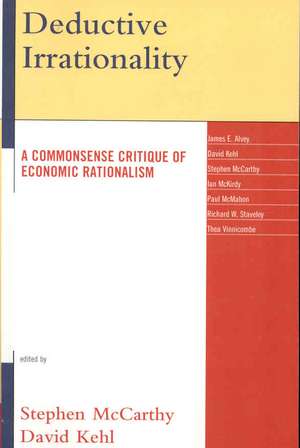
Deductive Irrationality: A Commonsense Critique of Economic Rationalism
Editat de Stephen McCarthy, David Kehl Contribuţii de James E. Alvey, Ian McKirdy, Paul McMahon, Richard W. Staveley, Thea Vinnicombeen Limba Engleză Paperback – 29 apr 2008
Preț: 338.57 lei
Preț vechi: 436.82 lei
-22%
Puncte Express: 508
Carte tipărită la comandă
Livrare economică 30 noiembrie-14 decembrie
Livrare prin curier în România Termenul estimat este afișat lângă disponibilitate.
Transport gratuit de la 400.00 lei Plată online sau ramburs, în funcție de opțiunile comenzii.
Retur gratuit în 14 zile Comandă securizată și suport în română.
Specificații
ISBN-13: 9780739116258
ISBN-10: 0739116258
Pagini: 284
Dimensiuni: 153 x 231 x 21 mm
Greutate: 0.44 kg
Editura: Bloomsbury Publishing
Colecția Lexington Books
Locul publicării:New York, United States
ISBN-10: 0739116258
Pagini: 284
Dimensiuni: 153 x 231 x 21 mm
Greutate: 0.44 kg
Editura: Bloomsbury Publishing
Colecția Lexington Books
Locul publicării:New York, United States
Cuprins
Chapter 1 Table of Contents
Chapter 2 1 Introduction
Chapter 3 2 John Locke, Thomas Hobbes, and the Development of Political Economy
Chapter 4 3 Adam Smith and the Invention of Economic Science
Chapter 5 4 Ethical and Methodological Foundations of Marshall's Economics
Chapter 6 5 Keynes's Return to Reality: The General Theory of Employment
Chapter 7 6 Rational Expectations Economics as the New Classical Economics
Chapter 8 7 Friedrich A. Hayek's Economic Theory of Law
Chapter 9 8 The Theory of Economic Development as Presented by Gunnar Myrdal
Chapter 10 Notes
Chapter 11 Appendix
Chapter 12 Bibliography
Chapter 13 Index
Chapter 2 1 Introduction
Chapter 3 2 John Locke, Thomas Hobbes, and the Development of Political Economy
Chapter 4 3 Adam Smith and the Invention of Economic Science
Chapter 5 4 Ethical and Methodological Foundations of Marshall's Economics
Chapter 6 5 Keynes's Return to Reality: The General Theory of Employment
Chapter 7 6 Rational Expectations Economics as the New Classical Economics
Chapter 8 7 Friedrich A. Hayek's Economic Theory of Law
Chapter 9 8 The Theory of Economic Development as Presented by Gunnar Myrdal
Chapter 10 Notes
Chapter 11 Appendix
Chapter 12 Bibliography
Chapter 13 Index
Recenzii
In their study of economics as rooted in the scientific rationalism of early modern political philosophy, Richard Staveley and his students offer a profound critique of economics as a purely abstract or mathematical science that is detached from reality as we know it by commonsense experience. Anyone who wants to understand the dubious philosophical assumptions of economics-and of the other social sciences as influenced by economics-must read this book.
This timely, original, and thought-provoking collection of essays, taken as a whole, constitutes a fundamental critique of the theory and the practice of economics. It argues that the much admired theoretical and quantitative sophistication of modern economics is a dangerous illusion that gives rise to bad and potentially disastrous policy prescriptions. The essays attempt to lay bare the source of this illusion-a longstanding and mistaken view of the scientific method-and to show how it has influenced economists since Adam Smith.
Ideal for students of public policy, this book peels back the protective covering of modern political economy, revealing the inner logic of economic rationality: a logic of economism with its own set of arbitrary and unsustainable policy preferences. Modern political economy has rarely received such an anatomy of abstraction, delivered through concrete case studies of public policy frameworks devised by the great liberal theorists of economic rationality: the Lockean liberals judged against standards of pre-liberal commonsense found in Aristotle's political science. What would Aristotle think of modern political economy? You have the answer here in your own hands, and it is not all negative.
This timely, original, and thought-provoking collection of essays, taken as a whole, constitutes a fundamental critique of the theory and the practice of economics. It argues that the much admired theoretical and quantitative sophistication of modern economics is a dangerous illusion that gives rise to bad and potentially disastrous policy prescriptions. The essays attempt to lay bare the source of this illusion-a longstanding and mistaken view of the scientific method-and to show how it has influenced economists since Adam Smith.
Ideal for students of public policy, this book peels back the protective covering of modern political economy, revealing the inner logic of economic rationality: a logic of economism with its own set of arbitrary and unsustainable policy preferences. Modern political economy has rarely received such an anatomy of abstraction, delivered through concrete case studies of public policy frameworks devised by the great liberal theorists of economic rationality: the Lockean liberals judged against standards of pre-liberal commonsense found in Aristotle's political science. What would Aristotle think of modern political economy? You have the answer here in your own hands, and it is not all negative.