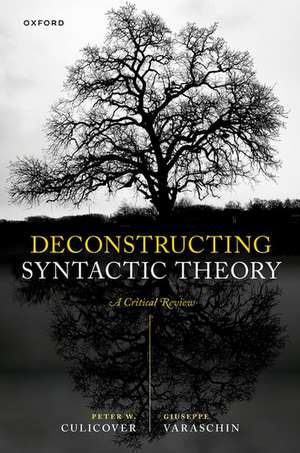
Deconstructing Syntactic Theory: A Critical Review
Autor Peter W. Culicover, Giuseppe Varaschinen Limba Engleză Hardback – 12 iun 2025
Structura lucrării Deconstructing Syntactic Theory este riguros organizată în patru secțiuni ce urmăresc demontarea metodologică a ipotezelor fundamentale din sintaxa derivațională contemporană. Ne-a atras atenția modul în care Peter W. Culicover și Giuseppe Varaschin pornesc de la relația dintre structură, ordine liniară și sens, pentru a chestiona validitatea mișcărilor sintactice și a structurilor invizibile. Autorii utilizează termenul de „cryptoconstructionalism” pentru a descrie modul în care teoriile actuale introduc stipulații specifice pentru a justifica forma expresiilor, argumentând în Partea a II-a că aceste dispozitive tehnice sunt adesea soluții ad-hoc pentru probleme empirice create chiar de modelul teoretic ales. Observăm o critică tăioasă în Partea a III-a și a IV-a, unde se demonstrează că structura ierarhică excesivă este nu doar inutilă, ci și inadecvată pentru modelarea fenomenelor semantice și morfologice. Această lucrare completează perspectiva oferită de Understanding Minimalism, adăugând o dimensiune critică radicală acolo unde textul lui Hornstein se concentrează pe introducerea tehnică a programului minimalist. În contextul operei sale, volumul de față rafinează temele din Syntactic Nuts și Principles and Parameters, evoluând de la prezentarea sistemelor de reguli către o pledoarie pentru o teorie mult mai suplă a reprezentărilor lingvistice. Suntem de părere că această ediție publicată de OUP OXFORD reprezintă punctul culminant al tranziției autorului către modelul „Simpler Syntax”, oferind o alternativă logică la complexitatea abstractă a curentului principal din lingvistica generativă.
Preț: 770.67 lei
Preț vechi: 1141.21 lei
-32%
Carte disponibilă
Livrare economică 06-11 noiembrie
Specificații
ISBN-10: 019894778X
Pagini: 400
Dimensiuni: 165 x 240 x 28 mm
Greutate: 0.74 kg
Editura: OUP OXFORD
Colecția OUP Oxford
Locul publicării:Oxford, United Kingdom
V-ar putea interesa
-
 The Oxford Handbook of Morphological TheoryJenny Audring-28%Preț: 370.82 lei513.24 lei
 -
 The Oxford Handbook of GrammaticalizationHeiko Narrog-23%Preț: 375.56 lei489.23 lei
 -
 -16%Preț: 197.09 lei234.49 lei
 -
 Cartography and Explanatory AdequacyÁngel J. Gallego-32%Preț: 631.63 lei928.79 lei
 -
 Parameter Hierarchies and Universal GrammarIan Roberts-17%Preț: 379.29 lei455.64 lei
 -
 Heritage Languages and Syntactic TheoryRoberta D'Alessandro-31%Preț: 678.70 lei988.08 lei
 -
 Nanosyntax and the Lexicalization AlgorithmPavel Caha-33%Preț: 774.21 lei1147.66 lei
 -
 Parenthetical Constructions in the Parallel ArchitectureRay Jackendoff-32%Preț: 545.79 lei807.43 lei
 -
 Core Syntax: A Minimalist ApproachDavid Adger-11%Preț: 266.91 lei300.74 lei
 -
 Mathematical Structure of Syntactic MergeMatilde Marcolli-14%Preț: 411.52 lei478.51 lei
 -
 Notes on the Synthesis of FormChristopher AlexanderPreț: 235.55 lei
 -
 The Cambridge Handbook of Comparative SyntaxSjef Barbiers-23%Preț: 1380.74 lei1793.17 lei
 -
 Chinese Grammar Q&AZhu Dexi-15%Preț: 431.47 lei507.61 lei
 -
 Understanding Sentence StructureChristina TortoraPreț: 382.28 lei
 -
 English Syntax and ArgumentationBas Aarts-18%Preț: 212.63 lei260.78 lei
 -
 -23%Preț: 198.18 lei255.95 lei
 -
 Exploring Cognitive Grammar in EnglishDr Zeki Hamawand-32%Preț: 601.26 lei881.76 lei
 -
 The Bloomsbury Companion to SyntaxSilvia Luraghi-19%Preț: 287.21 lei354.50 lei
 -
 The Truth About English GrammarGeoffrey K. PullumPreț: 141.81 lei
 -
 Philosophical Perspectives on LanguageRobert J. Stainton-25%Preț: 330.50 lei440.17 lei
De ce să citești această carte
Recomandăm această carte cercetătorilor și studenților avansați în lingvistică care doresc să înțeleagă limitările Programului Minimalist. Cititorul câștigă o perspectivă critică asupra mecanismelor interne ale sintaxei moderne și argumente solide pentru o abordare mai simplă a arhitecturii limbajului. Este o lectură esențială pentru a distinge între necesitatea empirică și stipulația teoretică în gramatica universală.
Despre autor
Peter W. Culicover este profesor de lingvistică și fost director al Centrului de Științe Cognitive de la Ohio State University. Cu o carieră de peste patru decenii, Culicover a explorat achiziția limbajului și bazele cognitive ale teoriei lingvistice. Lucrările sale anterioare, precum Dynamical Grammar și Syntactic Nuts, reflectă preocuparea constantă pentru arhitectura facultății limbajului. Alături de Giuseppe Varaschin, el continuă să rafineze modelul sintaxei simplificate, contestând paradigmele dominante prin analize care prioritizează eficiența computațională și adecvarea empirică în studiul limbii engleze și nu numai.
Descriere
Notă biografică
Cuprins
- Preface
- Acknowledgments
- 1: Overview
- Part I Order and Structure
- 2: Licensing order
- 3: Cryptoconstructionalism
- Part II Problems
- 4: Problems of movement
- 5: Problems of invisibility
- Part III Justifying Syntactic Structure
- 6: The case for flat structure
- 7: The explanatory role of syntactic structure
- Part IV Syntactocentrism
- 8: Syntactocentrism: Semantics
- 9: Syntactocentrism: Morphology
- Part V Minimalism
- 10: Whose minimalism?
- References
- Index