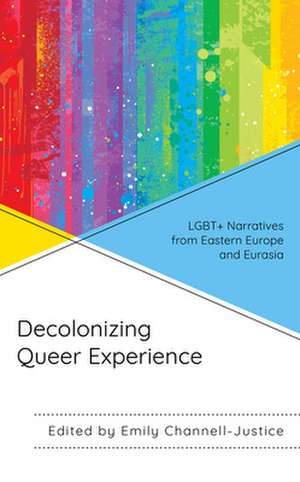
Decolonizing Queer Experience: LGBT+ Narratives from Eastern Europe and Eurasia
Editat de Emily Channell-Justice Contribuţii de Feruza Aripova, Vitaly Chernetsky, Tjasa Kancler, Polina Kislitsyna, Roman Leksikov, Janis Ozolins, Zhanar Sekerbayeva, Tamar Shirinian, Syinat Sultanalieva, Karlis Verdinsen Limba Engleză Hardback – 24 noi 2020
Preț: 555.30 lei
Preț vechi: 837.07 lei
-34%
Puncte Express: 833
Carte tipărită la comandă
Livrare economică 18 noiembrie-02 decembrie
Livrare prin curier în România Termenul estimat este afișat lângă disponibilitate.
Transport gratuit pentru acest produs Plată online sau ramburs, în funcție de opțiunile comenzii.
Retur gratuit în 14 zile Comandă securizată și suport în română.
Specificații
ISBN-13: 9781793630308
ISBN-10: 1793630305
Pagini: 232
Ilustrații: 8 b/w illustrations; 1 tables;
Dimensiuni: 161 x 229 x 23 mm
Greutate: 0.49 kg
Editura: Bloomsbury Publishing
Colecția Lexington Books
Locul publicării:New York, United States
ISBN-10: 1793630305
Pagini: 232
Ilustrații: 8 b/w illustrations; 1 tables;
Dimensiuni: 161 x 229 x 23 mm
Greutate: 0.49 kg
Editura: Bloomsbury Publishing
Colecția Lexington Books
Locul publicării:New York, United States
Cuprins
Preface: Vitaly Chernetsky
Introduction: Of Constatives, Performatives, and Disidentifications: Decolonizing Queer Critique in Post-socialist Times (5606)
Tamar Shirinian and Emily Channell-Justice
Section 1: The Categories Themselves
Chapter 1: Body Politics, Trans*Imaginary, and Decoloniality (6859)
Tjasa Kancler
Chapter 2: Queering Categories: Recognition, Misrecognition, and Identity Politics in Armenia (7753)
Tamar Shirinian
Chapter 3: Escaping the Dichotomies of 'Good' and 'Bad': Chronotopes of Queerness in Kyrgyzstan (6815)
Syinat Sultanaieva
Section 2: Queer in Public
Chapter 4: LGBT+ Rights, European Values, and Radical Critique: Leftist Challenges to LGBT+ Mainstreaming in Ukraine (7922)
Emily Channell-Justice
Chapter 5: Queering the Soviet Pribaltika: Criminal Cases of Consensual Sodomy in Soviet Latvia (1960s-1980s) (7796)
Feruza Aripova
Chapter 6: Queer People and the Criminal Justice System in Ukraine: Negotiating Relationships, Historical Trauma and Contemporary Western Disc
Introduction: Of Constatives, Performatives, and Disidentifications: Decolonizing Queer Critique in Post-socialist Times (5606)
Tamar Shirinian and Emily Channell-Justice
Section 1: The Categories Themselves
Chapter 1: Body Politics, Trans*Imaginary, and Decoloniality (6859)
Tjasa Kancler
Chapter 2: Queering Categories: Recognition, Misrecognition, and Identity Politics in Armenia (7753)
Tamar Shirinian
Chapter 3: Escaping the Dichotomies of 'Good' and 'Bad': Chronotopes of Queerness in Kyrgyzstan (6815)
Syinat Sultanaieva
Section 2: Queer in Public
Chapter 4: LGBT+ Rights, European Values, and Radical Critique: Leftist Challenges to LGBT+ Mainstreaming in Ukraine (7922)
Emily Channell-Justice
Chapter 5: Queering the Soviet Pribaltika: Criminal Cases of Consensual Sodomy in Soviet Latvia (1960s-1980s) (7796)
Feruza Aripova
Chapter 6: Queer People and the Criminal Justice System in Ukraine: Negotiating Relationships, Historical Trauma and Contemporary Western Disc
Recenzii
This edited volume adds to the existing literature on LGBT+ issues in Eastern Europe and Eurasia, and does so within the particular theoretical framing of decolonization. Previous scholarship has placed much emphasis on global movements and "normative" identities without examining the ways these are specifically iterated within local contexts. The inclusion of Central Asia and the Caucasus is particularly welcome given the history of those regions vis-à-vis the Russian Empire and Soviet Union more broadly, within the context of colonization. While this book's nine essays are all grounded in particular field sites and historical events, they move beyond mere description to explore the ways that experience, performance, and identity intersect.... [Readers] with the necessary regional and theoretical background will find much to appreciate. Recommended.
The ethnographic and historical essays in this collection beautifully combine queer and decolonial theory to unearth and unpack a variety of forms of queerness in Eastern Europe and Eurasia. From "bad girl" lesbian activists in Kyrgyzstan to "consensual sodomy' in Soviet Latvia back to gender transgression in Kazakh folklore then forward to the contemporary queer pairing of religion and LGBTQ persons in Russia, these essays deepen our understanding of queer lives in a part of the world that is too often constructed as uniformly straight and homo and transphobic. In fact, queers have always managed to live and even thrive in Eastern Europe and Eurasia and will continue to do so. These essays make that clear even as they deepen our understanding of how queer manifests differently in rural versus urban, Soviet or Post-Soviet regimes, and, of course, East vs. West.
By combining a focus on Eastern Europe and Eurasia with an attention to experience, performance, and narrative, this groundbreaking book contributes to our understandings of queer selfhood, community, and belonging. These perspectives broaden our theoretical frameworks and demonstrate the importance of this crucial region that links Europe and Asia. This book is a true achievement that will be valuable across a range of scholarly debates.
The ethnographic and historical essays in this collection beautifully combine queer and decolonial theory to unearth and unpack a variety of forms of queerness in Eastern Europe and Eurasia. From "bad girl" lesbian activists in Kyrgyzstan to "consensual sodomy' in Soviet Latvia back to gender transgression in Kazakh folklore then forward to the contemporary queer pairing of religion and LGBTQ persons in Russia, these essays deepen our understanding of queer lives in a part of the world that is too often constructed as uniformly straight and homo and transphobic. In fact, queers have always managed to live and even thrive in Eastern Europe and Eurasia and will continue to do so. These essays make that clear even as they deepen our understanding of how queer manifests differently in rural versus urban, Soviet or Post-Soviet regimes, and, of course, East vs. West.
By combining a focus on Eastern Europe and Eurasia with an attention to experience, performance, and narrative, this groundbreaking book contributes to our understandings of queer selfhood, community, and belonging. These perspectives broaden our theoretical frameworks and demonstrate the importance of this crucial region that links Europe and Asia. This book is a true achievement that will be valuable across a range of scholarly debates.