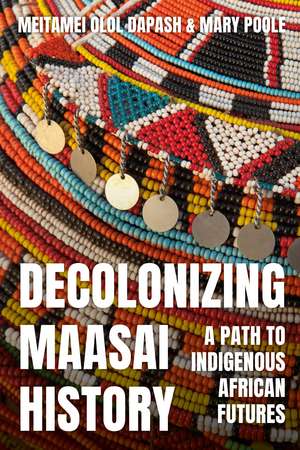
Decolonizing Maasai History: A Path to Indigenous African Futures
Autor Meitamei Olol Olol Dapash, Mary Pooleen Limba Engleză Paperback – 23 ian 2025
Theebook editions of this book are available open access under a CC BY-NC-ND 4.0 licence on bloomsburycollections.com. Open access was funded by the Bloomsbury Open Collections Library Collective.
Preț: 140.28 lei
Preț vechi: 169.04 lei
-17%
Puncte Express: 210
Carte disponibilă
Livrare economică 16-30 mai
Specificații
ISBN-13: 9781350427433
ISBN-10: 1350427438
Pagini: 240
Dimensiuni: 156 x 232 x 14 mm
Greutate: 0.42 kg
Editura: Bloomsbury Publishing
Colecția Zed Books
Locul publicării:London, United Kingdom
ISBN-10: 1350427438
Pagini: 240
Dimensiuni: 156 x 232 x 14 mm
Greutate: 0.42 kg
Editura: Bloomsbury Publishing
Colecția Zed Books
Locul publicării:London, United Kingdom
Cuprins
Introduction
Chapter 1: Maasai History and the Strategies of Neocolonialism
Chapter 2: Kenyamal Enkop: The History of Maasailand Occupation
Chapter 3: Melo Enkop: The Story of Mau Narok
Chapter 4: Amboseli: The Past and Future of Conservation in Maasailand
Chapter 5: Olosho Le Maa and the Long Century of Anti-Colonial Resistance
Conclusion: Entisere (the Future)
Bibliography
Index
Chapter 1: Maasai History and the Strategies of Neocolonialism
Chapter 2: Kenyamal Enkop: The History of Maasailand Occupation
Chapter 3: Melo Enkop: The Story of Mau Narok
Chapter 4: Amboseli: The Past and Future of Conservation in Maasailand
Chapter 5: Olosho Le Maa and the Long Century of Anti-Colonial Resistance
Conclusion: Entisere (the Future)
Bibliography
Index
Recenzii
In this outstanding book, the story of the Maasai is told from the perspective of the social insider. The fascinating book provides newer narratives that reflect the Maasai history from within its people. The book holds the ace as a major addition to the wider literature on decolonization. Here is the evidence that Maasai history now has pride of place in African Decolonial Studies.
Packed with storytelling deeply informed by ancestral knowledge, revelatory and incisive archival work, and detailed, groundbreaking analysis, Meitamei Olol Dapash and Mary Poole not only decolonize and reconstruct the framing of Maasai history, but in doing so offer the wisdom and insight necessary to move forward into new futures. Finishing this book felt like my first transformational trip to Maasailand. When I left I felt like I had embodied a new worldview, not only related to Kenya, Tanzania, and the African continent, but also one that helped me understand a planet so embroiled in crises and so in need of direction. Decolonizing Maasai History shows that another world not only is possible, but necessary.
Through their close collaboration with elders and activists of the Maa Nation, Meitamei Olol Dapash and Mary Poole have produced thrilling reconceptualization of Maasai history, of Kenyan history, and of the discipline of history itself. Olol Dapash and Poole provide an alternative to older scholarly approaches that "mine" communities of their knowledge and history for the benefit of the "miners." Their scholarship demonstrates how centering Indigenous perspectives can transform accepted histories while generating crucial historical and political insights.
The richness and depth of thoughts presented in this book offer a significant contribution to the discourse on Indigenous education and its evolving role in modern contexts. Through rigorous scholarship, Joel M. Olol Dapash and Mary Poole provide an insightful and reflective examination of the Maasai educational landscape, highlighting the tension between colonization and self-determination. This book goes beyond the confines of an academic investigation; it offers compelling evidence of the Maasai's strength, self-portrayal, and quest for cultural independence in an increasingly globalized society. It presents a future-oriented perspective on how education and activism can influence a sustainable future, making it a crucial and timely contribution to Indigenous studies and educational research. The book's clarity of thought, analytical rigor, and cultural sensitivity are vital for academic scholarship and the wider Indigenous community. I firmly believe that this book will encourage more exploration and pave the way for ongoing investigation into the transformative power of education and Indigenous empowerment. I highly recommend this book to readers who are dedicated to comprehending the connections between education, land rights, and decolonization with great enthusiasm and respect.
Packed with storytelling deeply informed by ancestral knowledge, revelatory and incisive archival work, and detailed, groundbreaking analysis, Meitamei Olol Dapash and Mary Poole not only decolonize and reconstruct the framing of Maasai history, but in doing so offer the wisdom and insight necessary to move forward into new futures. Finishing this book felt like my first transformational trip to Maasailand. When I left I felt like I had embodied a new worldview, not only related to Kenya, Tanzania, and the African continent, but also one that helped me understand a planet so embroiled in crises and so in need of direction. Decolonizing Maasai History shows that another world not only is possible, but necessary.
Through their close collaboration with elders and activists of the Maa Nation, Meitamei Olol Dapash and Mary Poole have produced thrilling reconceptualization of Maasai history, of Kenyan history, and of the discipline of history itself. Olol Dapash and Poole provide an alternative to older scholarly approaches that "mine" communities of their knowledge and history for the benefit of the "miners." Their scholarship demonstrates how centering Indigenous perspectives can transform accepted histories while generating crucial historical and political insights.
The richness and depth of thoughts presented in this book offer a significant contribution to the discourse on Indigenous education and its evolving role in modern contexts. Through rigorous scholarship, Joel M. Olol Dapash and Mary Poole provide an insightful and reflective examination of the Maasai educational landscape, highlighting the tension between colonization and self-determination. This book goes beyond the confines of an academic investigation; it offers compelling evidence of the Maasai's strength, self-portrayal, and quest for cultural independence in an increasingly globalized society. It presents a future-oriented perspective on how education and activism can influence a sustainable future, making it a crucial and timely contribution to Indigenous studies and educational research. The book's clarity of thought, analytical rigor, and cultural sensitivity are vital for academic scholarship and the wider Indigenous community. I firmly believe that this book will encourage more exploration and pave the way for ongoing investigation into the transformative power of education and Indigenous empowerment. I highly recommend this book to readers who are dedicated to comprehending the connections between education, land rights, and decolonization with great enthusiasm and respect.