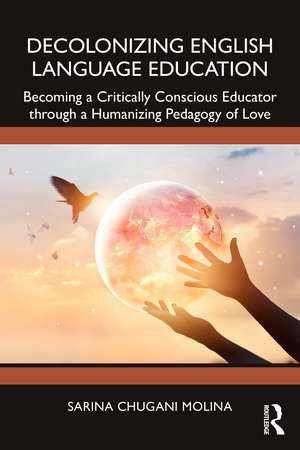
Decolonizing English Language Education: Becoming a Critically Conscious Educator through a Humanizing Pedagogy of Love
Autor Sarina Chugani Molinaen Limba Engleză Paperback – 4 sep 2026
Spanning histories of empire to present-day policies and practices, this book traces how English has been commonly associated with power, opportunity, and mobility while also perpetuating inequality and marginalization. Molina guides teachers through a reflective and methodical journey: first, understanding how colonial legacies shape language education; then, moving toward decolonizing one’s own consciousness; and, ultimately, adopting practical strategies for a transformative pedagogy rooted in critical, decolonial love. Drawing on the author’s own experience and insights from Indigenous knowledge systems and critical traditions, this book emphasizes the importance of love, spirituality, and relationality in language teacher education. Case studies and hands-on examples highlight how teachers can use translingual, multimodal, and culturally sustaining practices to affirm learners’ diverse identities and gifts. This book effectively re-imagines language teaching not just as skills-based instruction but as a moral and transformative endeavor.
By incorporating decolonial practice and reflection into research, this book is ideal for policymakers, scholars, and teachers alike. It is a valuable resource for applied linguistics, language acquisition, second language acquisition theory and methodology, and practical courses offering work placements.
Preț: 386.86 lei
Nou
Puncte Express: 580
Carte disponibilă
Livrare economică 13-27 noiembrie
Livrare express 30 octombrie-05 noiembrie pentru 31.58 lei
Livrare prin curier în România Termenul estimat este afișat lângă disponibilitate.
Transport gratuit de la 400.00 lei Plată online sau ramburs, în funcție de opțiunile comenzii.
Retur gratuit în 14 zile Comandă securizată și suport în română.
Specificații
ISBN-13: 9781032909035
ISBN-10: 103290903X
Pagini: 258
Ilustrații: 36
Dimensiuni: 156 x 234 mm
Greutate: 0.37 kg
Ediția:1
Editura: Taylor & Francis
Colecția Routledge
Locul publicării:Oxford, United Kingdom
ISBN-10: 103290903X
Pagini: 258
Ilustrații: 36
Dimensiuni: 156 x 234 mm
Greutate: 0.37 kg
Ediția:1
Editura: Taylor & Francis
Colecția Routledge
Locul publicării:Oxford, United Kingdom
Public țintă
PostgraduateCuprins
Introduction Part I. Understanding Coloniality, Raciolinguistics, and Power in the Field of English Language Education Chapter 1. Understanding Coloniality in the Field of English Language Education Chapter 2. Tracing Language Learning Theories: from Behaviorism to Raciolinguistic Theory Chapter 3. Messaging of Power in the Field of English Language Education Part II. Decolonizing Consciousness and Examining Policies, Pedagogies, and Practices Chapter 4. The Inner Work of Decolonizing Consciousness and the Journey Toward Onto-Epistemological Integration Chapter 5. Examining Our Own Policies, Pedagogies, and Practices Through Critical, Decolonial Inquiry Part III. Reimagining English Language Education Through Critical and Humanizing Pedagogies Chapter 6. Critical, Decolonial Love as Healing, Resistance, and Relational Praxis in English Language Education Chapter 7. Critical, Decolonial Love in English Language Education: from Theory to Praxis Chapter 8. Imagining, Dreaming, Decolonial Possibilities in Teaching English to Speakers of Other Languages
Notă biografică
Sarina Chugani Molina is Professor at the University of San Diego. Her research foregrounds decolonial pedagogy, teacher identity, and justice-oriented work. She has published several books with Routledge, such as Family, School, Community Engagement and Partnerships (2015) and English Language Education and Social Inequality (2023), as well as articles and book chapters on leadership, mindfulness, and TESOL teacher development.
Descriere
Decolonising English Language Education offers a grounded introduction to decolonial practices in language learning. It invites readers to problematise and rethink English language education by uncovering its deep ties to colonial history and imagining new, more humanizing possibilities for the contemporary classroom.