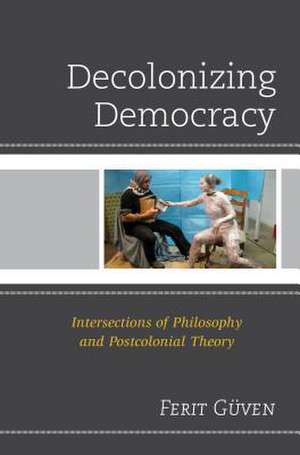
Decolonizing Democracy
Autor Ferit Güvenen Limba Engleză Hardback – 6 mai 2015
| Toate formatele și edițiile | Preț | Express |
|---|---|---|
| Paperback (1) | 247.91 lei 6-8 săpt. | |
| Bloomsbury Publishing – 23 mai 2019 | 247.91 lei 6-8 săpt. | |
| Hardback (1) | 597.83 lei 6-8 săpt. | |
| Bloomsbury Publishing – 6 mai 2015 | 597.83 lei 6-8 săpt. |
Preț: 597.83 lei
Preț vechi: 703.33 lei
-15%
Puncte Express: 897
Preț estimativ în valută:
105.82€ • 123.46$ • 91.63£
105.82€ • 123.46$ • 91.63£
Carte tipărită la comandă
Livrare economică 26 februarie-12 martie
Preluare comenzi: 021 569.72.76
Specificații
ISBN-13: 9780739199572
ISBN-10: 0739199579
Pagini: 144
Dimensiuni: 157 x 235 x 13 mm
Greutate: 0.37 kg
Editura: Bloomsbury Publishing
ISBN-10: 0739199579
Pagini: 144
Dimensiuni: 157 x 235 x 13 mm
Greutate: 0.37 kg
Editura: Bloomsbury Publishing
V-ar putea interesa
-
 Listening to Grasshoppers: Field Notes on DemocracyArundhati Roy-21%Preț: 59.55 lei75.19 lei
 -
 -18%Preț: 341.65 lei417.70 lei
 -
 Equality and LegitimacyWojciech Sadurski-14%Preț: 468.38 lei546.29 lei
 -
 -10%Preț: 364.39 lei404.06 lei
 -
 The Representative ClaimMichael Saward-14%Preț: 718.63 lei835.61 lei
 -
 Designing Democracy in a Dangerous WorldAndrew Reynolds-10%Preț: 323.09 lei359.88 lei
 -
 Changes for Democracy: Actors, Structures, ProcessesLeonardo Morlino-9%Preț: 305.57 lei337.23 lei
 -
 No One's World: The West, the Rising Rest, and the Coming Global TurnCharles A. Kupchan-12%Preț: 133.19 lei151.35 lei
 -
 Theories of the Democratic StateJohn Dryzek-18%Preț: 318.63 lei389.08 lei
 -
 The Future of FreedomFareed ZakariaPreț: 110.10 lei
 -
 Democratic GovernanceMark BevirPreț: 394.46 lei
 -
 Preț: 499.43 lei
 -
 Preț: 224.81 lei
 -
 Preț: 246.25 lei
 -
 The Uncivil WarDavid LebedoffPreț: 188.58 lei
 -
 Turning Points in African DemocracyAbdul Raufu MustaphaPreț: 216.77 lei
Cuprins
Chapter 1: The Genealogy of Democracy: From Plato to Schmitt Chapter 2: Foucault, Bio-disciplinary power and ¿Cogitological Power¿ Chapter 3: Democracy and Specters of Post/Neo Colonialism Chapter 4: Hunger Strikers, Suicide Bombers & All the other Evil Terrorists Chapter 5: Derrida and Democracy-to-come
Descriere
This book analyzes the concept of democracy and its practical application in the twenty-first century from a philosophical and postcolonial perspective.
Recenzii
Discussions of democracy and postcolonialism do not easily come together; this book manages to do so in a uniquely successful way. The extent to which Hegelian ideas still determine our concept of democracy is astounding and brought out here very clearly. For me, the highlight of the book is the final chapter with its elucidating discussion of Kantian ideas in the regulative sense and the proof that Derrida, against his own intentions, relies on teleology in his concept of democracy.