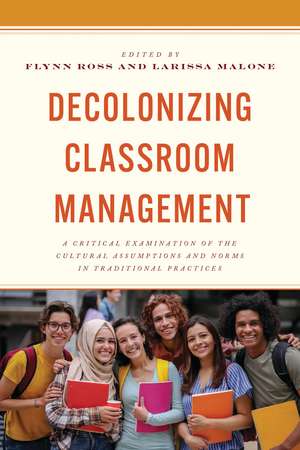
Decolonizing Classroom Management: A Critical Examination of the Cultural Assumptions and Norms in Traditional Practices
Editat de Flynn Ross, Larissa Maloneen Limba Engleză Paperback – 26 oct 2024
Preț: 178.24 lei
Preț vechi: 238.34 lei
-25%
Puncte Express: 267
Carte tipărită la comandă
Livrare economică 09-23 noiembrie
Livrare prin curier în România Termenul estimat este afișat lângă disponibilitate.
Transport gratuit de la 400.00 lei Plată online sau ramburs, în funcție de opțiunile comenzii.
Retur gratuit în 14 zile Comandă securizată și suport în română.
Specificații
ISBN-13: 9781475873603
ISBN-10: 1475873603
Pagini: 192
Ilustrații: 3 BW Illustrations, 3 Tables
Dimensiuni: 148 x 226 x 14 mm
Greutate: 0.29 kg
Editura: Bloomsbury Publishing
Colecția Rowman & Littlefield
Locul publicării:New York, United States
ISBN-10: 1475873603
Pagini: 192
Ilustrații: 3 BW Illustrations, 3 Tables
Dimensiuni: 148 x 226 x 14 mm
Greutate: 0.29 kg
Editura: Bloomsbury Publishing
Colecția Rowman & Littlefield
Locul publicării:New York, United States
Cuprins
Forward
Marie Battiste
Introduction
Flynn Ross and Larissa Malone
1 Theoretical Framework for Decolonizing Classroom Management
Flynn Ross
2 Colonialism, Assimilation, and Dominant Discourse: A Brief History of Classroom Management
Adam Schmitt
SECTION 1: Assumptive Language - Decolonizing Our Thinking
3 Problematizing Best Practices and Educational Research by Ronald Philip Cunningham
4 Under the Hood of a Well-Oiled Machine: Revealing Racism and Ableism within Classroom Management Practices Through Disability Critical Race Theory (DisCrit)
April Coloma Boyce and Maggie R. Beneke
5 Building Belonging in Classroom Learning Communities
Erika McDowell
6 Decolonizing Classroom Relationships
Dina Strasser
7 Centering Humanity, Love, and Connection in Classroom Management
Erica Holyoke
SECTION 2: Challenging Established Classroom Management Models
8 From Interest Convergence in PBIS to Co-Generative Praxis
Matthew Green and Jade Calais
9 Reimagining Classroom Management: A Humanizing Social and Emotional Framework
Brandie Oliver, Brooke Harris Garad, Brian Dinkins, Danielle Madrazo, and Katie Brooks
10 Decolonizing Mindfulness: Centering Liberation and Connection
Patricia Benitez Hemans
11 Challenging the Narrative: How Unexamined Behaviorist Beliefs Can Sabotage Trauma Informed Practices
Jennifer Randhare Ashton, Jessica Sniatecki, and Maria Timberlake
12 Shaking Restorative Justice Free from Retributive Justice
Flynn Ross
SECTION 3: Directions to Consider
13 Fostering Social and Emotional Bonds Through Indigenous Storytelling
Jose Ortiz
14 Dreaming Communities of Care: Radical World-Building with Abolitionist Organizers Toward Students' Heartwholeness
Riley Drake
15 Creating Harmonious Classroom Communities by Embracing Community Cultural Wealth and Connection Building
Violet Jiménez Sims and Dana Trunquest
16 A Collaborative Approach of Ubuntu: Dismantling Colonial Classroom Management Practices in South African Schools through the Spirit of Ubuntu
Amy Sarah Padaychee and Samatha Kriger
Epilogue: Decolonial Theory to Practice, Toward Shared Anti-Colonial Futures
Rebecca Sockbeson, Fiona Hopper, Bridgid Neptune, and Starr Kelly
Contributors
About the Editors
Marie Battiste
Introduction
Flynn Ross and Larissa Malone
1 Theoretical Framework for Decolonizing Classroom Management
Flynn Ross
2 Colonialism, Assimilation, and Dominant Discourse: A Brief History of Classroom Management
Adam Schmitt
SECTION 1: Assumptive Language - Decolonizing Our Thinking
3 Problematizing Best Practices and Educational Research by Ronald Philip Cunningham
4 Under the Hood of a Well-Oiled Machine: Revealing Racism and Ableism within Classroom Management Practices Through Disability Critical Race Theory (DisCrit)
April Coloma Boyce and Maggie R. Beneke
5 Building Belonging in Classroom Learning Communities
Erika McDowell
6 Decolonizing Classroom Relationships
Dina Strasser
7 Centering Humanity, Love, and Connection in Classroom Management
Erica Holyoke
SECTION 2: Challenging Established Classroom Management Models
8 From Interest Convergence in PBIS to Co-Generative Praxis
Matthew Green and Jade Calais
9 Reimagining Classroom Management: A Humanizing Social and Emotional Framework
Brandie Oliver, Brooke Harris Garad, Brian Dinkins, Danielle Madrazo, and Katie Brooks
10 Decolonizing Mindfulness: Centering Liberation and Connection
Patricia Benitez Hemans
11 Challenging the Narrative: How Unexamined Behaviorist Beliefs Can Sabotage Trauma Informed Practices
Jennifer Randhare Ashton, Jessica Sniatecki, and Maria Timberlake
12 Shaking Restorative Justice Free from Retributive Justice
Flynn Ross
SECTION 3: Directions to Consider
13 Fostering Social and Emotional Bonds Through Indigenous Storytelling
Jose Ortiz
14 Dreaming Communities of Care: Radical World-Building with Abolitionist Organizers Toward Students' Heartwholeness
Riley Drake
15 Creating Harmonious Classroom Communities by Embracing Community Cultural Wealth and Connection Building
Violet Jiménez Sims and Dana Trunquest
16 A Collaborative Approach of Ubuntu: Dismantling Colonial Classroom Management Practices in South African Schools through the Spirit of Ubuntu
Amy Sarah Padaychee and Samatha Kriger
Epilogue: Decolonial Theory to Practice, Toward Shared Anti-Colonial Futures
Rebecca Sockbeson, Fiona Hopper, Bridgid Neptune, and Starr Kelly
Contributors
About the Editors
Recenzii
Decolonizing Classroom Management gives teachers tools to take on one of the most difficult challenges in teaching: classroom management. In this collection of highly readable essays, authors deconstruct prevailing systems that are rooted in whiteness and control. Using stories from their own practice, authors show what decolonized classroom management looks and feels like to both students and teachers.
Decolonizing Classroom Management amplifies the important message that the time has come to take a deep dive into examining existing classroom practices. Each of the essays in this roadmap for classroom reform stand alone, providing compelling arguments for change. Taken together, they create a powerful argument for curricular reform at all levels to ensure all students see themselves reflected in their studies, and provide educators with a culturally responsive framework for their work.
As an educator who supports and advocates for diversity, equity, and inclusion (DEI) and Culturally Responsive Classroom Management (CRCM), I expected to feel at home with the contents of Decolonizing Classroom Management. I was wrong. In this bold, yet warm-spirited book, editors Flynn Ross and Larissa Malone and an extremely diverse group of contributors push the envelope of DEI and CRCM and call for decolonization--dismantling the white, middle-class, Eurocentric worldviews and power structures of today's classrooms. I never thought of myself as a "white settler," but the authors have pushed me to consider a colonialist framework without hurling names or attacking. They encourage educators to integrate Western codes of conduct with Indigenous ways of being and to reflect on the cultural assumptions underlying many popular classroom management practices. Decolonizing Classroom Management has provided me with a new lens through which to view the power dynamics of classrooms and the obvious inequities that can result.
This thoughtful volume essentially decolonizes modern-day (de)colonialism, peering beneath the mantle of practices labeled liberatory, yet which can/do ultimately reify and perpetuate oppressive structures and re-normalize whiteness. Uniformly, the authors challenge us to look with new eyes at prevailing, "new and improved" classroom models and methods, so we can begin to see where they fall short, where they harm, where they exclude, and how they can be transformed to truly honor the polyvocal voices, complex and layered identities, latent agency and collective power of young people.
Decolonizing Classroom Management amplifies the important message that the time has come to take a deep dive into examining existing classroom practices. Each of the essays in this roadmap for classroom reform stand alone, providing compelling arguments for change. Taken together, they create a powerful argument for curricular reform at all levels to ensure all students see themselves reflected in their studies, and provide educators with a culturally responsive framework for their work.
As an educator who supports and advocates for diversity, equity, and inclusion (DEI) and Culturally Responsive Classroom Management (CRCM), I expected to feel at home with the contents of Decolonizing Classroom Management. I was wrong. In this bold, yet warm-spirited book, editors Flynn Ross and Larissa Malone and an extremely diverse group of contributors push the envelope of DEI and CRCM and call for decolonization--dismantling the white, middle-class, Eurocentric worldviews and power structures of today's classrooms. I never thought of myself as a "white settler," but the authors have pushed me to consider a colonialist framework without hurling names or attacking. They encourage educators to integrate Western codes of conduct with Indigenous ways of being and to reflect on the cultural assumptions underlying many popular classroom management practices. Decolonizing Classroom Management has provided me with a new lens through which to view the power dynamics of classrooms and the obvious inequities that can result.
This thoughtful volume essentially decolonizes modern-day (de)colonialism, peering beneath the mantle of practices labeled liberatory, yet which can/do ultimately reify and perpetuate oppressive structures and re-normalize whiteness. Uniformly, the authors challenge us to look with new eyes at prevailing, "new and improved" classroom models and methods, so we can begin to see where they fall short, where they harm, where they exclude, and how they can be transformed to truly honor the polyvocal voices, complex and layered identities, latent agency and collective power of young people.