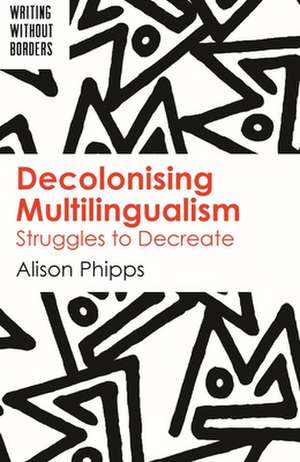
Decolonising Multilingualism: Writing without Borders, cartea 1
Autor Alison Phippsen Limba Engleză Paperback – 15 iul 2019
If we are going to do this, if we are going to decolonise multilingualism, let's do it as an attempt at a way of doing it.
If we are going to do this, let's cite with an eye to decolonising.
If we are going to do this then let's improvise and devise. This is how we might learn the arts of decolonising.
If we are going to do this then we need different companions.
If we are going to do this we will need artists and poetic activists.
If we are going to do this, let's do it in a way which is as local as it is global; which affirms the granulations of the way peoples name their worlds.
Finally, if we are going to do this, let's do it multilingually.
Preț: 81.64 lei
Puncte Express: 122
Carte disponibilă
Livrare economică 08-22 decembrie
Livrare express 21-27 noiembrie pentru 16.16 lei
Livrare prin curier în România Termenul estimat este afișat lângă disponibilitate.
Transport gratuit de la 400.00 lei Plată online sau ramburs, în funcție de opțiunile comenzii.
Retur gratuit în 14 zile Comandă securizată și suport în română.
Specificații
ISBN-13: 9781788924047
ISBN-10: 1788924045
Pagini: 114
Dimensiuni: 127 x 203 x 7 mm
Greutate: 0.13 kg
Editura: MULTILINGUAL MATTERS
Colecția Writing Without Borders
Seria Writing without Borders
ISBN-10: 1788924045
Pagini: 114
Dimensiuni: 127 x 203 x 7 mm
Greutate: 0.13 kg
Editura: MULTILINGUAL MATTERS
Colecția Writing Without Borders
Seria Writing without Borders
Notă biografică
Alison Phipps is UNESCO Chair in Refugee Integration through Languages and the Arts, and Professor of Languages and Intercultural Studies at the University of Glasgow, UK. She writes and publishes widely in both academic publications and the media, and is a respected activist and campaigner for humane treatment for those seeking refuge.
Descriere
In this groundbreaking text, Alison Phipps pulls together ethical approaches to researching multilingually in contexts of pain, conflict and crisis; the position of the researcher; and the question of multilingualism and anglonormativity. It is both global and local in scale, ranging from Scotland to Ghana, Aotearoa / New Zealand to Sudan.