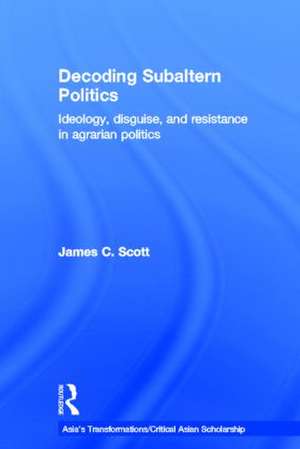
Decoding Subaltern Politics: Ideology, Disguise, and Resistance in Agrarian Politics: Asia's Transformations/Critical Asian Scholarship
Autor James C. Scotten Limba Engleză Hardback – 10 oct 2012
The book covers three distinct yet interlinked bodies of work. The first lays out a framework for understanding peasant politics and rebellion, much of which is applicable to rural areas of the contemporary global south. Scott then goes on to develop his arguments regarding everyday forms of peasant resistance using the comparative example of the religious tithe in France and Malaysia, and tracing the forms of resistance that cover their own tracks and avoid direct clashes with authorities. For much of the world’s population, and for most of its history, this sort of politics was far more common than the violent clashes that dominate the history books, and in this book one can examine the anatomy of such resistance in rich comparative detail. Finally, Scott explores how the state’s increasing grip on its population: its identity, land-holding, income, and movements, is a precondition for political hegemony. Crucially, in examining the invention of state-mandated legal identities, especially, the permanent patronym and the vagaries of its imposition on vernacular life, Scott lays bare the micro-processes of state-formation and resistance.
Written by one of the leading social theorists of our age, Decoding Subaltern Politics: Ideology, Disguise, and Resistance in Agrarian Politics is an indispensible guide to the study of subaltern culture and politics and is essential reading for political scientists, anthropologists, sociologists and historians alike.







Preț: 1113.77 lei
Preț vechi: 1358.26 lei
-18%
Puncte Express: 1671
Carte tipărită la comandă
Livrare economică 30 noiembrie-14 decembrie
Livrare prin curier în România Termenul estimat este afișat lângă disponibilitate.
Transport gratuit pentru acest produs Plată online sau ramburs, în funcție de opțiunile comenzii.
Retur gratuit în 14 zile Comandă securizată și suport în română.
Specificații
ISBN-13: 9780415539753
ISBN-10: 0415539757
Pagini: 176
Ilustrații: 3 tables
Dimensiuni: 156 x 234 x 11 mm
Greutate: 0.49 kg
Ediția:1
Editura: Taylor & Francis
Colecția Routledge
Seria Asia's Transformations/Critical Asian Scholarship
Locul publicării:Oxford, United Kingdom
ISBN-10: 0415539757
Pagini: 176
Ilustrații: 3 tables
Dimensiuni: 156 x 234 x 11 mm
Greutate: 0.49 kg
Ediția:1
Editura: Taylor & Francis
Colecția Routledge
Seria Asia's Transformations/Critical Asian Scholarship
Locul publicării:Oxford, United Kingdom
V-ar putea interesa
-
 Preț: 305.74 lei
 -
 A Crisis of Waste?: Understanding the Rubbish SocietyMartin O'BrienPreț: 474.91 lei
 -
 -18%Preț: 1254.12 lei1529.41 lei
 -
 -15%Preț: 483.82 lei569.20 lei
 -
 -18%Preț: 787.60 lei960.49 lei
 -
 Culture and Conservation: Beyond AnthropocentrismEleanor Shoreman-Ouimet-18%Preț: 1252.80 lei1527.80 lei
 -
 The Political Ecology of the State: The basis and the evolution of environmental statehoodAntonio Augusto Rossotto Ioris-18%Preț: 1435.27 lei1750.34 lei
 -
 Anthropology and RiskAsa BoholmPreț: 460.49 lei
 -
 Infrastructural Lives: Urban Infrastructure in ContextStephen Graham-15%Preț: 516.51 lei607.66 lei
 -
 Environmental Anthropology TodayHelen KopninaPreț: 476.75 lei
 -
 Preț: 349.38 lei
 -
 -18%Preț: 1355.29 lei1652.79 lei
 -
 -15%Preț: 424.09 lei498.92 lei
 -
 The Social Life of Climate Change Models: Anticipating NatureKirsten Hastrup-15%Preț: 472.11 lei555.42 lei
 -
 -18%Preț: 1253.77 lei1528.98 lei
 -
 -18%Preț: 1251.35 lei1526.04 lei
 -
 -18%Preț: 1290.09 lei1573.27 lei
 -
 The Consequences of Global DisastersEric L. HsuPreț: 472.93 lei
 -
 Climate Action Upsurge: The Ethnography of Climate Movement PoliticsStuart RosewarnePreț: 474.92 lei
 -
 Environmental Anthropology: Future DirectionsHelen KopninaPreț: 410.87 lei
 -
 Anthropology and NatureKirsten HastrupPreț: 380.41 lei
 -
 Preț: 436.39 lei
 -
 Preț: 114.52 lei
Cuprins
1. Introduction 2. The "Way" Of Peasant Politics 3. Themes Of Peasant Politics; Localism, Syncretism, Profanation 4. Modes Of Dissimulation: The Infra-Politics Of Subordinate Groups 5. Dissimulation In Practice: Resistance To The Tithe In France And Malaysia—Below The Radar 6. The State’s Grip On The Vernacular World 7. The Production Of Legal Identities Proper To The State: The Case Of The Permanent Family Surname
Notă biografică
James C. Scott is the Sterling Professor of Political Science and Professor of Anthropology, and is Director of the Agrarian Studies Program at Yale University, USA.
Descriere
This book brings together James C. Scott's most important work on peasant religion and ideology; everyday forms of peasant resistance; and state technologies of personal identification. In a collection of interrelated essays Scott introduces the major concepts that lie at the core of his work and illustrates, through ethnographic and historical work how they can be understood through practical examples.