
Decision-Making Models: A Perspective of Fuzzy Logic and Machine Learning: Uncertainty, Computational Techniques, and Decision Intelligence
Editat de Tofigh Allahviranloo, Witold Pedrycz, Amir Seyyedabbasien Limba Engleză Paperback – 25 iul 2024
Other areas of note include optimization problems and artificial intelligence practices, as well as how to analyze IoT solutions with applications and develop decision-making mechanisms realized under uncertainty.
- Introduces mathematics of intelligent systems which provides the usage of mathematical rigor such as precise definitions, theorems, results, and proofs
- Provides extended and new comprehensive methods which can be used efficiently in a fuzzy environment as well as optimization problems and related fields
- Covers applications and elaborates on the usage of the developed methodology in various fields of industry such as software technologies, biomedicine, image processing, and communications







Preț: 689.02 lei
Preț vechi: 1124.95 lei
-39%
Puncte Express: 1034
Carte tipărită la comandă
Livrare economică 19 noiembrie-03 decembrie
Livrare express 22-28 octombrie pentru 273.29 lei
Livrare prin curier în România Termenul estimat este afișat lângă disponibilitate.
Transport gratuit pentru acest produs Plată online sau ramburs, în funcție de opțiunile comenzii.
Retur gratuit în 14 zile Comandă securizată și suport în română.
Specificații
ISBN-13: 9780443161476
ISBN-10: 044316147X
Pagini: 678
Dimensiuni: 191 x 235 x 35 mm
Greutate: 1.15 kg
Editura: ELSEVIER SCIENCE
Seria Uncertainty, Computational Techniques, and Decision Intelligence
ISBN-10: 044316147X
Pagini: 678
Dimensiuni: 191 x 235 x 35 mm
Greutate: 1.15 kg
Editura: ELSEVIER SCIENCE
Seria Uncertainty, Computational Techniques, and Decision Intelligence
V-ar putea interesa
-
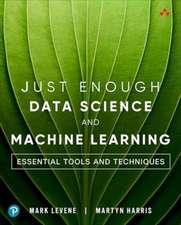 Just Enough Data Science and Machine LearningMark LevenePreț: 342.01 lei
 -
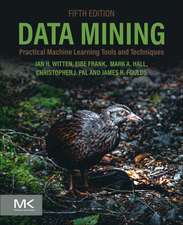 -39%Preț: 394.79 lei646.62 lei
 -
 Soft Computing for Smart Environments: Techniques and ApplicationsMohamed Abdel-Basset-20%Preț: 370.01 lei462.50 lei
 -
 -38%Preț: 456.35 lei742.01 lei
 -
 -9%Preț: 610.00 lei670.33 lei
 -
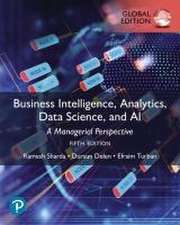 -9%Preț: 581.31 lei638.79 lei
 -
 Machine Learning For DummiesLuca Massaron-20%Preț: 149.88 lei187.36 lei
 -
 The Essential Book of AIAnne Rooney-20%Preț: 76.61 lei95.77 lei
 -
 The Decisive MindSheheryar BanuriPreț: 158.44 lei
 -
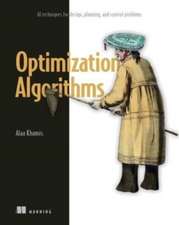 Optimization AlgorithmsAlaa Khamis-20%Preț: 405.89 lei507.37 lei
 -
 Intelligent and Fuzzy Techniques: Smart and Innovative SolutionsCengiz Kahraman-20%Preț: 1291.11 lei1613.88 lei
 -
 -20%Preț: 1012.93 lei1266.17 lei
 -
 -20%Preț: 1133.57 lei1416.96 lei
 -
 Modeling Decisions for Artificial IntelligenceVicenç Torra-20%Preț: 390.39 lei487.98 lei
 -
 Decision Intelligence SolutionsNitasha Hasteer-20%Preț: 1557.17 lei1946.46 lei
 -
 Machine Learning and Metaheuristics: Methods and AnalysisUma N. Dulhare-20%Preț: 1125.83 lei1407.28 lei
Cuprins
Section 1: Decision Making: New Developments
1. Neural networks
2. Artificial intelligent algorithms, motivation and terminology
3. Decision processes
4. Learning theory
Section 2: Metaheuristic Algorithms
5. Nature-inspired algorithms
6. Physic-based algorithms
7. evolution-based algorithms
8. swarm-based algorithms
9. Multi-objective algorithms
10. Unconstrained / constrained nonlinear optimization
11. Evolutionary Computing
Section 3: Optimization Problems
12. Mathematical Programming
13. Discrete and Combinatorial Optimization
14. Optimization and Data Analysis
15. Applied optimization problems
16. Engineering problems
Section 4: Machine Learning
17. Deep Learning
18. (Artificial) Neural Networks
19. Reinforcement Learning Algorithms
20. Classification and clustering
Section 5: Soft Computation
21. Uncertainty theory
22. Fuzzy sets
23. Computation with words
24. Soft modelling
25. Uncertain optimization models
26. Chaos theory and chaotic systems
Section 6: Data Analysis
27. Data mining and knowledge discovery
28. Categories of techniques of data analysis
29. Numerical analysis
30. Risk analysis
Section 7: Fuzzy Decision System
31. Fuzzy Control
32. Approximate Reasoning
33. Effectiveness in Fuzzy Logics
34. Neuro-fuzzy Systems
35. Fuzzy rule-based systems
1. Neural networks
2. Artificial intelligent algorithms, motivation and terminology
3. Decision processes
4. Learning theory
Section 2: Metaheuristic Algorithms
5. Nature-inspired algorithms
6. Physic-based algorithms
7. evolution-based algorithms
8. swarm-based algorithms
9. Multi-objective algorithms
10. Unconstrained / constrained nonlinear optimization
11. Evolutionary Computing
Section 3: Optimization Problems
12. Mathematical Programming
13. Discrete and Combinatorial Optimization
14. Optimization and Data Analysis
15. Applied optimization problems
16. Engineering problems
Section 4: Machine Learning
17. Deep Learning
18. (Artificial) Neural Networks
19. Reinforcement Learning Algorithms
20. Classification and clustering
Section 5: Soft Computation
21. Uncertainty theory
22. Fuzzy sets
23. Computation with words
24. Soft modelling
25. Uncertain optimization models
26. Chaos theory and chaotic systems
Section 6: Data Analysis
27. Data mining and knowledge discovery
28. Categories of techniques of data analysis
29. Numerical analysis
30. Risk analysis
Section 7: Fuzzy Decision System
31. Fuzzy Control
32. Approximate Reasoning
33. Effectiveness in Fuzzy Logics
34. Neuro-fuzzy Systems
35. Fuzzy rule-based systems