
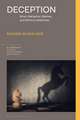
Deception: Mind, Metaphor, Memes, and Mimicry Machines: Bloomsbury Studies in Philosophy and Poetry
Autor Professor of Linguistics and English Rukmini Bhaya Nairen Limba Engleză Paperback – 24 iun 2027
Rukmini Bhaya Nair explores the distinction between lies, metaphor and narrative performativity, presenting them as part of an interactive continuum informing how cultures engage with the concept of truth. With an engaging intellectual energy, Nair's discussion traverses an impressive diversity of writers and thinkers including Paul Grice, Ludwig Wittgenstein, Paul De Man, Noam Chomsky, the Natyashastra of Bharata, Sylvia Plath and Salman Rushdie. She argues that literary texts permit a re-evaluation of truth-telling conventions and offer a space to theorize and understand crises and problems in the world. Augmenting observations on philosophy, fiction, poetry and literary theory with scholarship in cognitive linguistics, the book shows how metaphors, fictions, and lies can function as potent cognitive stimulants.
Deception lays the groundwork for a truly inter-disciplinary account of lying as a deep-rooted form of linguistic behavior, which will appeal to anyone interested in research on developmental psychology, philosophy of language, literary and cultural studies, and linguistics.






Preț: 209.19 lei
Preț vechi: 280.95 lei
-26% Precomandă
Puncte Express: 314
Carte nepublicată încă
Livrare prin curier în România Precomanda se expediază când titlul devine disponibil.
Transport gratuit de la 400.00 lei Plată online sau ramburs, în funcție de opțiunile comenzii.
Retur gratuit în 14 zile Comandă securizată și suport în română.
Doresc să fiu notificat când acest titlu va fi disponibil:
Se trimite...
Specificații
ISBN-13: 9781350466616
ISBN-10: 1350466611
Pagini: 304
Ilustrații: 15 bw illus
Dimensiuni: 156 x 234 x 25 mm
Greutate: 0.45 kg
Editura: Bloomsbury Publishing
Colecția Bloomsbury Academic
Seria Bloomsbury Studies in Philosophy and Poetry
Locul publicării:London, United Kingdom
ISBN-10: 1350466611
Pagini: 304
Ilustrații: 15 bw illus
Dimensiuni: 156 x 234 x 25 mm
Greutate: 0.45 kg
Editura: Bloomsbury Publishing
Colecția Bloomsbury Academic
Seria Bloomsbury Studies in Philosophy and Poetry
Locul publicării:London, United Kingdom
Cuprins
List of Figures
List of Tables
Acknowledgements
Introduction: The Logic of the Lie
1. Figuring It Out: A Typology of Lies
2. Pretending Versus Lying: Imponderable Evidence and Lie Detection
3. Attempting to Mean: Embodiment and Bilingual Children's Use of Figurative Language
4. Transforming the Tree: Metaphor as an Organizing Device in Disciplinary Discourse
5. Creating Codes: Cross-Cultural Approaches to Deception as Performance
6. Dreamworking: Experiments with Truth in Colonial & Postcolonial Literature
7. Rewarding Risks: Narrative, Memes, Mimicry, Truth and Lies
8. Chatting with Machines: The Evolution of Deception
Conclusion: The Future of the Lie
References
Index
List of Tables
Acknowledgements
Introduction: The Logic of the Lie
1. Figuring It Out: A Typology of Lies
2. Pretending Versus Lying: Imponderable Evidence and Lie Detection
3. Attempting to Mean: Embodiment and Bilingual Children's Use of Figurative Language
4. Transforming the Tree: Metaphor as an Organizing Device in Disciplinary Discourse
5. Creating Codes: Cross-Cultural Approaches to Deception as Performance
6. Dreamworking: Experiments with Truth in Colonial & Postcolonial Literature
7. Rewarding Risks: Narrative, Memes, Mimicry, Truth and Lies
8. Chatting with Machines: The Evolution of Deception
Conclusion: The Future of the Lie
References
Index
Recenzii
Rukmini Bhaya Nair's central argument that 'deception' is a core strategy that human beings use to ensure their survival is both bold in its claim and simple in its formulation. Deception is a book for the ages and must be on the shelf along with Darwin, Chomsky, Mead, and Arendt.
This is a remarkable book about an important subject: the human capacity for deception and how and why we acquire it. It explores the pleasure we take in deception as well as why we disapprove of it when It takes the form of lying. Rukmini Nair draws on a wide range of disciplinary perspectives from philosophy, psychology, linguistics, and literary and culture studies. Each chapter is an exhilarating exercise in thought, whether she is writing about the relation between poetry and computer coding, discussing the linguistic energy of Salman Rushdie's work, or analysing the transcripts from a court of law. Deception will prove to be a definitive work on this subject, and one that will become a vital reference for any future discussions of the intimate relations between our capacity for deception and our desire for truthfulness.
This is a remarkable book about an important subject: the human capacity for deception and how and why we acquire it. It explores the pleasure we take in deception as well as why we disapprove of it when It takes the form of lying. Rukmini Nair draws on a wide range of disciplinary perspectives from philosophy, psychology, linguistics, and literary and culture studies. Each chapter is an exhilarating exercise in thought, whether she is writing about the relation between poetry and computer coding, discussing the linguistic energy of Salman Rushdie's work, or analysing the transcripts from a court of law. Deception will prove to be a definitive work on this subject, and one that will become a vital reference for any future discussions of the intimate relations between our capacity for deception and our desire for truthfulness.