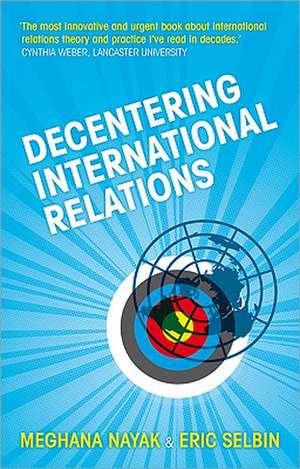
Decentering International Relations
Autor Doctor Meghana Nayak, Professor Eric Selbinen Limba Engleză Paperback – 26 aug 2010
Through engagement with a variety of theories (ranging beyond the usual 'mainstream' versus 'critical/alternative' binary), and conversations with scholars, activists, and students, the authors invite the reader to participate in an accessible yet provocative experiment to decentre the North/West when we learn, study and do IR. In particular, they examine how the pressing issues of 'human rights', 'globalization', 'peace and security', and 'indigeneity' are simultaneously normative inventions meant to sustain particular power structures and sites for insurgent and subversive attempts to live IR at the margins.
Selbin and Nayak have written a remarkable and provocative re-envisioning of a globally important subject.
Preț: 183.88 lei
Preț vechi: 223.61 lei
-18%
Puncte Express: 276
Carte tipărită la comandă
Livrare economică 08-22 decembrie
Livrare prin curier în România Termenul estimat este afișat lângă disponibilitate.
Transport gratuit de la 400.00 lei Plată online sau ramburs, în funcție de opțiunile comenzii.
Retur gratuit în 14 zile Comandă securizată și suport în română.
Specificații
ISBN-13: 9781848132399
ISBN-10: 1848132395
Pagini: 226
Dimensiuni: 138 x 216 x 13 mm
Greutate: 0.3 kg
Editura: Bloomsbury Publishing
Colecția Zed Books
Locul publicării:London, United Kingdom
ISBN-10: 1848132395
Pagini: 226
Dimensiuni: 138 x 216 x 13 mm
Greutate: 0.3 kg
Editura: Bloomsbury Publishing
Colecția Zed Books
Locul publicării:London, United Kingdom
Cuprins
1. Introduction
2. Interventions
3. Indigenous Peoples: International Affairs...and Fantasies
4. Human Rights (and Wrongs)
5. Globalisation
6. (In)Security: Paradoxes of Peace and Violence
7. Conclusion
2. Interventions
3. Indigenous Peoples: International Affairs...and Fantasies
4. Human Rights (and Wrongs)
5. Globalisation
6. (In)Security: Paradoxes of Peace and Violence
7. Conclusion
Recenzii
This superb book audaciously undermines International Relations theory conceived in Western conceit. Without denying Western power, the book asks whether the peoples of the world wake each day forming privileged opinions about us, presuming to give us their prescriptions for what they think we should do.
Nayak and Selbin effectively engage all of us as students, as people trying to make more reliable, less blinkered sense of international politics. Their style is accessible, the questions they pose crucial. They challenge each of us to seriously think about who "we" are when we talk about "them." That's IR at its best.
The most innovative and urgent book about international relations theory and practice I've read in decades.
Nayak and Selbin engage in an important debate which for too long has taken place on the peripheries of our discipline.
Nayak and Selbin's well-crafted new volume contributes to the small but growing literature that seeks to "decenter, unsettle, relativize and provincialize" the pseudo-universalisms of a profoundly (neo)colonial International Relations (IR) discipline fundamentally rooted in and reproductive of the self-understandings of the USA/North/West.
This is a refreshingly unusual book on International Relations. It asks all the right questions, not only about world politics but about the ways they are seen and theorised.
Nayak and Selbin effectively engage all of us as students, as people trying to make more reliable, less blinkered sense of international politics. Their style is accessible, the questions they pose crucial. They challenge each of us to seriously think about who "we" are when we talk about "them." That's IR at its best.
The most innovative and urgent book about international relations theory and practice I've read in decades.
Nayak and Selbin engage in an important debate which for too long has taken place on the peripheries of our discipline.
Nayak and Selbin's well-crafted new volume contributes to the small but growing literature that seeks to "decenter, unsettle, relativize and provincialize" the pseudo-universalisms of a profoundly (neo)colonial International Relations (IR) discipline fundamentally rooted in and reproductive of the self-understandings of the USA/North/West.
This is a refreshingly unusual book on International Relations. It asks all the right questions, not only about world politics but about the ways they are seen and theorised.