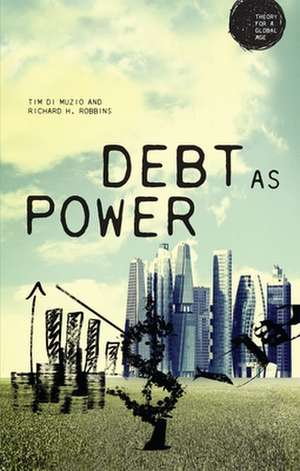
Debt as Power: Theory for a Global Age
Autor Richard H. Robbins, Tim Di Muzioen Limba Engleză Paperback – 20 ian 2016
| Toate formatele și edițiile | Preț | Express |
|---|---|---|
| Paperback (2) | 101.64 lei 3-5 săpt. | +12.12 lei 6-12 zile |
| MANCHESTER UNIVERSITY PRESS – 20 ian 2016 | 101.64 lei 3-5 săpt. | +12.12 lei 6-12 zile |
| Bloomsbury Publishing – 21 oct 2015 | 91.30 lei Precomandă | |
| Hardback (1) | 672.28 lei 6-8 săpt. | |
| MANCHESTER UNIVERSITY PRESS – 2016 | 672.28 lei 6-8 săpt. |


Preț: 101.64 lei
Puncte Express: 152
Preț estimativ în valută:
17.97€ • 20.82$ • 15.54£
17.97€ • 20.82$ • 15.54£
Carte disponibilă
Livrare economică 16-30 aprilie
Livrare express 01-07 aprilie pentru 22.11 lei
Specificații
ISBN-13: 9781784993269
ISBN-10: 1784993263
Pagini: 216
Dimensiuni: 137 x 213 x 18 mm
Greutate: 0.27 kg
Editura: MANCHESTER UNIVERSITY PRESS
Seria Theory for a Global Age
ISBN-10: 1784993263
Pagini: 216
Dimensiuni: 137 x 213 x 18 mm
Greutate: 0.27 kg
Editura: MANCHESTER UNIVERSITY PRESS
Seria Theory for a Global Age
V-ar putea interesa
-
 Banking Regulation and GlobalizationAndreas Busch-18%Preț: 331.16 lei402.09 lei
 -
 Preț: 376.62 lei
 -
 Preț: 374.18 lei
 -
 -54%Preț: 176.92 lei387.36 lei
 -
 The Third Industrial RevolutionJeremy RifkinPreț: 115.13 lei
 -
 Globalization and Development in East AsiaJan Nederveen Pieterse-18%Preț: 1197.62 lei1460.52 lei
 -
 -16%Preț: 93.43 lei111.16 lei
 -
 AnyoneNigel Rapport-23%Preț: 720.16 lei935.27 lei
 -
 Changing Global Economic Landscape: Trends & U.S.-Centric AnalysesStephanie J Palmer-30%Preț: 916.99 lei1315.88 lei
 -
 International Economic Cooperation: Institutions, Funds & BanksHolden J Murray-30%Preț: 1118.31 lei1603.74 lei
 -
 -17%Preț: 137.97 lei166.97 lei
 -
 Global Sports PolicyCatherine PalmerPreț: 420.53 lei
 -
 Balancing between Trade and Risk: Integrating Legal and Social Science PerspectivesMarjolein B. A. van Asselt-18%Preț: 1201.43 lei1465.16 lei
Descriere
"Debt as power is a timely and innovative contribution to our understanding of one of the most prescient issues of our time: the explosion of debt across the global economy and related requirement of political leaders to pursue exponential growth to meet the demands of creditors and investors."
Caracteristici
New revelations include the role of debt in the Atlantic slave trade and in the establishment of modern capitalism in Europe
Notă biografică
Richard H. Robbins is Distinguished Teaching Professor in Anthropology at Plattsburg State University of New York, USATim Di Muzio is Senior Lecturer in the School of Law, Humanities and the Arts at the University of Wollongong, Australia
Cuprins
Introduction: Towards a Stark UtopiaOrigins: War, National Debt and the Capitalist StateIntensification: War, Debt and Colonial PowerConsequences: Exponential Growth, Magic Money and AusterityWhat Is To Be Done?BibliographyIndex
Recenzii
This is economic anthropology at its best – relevant, sophisticated, and readable. The authors brilliantly show how debt has been the essential glue that holds the world economic system together, an instrument that spreads untold misery and modern forms of slavery, to the continuing benefit of creditors. A powerful anthropological answer to Piketty’s “Capital in the 21st Century,” Debt as Power is a clear-eyed and thoroughly original dissection of capitalism, an essential guide to understanding how today’s world works. This is an important book, a comprehensive and sensible guide to our economic future.
This book is a crucial introduction to the phenomenon of debt, and should be part of a standard issue survival kit for young people around the world. Those of us already in debt may also yet benefit from its insights. Debt, argue Di Muzio and Robbins, is more than an economic and social debacle: it is a technique of government for disciplining and managing people and the environment. At the same time, however, the individuation of the power to make money, by taking on debt, increasingly puts the world economy in the hands of everyday people. The realization of this power, Di Muzio and Robbins conclude, could be the key to a more equitable and ecologically sane future. Forget Foucault? I think not!
Meticulously researched and clearly exposited, Debt as Power makes a most convincing case that modern capitalism must be explained as political economy. An indispensible companion to understanding contemporary world affairs.
This book is a crucial introduction to the phenomenon of debt, and should be part of a standard issue survival kit for young people around the world. Those of us already in debt may also yet benefit from its insights. Debt, argue Di Muzio and Robbins, is more than an economic and social debacle: it is a technique of government for disciplining and managing people and the environment. At the same time, however, the individuation of the power to make money, by taking on debt, increasingly puts the world economy in the hands of everyday people. The realization of this power, Di Muzio and Robbins conclude, could be the key to a more equitable and ecologically sane future. Forget Foucault? I think not!
Meticulously researched and clearly exposited, Debt as Power makes a most convincing case that modern capitalism must be explained as political economy. An indispensible companion to understanding contemporary world affairs.