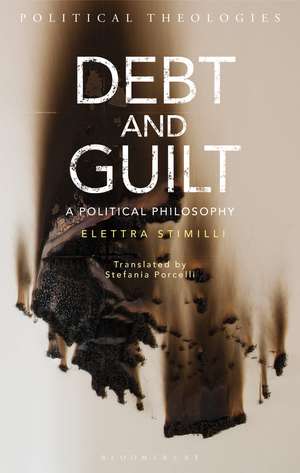
Debt and Guilt: A Political Philosophy: Political Theologies
Autor Elettra Stimilli Traducere de Stefania Porcellien Limba Engleză Paperback – 27 dec 2018
The first English translation of Debito e Colpa, this book provokes new ways of thinking about how we experience both debt and guilt in contemporary society.
Din seria Political Theologies
- nou
 Preț: 550.36 lei
 -
 Preț: 183.72 lei
 - 25%
 Preț: 241.41 lei
 - 15%
 Preț: 247.47 lei
 - 25%
 Preț: 246.95 lei
 - 27%
 Preț: 235.01 lei
 - 24%
 Preț: 248.30 lei
 - 26%
 Preț: 216.72 lei
 - 28%
 Preț: 210.15 lei
 - 26%
 Preț: 206.67 lei
 - 33%
 Preț: 543.83 lei
 - 32%
 Preț: 551.65 lei
 - nou
 Preț: 181.65 lei
 - nou
 Preț: 560.97 lei
 - nou
 Preț: 553.17 lei
Preț: 165.57 lei
Preț vechi: 195.25 lei
-15%
Puncte Express: 248
Carte disponibilă
Livrare economică 02-16 noiembrie
Livrare prin curier în România Termenul estimat este afișat lângă disponibilitate.
Transport gratuit de la 400.00 lei Plată online sau ramburs, în funcție de opțiunile comenzii.
Retur gratuit în 14 zile Comandă securizată și suport în română.
Specificații
ISBN-13: 9781350063433
ISBN-10: 1350063436
Pagini: 184
Dimensiuni: 214 x 138 x 18 mm
Greutate: 0.23 kg
Editura: Bloomsbury Publishing
Colecția Bloomsbury Academic
Seria Political Theologies
Locul publicării:London, United Kingdom
ISBN-10: 1350063436
Pagini: 184
Dimensiuni: 214 x 138 x 18 mm
Greutate: 0.23 kg
Editura: Bloomsbury Publishing
Colecția Bloomsbury Academic
Seria Political Theologies
Locul publicării:London, United Kingdom
Cuprins
Introduction
Chapter One: Debt: Between Appropriation, Exchange, and Gift
1. The Problematic Context
2. Appropriation
3. Exchange
4. Gift
Chapter Two: An Open Question
1. The Neoliberal Turn
2. The Society of Generalized Debt
3. The Paradigm of Man in Debt
Chapter Three: Between Political Theology and Economic Theology
1. Beyond the Boundaries of Economic Science
2. Religion, Politics, and Economics
3. "Faith" in the Era of the Predominance of Finance
4. Debt and Sacrifice
5. Guilt and Violence: At the Origin of Juridical Power
Chapter Four: The Religion of Debt
1. Bare Life and the Law
2. Capitalism: A Cult with no Theology
3. Economy and Regulatory Experimentation
4. The Invention of Oikonomia
5. Debt as Investment
Chapter Five: The Psychic Life of Debt
1. The Guilt of Being in Debt
2. Establishing the Rule: Psychic Dimension and Social Sphere
3. Feminism and Neoliberalism
4. The Mystery of Guilt and the Psychic Life of Power
5. Envisioning New Ways of Assuming Power
Conclusions
Bibliography
Index
Chapter One: Debt: Between Appropriation, Exchange, and Gift
1. The Problematic Context
2. Appropriation
3. Exchange
4. Gift
Chapter Two: An Open Question
1. The Neoliberal Turn
2. The Society of Generalized Debt
3. The Paradigm of Man in Debt
Chapter Three: Between Political Theology and Economic Theology
1. Beyond the Boundaries of Economic Science
2. Religion, Politics, and Economics
3. "Faith" in the Era of the Predominance of Finance
4. Debt and Sacrifice
5. Guilt and Violence: At the Origin of Juridical Power
Chapter Four: The Religion of Debt
1. Bare Life and the Law
2. Capitalism: A Cult with no Theology
3. Economy and Regulatory Experimentation
4. The Invention of Oikonomia
5. Debt as Investment
Chapter Five: The Psychic Life of Debt
1. The Guilt of Being in Debt
2. Establishing the Rule: Psychic Dimension and Social Sphere
3. Feminism and Neoliberalism
4. The Mystery of Guilt and the Psychic Life of Power
5. Envisioning New Ways of Assuming Power
Conclusions
Bibliography
Index
Recenzii
Elettra Stimilli's new book offers a deeply-informed, succinct and far-ranging account of the debates around our contemporary condition of "universal indebtedness." By asking fundamental questions and putting major figures into dialogue, she has rebooted and redrawn a whole field of political thinking. Her book deserves to be widely read by those-both in and out of academia-who believe that the present regime of debt and guilt cannot have the last word.
What a bracing, challenging, and compelling analysis and conceptual genealogy of the devastations of financial capitalism. Stimilli writes with clarity, eloquence, and brilliance. She not only shows how debt is the essential mechanism enabling the osmosis between the contemporary neoliberal state and the global financial market but also demonstrates the psychic, cultural and ultimately theological dimensions of debt in all its vicissitudes. This is essential reading for anyone who is trying to make sense of the current disaster.
What a bracing, challenging, and compelling analysis and conceptual genealogy of the devastations of financial capitalism. Stimilli writes with clarity, eloquence, and brilliance. She not only shows how debt is the essential mechanism enabling the osmosis between the contemporary neoliberal state and the global financial market but also demonstrates the psychic, cultural and ultimately theological dimensions of debt in all its vicissitudes. This is essential reading for anyone who is trying to make sense of the current disaster.
Notă biografică
Elettra Stimilli is Professor of Theoretical Philosophy at the Department of Philosophy at the Sapienza University of Rome, Italy. She is the author of The Debt of the Living (2017), Debt and Guilt (2018), Philosophy of the Means for a New Politics of Bodies (2026) and the co-editor, with Dario Gentili and Glenda Garelli, of Italian Critical Thought (2018).