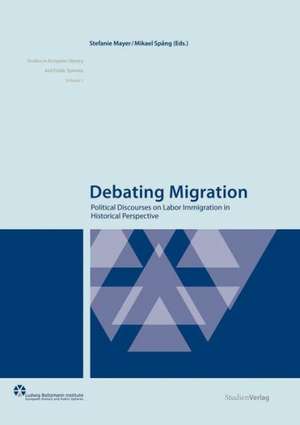
Debating Migration: Political Discourses on Labor Immigration in Historical Perspective: Studien Verlag
Editat de Stefanie Mayer, Mikael Spången Limba Engleză Hardback – 2 iul 2013
Din seria Studien Verlag
- 8%
 Preț: 489.78 lei
 - 9%
 Preț: 809.37 lei
 -
 Preț: 271.34 lei
 -
 Preț: 401.91 lei
 - 24%
 Preț: 1124.50 lei
 - 21%
 Preț: 353.36 lei
 - 11%
 Preț: 339.42 lei
 - 22%
 Preț: 711.05 lei
 - 15%
 Preț: 285.55 lei
 - 21%
 Preț: 428.70 lei
 - 11%
 Preț: 335.66 lei
 - 12%
 Preț: 319.75 lei
 - 12%
 Preț: 318.38 lei
 - 25%
 Preț: 1100.96 lei
 - 11%
 Preț: 351.94 lei
 -
 Preț: 294.42 lei
Preț: 1099.64 lei
Preț vechi: 1461.36 lei
-25%
Puncte Express: 1649
Carte indisponibilă temporar
Doresc să fiu notificat când acest titlu va fi disponibil:
Se trimite...
Specificații
ISBN-13: 9783706548588
ISBN-10: 3706548585
Pagini: 160
Dimensiuni: 175 x 244 x 15 mm
Greutate: 0.45 kg
Ediția:1
Editura: Studien Verlag, Austria
Colecția Studien Verlag, Austria
Seria Studien Verlag
ISBN-10: 3706548585
Pagini: 160
Dimensiuni: 175 x 244 x 15 mm
Greutate: 0.45 kg
Ediția:1
Editura: Studien Verlag, Austria
Colecția Studien Verlag, Austria
Seria Studien Verlag
Notă biografică
Stefanie Mayer is currently working on her PhD in political science at the sociology department of the Institute for Advanced Studies in Vienna.
Mikael SpAng is an associate professor of political science in the department of global political studies at MalmO University.
Mikael SpAng is an associate professor of political science in the department of global political studies at MalmO University.
Cuprins
Mikael Spång and Stefanie Mayer: Introduction, Institutional Structures and Political Systems, Migration Patterns during the Post World War II Era, Method and Material, Structure of the Publication, Stefanie Mayer: Migration & Labor Markets. Political Discourse in Austria, Protecting the National Labor Market – from Habsburg to the Second Republic, Development of the Policy Field Immigration (1960s/1970s), Integration before Immigration, Austria going EU, Conclusions, Mikael Spång: Debating Labor Immigration and Immigration Policy in Sweden, 1960–2008, Introduction, Immigration Policy during the early and mid 20th Century, Regulating Labor Immigration in the 1960s, Topoi in the 1960s Debate on Labor Immigration, Refugee Immigration and Family Reunification in the 1970s and 1990s, The 1989 Aliens Act and the 1989 Decision on Refugees, Changes to Refugee Immigration and Family Reunification Policy in the 1990s, The Europeanization of Immigration Policy, Labor Immigration from outside the EU, Topoi to the Debate about Labor Immigration from outside the EU, The 2004 Debate about Transition Rules, Topoi to the 2004 Debate about Transition Rules, Conclusions, Selma Muhic Dizdarevic: A Question of Equality. Some Aspects of the Temporary Restrictions in Access to the EU-15 Labor Market in the Czech Republic, Introduction, Restrictions vs. Needs, Restrictions towards Third Country Nationals, Conclusions, Dunja Larise: The Socialist Federative Republic of Yugoslavia and the, Economic Emigration of the Sixties, Seventies and Eighties, Ayhan Kaya: Transnationalizing Integration in the Age of Securitization:, A Perspective through Euro-Turks, Changing Immigration Laws: Attracting Qualified Labor, Transnationalizing Integration, Concluding Remarks, Saara Pellander: Sending and Receiving, Welcoming and Excluding:, Developments and Debates in Finland's Migration Policy, Migration Patterns in Finland, Towards a Finnish Migration Policy, Conclusion: Finland following Sweden's Footsteps?, Mikael Spång and Stefanie Mayer: Conclusions, Changing Institutional Arrangements, Liberalization and Regulation, Debates and Contention about Integration, Topics in Migration Debates, Institutions and Discourse intertwined, Sources and Literature, Authors.
Descriere
Stefanie Mayer and Mikael SpAng take a close look at debates regarding (labor) immigration in Austria and Sweden by comparing discussions during the 1960s and 1970s with contemporary political discourse. The editors combine their research on institutional developments with elements of critical discourse analysis in a comparative perspective.