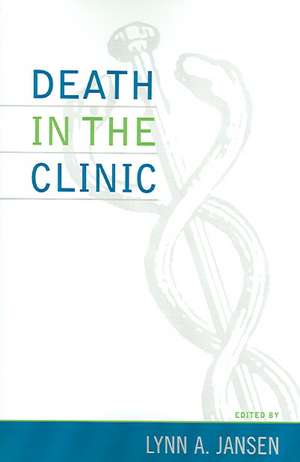
Death in the Clinic: Practicing Bioethics
Editat de Lynn A. Jansen Contribuţii de David Barnard, Celia Berdes, James L. Bernat, Linda Emanuel, Robert Fogerty, Linda Ganzini, Elizabeth R. Goy, David J. Mayo, John Paris, Michael D. Schreiber, J David Velleman, Mark R. Wicclairen Limba Engleză Paperback – 9 noi 2005
Preț: 160.61 lei
Preț vechi: 230.48 lei
-30%
Puncte Express: 241
Carte tipărită la comandă
Livrare economică 03-17 iunie
Specificații
ISBN-13: 9780742535107
ISBN-10: 074253510X
Pagini: 164
Dimensiuni: 176 x 214 x 12 mm
Greutate: 0.25 kg
Editura: Bloomsbury Publishing
Colecția Rowman & Littlefield
Seria Practicing Bioethics
Locul publicării:New York, United States
ISBN-10: 074253510X
Pagini: 164
Dimensiuni: 176 x 214 x 12 mm
Greutate: 0.25 kg
Editura: Bloomsbury Publishing
Colecția Rowman & Littlefield
Seria Practicing Bioethics
Locul publicării:New York, United States
V-ar putea interesa
-
 Meeting Health Information Needs Outside Of Healthcare: Opportunities and ChallengesCatherine Arnott Smith-5%Preț: 356.87 lei375.65 lei
 -
 Infectious Disease: A Very Short IntroductionMarta Wayne-5%Preț: 65.22 lei68.65 lei
 -
 Antimicrobial ChemotherapyPeter Davey-27%Preț: 674.00 lei919.52 lei
 -
 Nutrition at a Glance 2eS Sharma-5%Preț: 255.23 lei268.66 lei
 -
 Planning Health Promotion ProgramsChristine M. Markham-5%Preț: 812.51 lei855.28 lei
 -
 -5%Preț: 624.46 lei657.33 lei
 -
 -28%Preț: 84.14 lei116.36 lei
 -
 Marsden, K: The Paleo PrimerMatt Whitmore-18%Preț: 98.61 lei120.10 lei
 -
 A Systematic Review of Key Issues in Public HealthStefania Boccia-5%Preț: 364.11 lei383.27 lei
 -
 -5%Preț: 755.07 lei794.80 lei
 -
 Benefit-Risk Assessment of MedicinesJames Leong-5%Preț: 365.70 lei384.95 lei
 -
 Nutritional Supplements in Sports and ExerciseMike Greenwood-5%Preț: 1087.09 lei1144.30 lei
 -
 Physical Activity, Exercise, Sedentary Behavior and HealthKazuyuki Kanosue-5%Preț: 701.31 lei738.22 lei
Cuprins
Chapter 1 Introduction
Part 2 The Public Meaning of Death
Chapter 3 Some Reflections on Whether Death is Bad
Chapter 4 Defining Death
Part 5 Facing Death in the Clinic
Chapter 6 Against the Right to Die
Chapter 7 The Skull at the Banquet
Chapter 8 Influence of Mental Illnes on Decision-Making at the End of Life
Chapter 9 Creative Adaptation in Aging and Dying: Ethical Imperative or Impossible Dream?
Chapter 10 Rage, Rage Against the Dying of the Light: Not a Metaphor for End-of-Life-Care
Chapter 11 After Death: Respect and Cultural Norms
Chapter 12 Training on Newly Deceased Patients: An Ethical Analysis
Chapter 13 Appendix: Abstracts of the Chapters
Chapter 14 Index
Chapter 15 About the Contributors
Part 2 The Public Meaning of Death
Chapter 3 Some Reflections on Whether Death is Bad
Chapter 4 Defining Death
Part 5 Facing Death in the Clinic
Chapter 6 Against the Right to Die
Chapter 7 The Skull at the Banquet
Chapter 8 Influence of Mental Illnes on Decision-Making at the End of Life
Chapter 9 Creative Adaptation in Aging and Dying: Ethical Imperative or Impossible Dream?
Chapter 10 Rage, Rage Against the Dying of the Light: Not a Metaphor for End-of-Life-Care
Chapter 11 After Death: Respect and Cultural Norms
Chapter 12 Training on Newly Deceased Patients: An Ethical Analysis
Chapter 13 Appendix: Abstracts of the Chapters
Chapter 14 Index
Chapter 15 About the Contributors
Recenzii
It is not easy to find fresh voices on care at the end of life. But Death in the Clinic does just that, bringing to bear on an old topic many new, and much needed, insights.
An engaging and challenging collection of insightful essays that constructively challenges assumptions about death in the clinic. This anthology is important reading for practitioner and policymaker alike interested in improving end-of-life care and understanding why needed reform has been so elusive and hard to achieve.
Most people die in hospitals, yet the meaning and implications of death in the clinic are rarely explored. Lynn Jansen's book goes a long way towards filling this gap in the literature of bioethics.
This wide-ranging edited collection provides the reader with ethical perspectives on death and dying that are focused on concrete, 'everyday' concerns in clinical settings. The book is aimed at all professional groups who work in the field of death and dying, although its primary focus is on the needs of physicians and medical students....The strength of this book is that it places ethics on the agenda in a way that aims to provide a practical guide to end-of-life challenges.
An engaging and challenging collection of insightful essays that constructively challenges assumptions about death in the clinic. This anthology is important reading for practitioner and policymaker alike interested in improving end-of-life care and understanding why needed reform has been so elusive and hard to achieve.
Most people die in hospitals, yet the meaning and implications of death in the clinic are rarely explored. Lynn Jansen's book goes a long way towards filling this gap in the literature of bioethics.
This wide-ranging edited collection provides the reader with ethical perspectives on death and dying that are focused on concrete, 'everyday' concerns in clinical settings. The book is aimed at all professional groups who work in the field of death and dying, although its primary focus is on the needs of physicians and medical students....The strength of this book is that it places ethics on the agenda in a way that aims to provide a practical guide to end-of-life challenges.