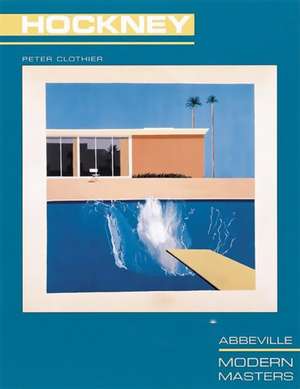
David Hockney: Modern Masters
Autor Peter Clothieren Limba Engleză Paperback – 16 mar 1995
Perioada postbelică a adus o redefinire a modului în care percepem imaginea, iar David Hockney rămâne una dintre cele mai vizibile și influente figuri ale acestui curent, relevanța sa fiind menținută de o curiozitate tehnologică neobosită. În acest volum din seria Abbeville Press, remarcăm modul în care Peter Clothier reușește să surprindă nu doar estetica, ci și spiritul ludic care guvernează întreaga operă a artistului britanic. Subliniem calitatea producției grafice, cele peste 100 de ilustrații alternând între rigoarea portretelor alb-negru și explozia cromatică a celebrelor sale peisaje sau scene de interior. Ne-a atras atenția structura riguroasă a cărții, care ghidează cititorul de la primele încercări narative către explorările complexe ale spațiului și perspectivei. Dincolo de analiza critică, volumul include secțiuni practice extrem de valoroase: note despre tehnică, o bibliografie adnotată și declarații ale artistului, oferind o perspectivă intimă asupra procesului de creație. Pe raftul de artă, alături de David Hockney. A Chronology, acest album se distinge prin abordarea sa sintetică și echilibrată, oferind o introducere accesibilă, dar profundă, în timp ce lucrarea lui Holzwarth pune un accent mai mare pe desfășurarea temporală vastă a carierei sale. Experiența de lectură este una senzorială; parcurgând paginile, observăm tranziția de la naturalism la experimentul radical cu aparatul foto sau faxul. Față de A Yorkshire Sketchbook, unde accentul cade pe peisajul natal capturat tradițional sau digital, volumul de față oferă o privire de ansamblu asupra versatilității lui Hockney, integrând atât dimensiunea sa de „lumean” stabilit în Hollywood, cât și atașamentul față de originile sale din nordul Angliei.

Preț: 139.87 lei
Carte disponibilă
Livrare economică 17 noiembrie-01 decembrie
Livrare express 31 octombrie-06 noiembrie pentru 39.20 lei
Specificații
ISBN-10: 0789200368
Pagini: 128
Ilustrații: colour and b&w illustrations, portraits
Dimensiuni: 217 x 279 x 15 mm
Greutate: 0.64 kg
Ediția:Adnotată
Editura: Abbeville Press Inc.,U.S.
Colecția Modern Masters
Seria Modern Masters
Locul publicării:United States
V-ar putea interesa
-
 The World According to David HockneyDavid Hockney-17%Preț: 89.55 lei108.47 lei
 -
 David HockneyMarco Livingstone-14%Preț: 98.06 lei114.02 lei
 -
 Spring Cannot be CancelledDavid Hockney-16%Preț: 91.92 lei109.80 lei
 -
 Hockney's PicturesDavid Hockney-14%Preț: 251.29 lei292.11 lei
 -
 David HockneyMaria Isabel Sanchez Vegara-17%Preț: 66.88 lei80.62 lei
 -
 HockneySimon Elliott-14%Preț: 108.80 lei127.23 lei
 -
 -21%Preț: 93.70 lei118.13 lei
 -
 Meet the Artist: Peter BlakeRose Blake-19%Preț: 40.71 lei50.31 lei
 -
 David Hockney: Moving FocusHelen Little-17%Preț: 232.28 lei280.96 lei
 -
 David Hockney: Drawing from LifeIsabel Seligman-16%Preț: 236.93 lei283.67 lei
 -
 Six Fairy Tales from the Brothers GrimmDavid HockneyPreț: 130.61 lei
 -
 David HockneyTim BarringerPreț: 309.91 lei
 -
 David HockneyJames Cahill-27%Preț: 66.98 lei91.81 lei
 -
 David Hockney in Pays d'AugeJean FremonPreț: 96.61 lei
 -
 David Hockney. A ChronologyHans Werner HolzwarthPreț: 237.68 lei
 -
 David Hockney. 220 for 2020Hans Werner Holzwarth-19%Preț: 731.68 lei903.31 lei
 -
 David HockneyShai Baitel-16%Preț: 365.99 lei435.66 lei
De ce să citești această carte
Această monografie este esențială pentru cei care doresc să înțeleagă mecanismele din spatele culorilor vibrante ale lui Hockney. Cititorul câștigă o înțelegere clară a modului în care joaca și experimentul pot coexista cu o disciplină artistică riguroasă. Este o resursă prețioasă atât pentru studenții la arte plastice, datorită capitolului dedicat tehnicii, cât și pentru entuziaștii care vor să descopere omul din spatele celebrelor rame de ochelari.
Despre autor
Peter Clothier este un romancier, critic de artă și blogger de renume internațional, cunoscut pentru capacitatea sa de a traduce concepte estetice complexe într-un limbaj accesibil și elegant. Cu o experiență vastă în analiza artei contemporane, Clothier abordează biografiile artiștilor cu o inteligență pătrunzătoare. În alte lucrări ale sale, precum Sculpting in Wood, acesta demonstrează un interes deosebit pentru procesul tehnic și materialitatea artei, o perspectivă pe care o aduce și în analiza operei lui Hockney, unde insistă pe diversitatea mediilor de exprimare utilizate de artist.
Descriere scurtă
From his theatrical early canvases to his more recent photographic collages and operatic set designs, Hockney has tackled the challenge of space on a grand scale. At the same time, much of his work has been devoted to the things most dear to him-friends, family, home, and studio. An intellectual of wide-ranging erudition and a world traveler who makes his home in Hollywood, he still cherishes his roots in Bradford, the northern British town where he was born in 1937.
Invention, the driving force behind Hockney's art, is in good part play: "If art isn't playful," he once commented, "it's nothing." This illuminating, color-rich volume conveys with vivid clarity Hockney's serious delight in making art that gives pleasure to both its creator and its audience.
About the Modern Masters series:
With informative, enjoyable texts and over 100 illustrations—approximately 48 in full color—this innovative series offers a fresh look at the most creative and influential artists of the postwar era. The authors are highly respected art historians and critics chosen for their ability to think clearly and write well. Each handsomely designed volume presents a thorough survey of the artist's life and work, as well as statements by the artist, an illustrated chapter on technique, a chronology, lists of exhibitions and public collections, an annotated bibliography, and an index. Every art lover, from the casual museumgoer to the serious student, teacher, critic, or curator, will be eager to collect these Modern Masters. And with such a low price, they can afford to collect them all.
Cuprins
Early Days 11
Toward Naturalism 25
Out of the Trap 43
Explorations in Space 65
Turning Inward 83
Notes 101
Artists’ Statements 103
Notes on Technique 109
Chronology 115
Exhibitions 119
Public Collections 122
Selected Bibliography 123
Index 126
Notă biografică
Extras
For the contemporary artist of serious aesthetic purpose, David Hockney enjoys immense, perhaps unequaled public visibility: the shock of dyed blond hair, the owlish glasses, and the shy schoolboy grin are known as much through the popular press as through the journals of the art world. His renown results in part from his early emergence as the enfant terrible of contemporary British painting, photographed by Lord Snowdon for the Sunday Times in the flamboyant gold lame jacket in which he opted to receive his medal for “work of outstanding distinction” as he graduated from the Royal College of Art in 1962. This was the time, too, when London was the swinging capital of the new jet set, and the high-spirited antics of youngsters like the Beatles and the Rolling Stones had rocketed their country to the vanguard of international popular culture. It was an ideal context for Hockney’s disarming openness, for the cheerful disrespect for convention that characterized his life and work, and for the zest with which he embraced his growing fame.
Yet behind the eccentric individualist who appeared so eager for success lurked a relatively shy and introspective artist, whose determination can be gauged by the injunction that he painted in careful Roman lettering on the chest of drawers by the bed in his first London studio: “Get up and work immediately.” This dual spirit of play and stubborn dedication has continued to determine both his chosen path in life and the nature of his work. A celebrity and world traveler who makes his home in Hollywood, he continues to cherish his roots in Bradford, the northern British town where he was born in 1937 to a “radical working-class family.” An intellectual of wide-ranging erudition and culture, he still speaks with the blunt, unabashed simplicity of a Yorkshireman. He reveres the parents whose qualities he blends: his mother, Laura, a Methodist and a vegetarian, a woman of unstinting dedication to the work of keeping a brood of four sons and one daughter in strict but loving order; and his father, Kenneth, a true British eccentric who penned protest letters on political issues to world leaders like Stalin and Mao. “He taught me,” Hockney said, “not to care what the neighbors think.” Kenneth’s fascination with technology—from clocks and watches to the collection of battered, Scotch-taped cameras he would wear around his neck—was perhaps the source of Hockney’s own continuing obsession with invention and the latest high-tech gear.
It may seem a contradiction that this son of the gloomy north eventually produced those pictures for which he is best known, images of the brilliant light and the good life of Southern California. Paintings like A Bigger Splash (1967)—and the movie that borrowed its name—created a bigger splash than Hockney may have expected, generating an unwanted stereotype from which he found it hard to separate. The popular appeal of these paintings also placed a weapon in the hands of detractors who mistrusted their beauty, their extraordinary facility with line and color, and their delight in depiction at a historical moment when representational painting had been declared retrograde by a powerful critical elite. Yet for Hockney, in the words of his friend Henry Geldzahler, “Art from the first has been the need to communicate directly with the viewer. [He] is not at all involved in the creation of beauty as an end in itself. It is exactly this urgency, this need to be heard plainly and to be understood clearly, which is the basis for his phenomenal popularity.
Hockney’s vision ranges from the grandiose to the intimate, often embracing both at the same time. From early paintings of theatrical intention and scope like A Grand Procession of Dignitaries in the Semi-Egyptian Style to photo collages of the Grand Canyon and his recent operatic set designs, he has engaged the challenge of space on a massive scale. At the same time, a great body of his work is devoted to things most close and dear to him—friends, family, home, and studio. To come to know his work is to learn to recognize those faces that recur everywhere in paintings, drawings, photo collages, graphic works, and snapshots: his mother, Henry Geldzahler, and his friend and frequent model Celia Birtwell, among many others. Prominent in this personal gallery are the faces and sensuous bodies of the young men he has admired and loved, seen through his eyes in all their erotic beauty.
The human body has been central to Hockney’s art, most obviously as its subject. But painting has also meant physical action for him. As a child he watched his father refurbish old bicycles with a coat of paint and “modernize” the family house by decorating all the doors with sunsets, and he felt “the fascination of the brush dripping in paint, putting it on, I loved that even then, I love it now.” He has become increasingly aware in recent years that the love of Cubism derives from his sense that it was “about our bodily presence in the world…It’s ultimately about where we are in it, how we are in it.” His idea of representation is not to reflect back images of the external world—those “naturalist” images that, he has argued frequently, the photographic process has deceived us into accepting as reality—but to re-create the process of our seeing, to invent in art a world in which we experience the visceral reality of space and time, physical substance, change, and movement.
Invention, the driving force behind his art, is in good part play: “If art isn’t playful,” he once commented, “it’s nothing.” In part, too, it is the unfailing spirit of curiosity and exploration. “Hockney is the kind of artist,” one critic noted, “who, upon encountering a question in his work, no matter how small or seemingly insignificant, will follow the path that opens up until he feels comfortable with the new terrain.” Alarming to those who are more comfortable with clear progression and continuity, this quality has contributed to Hockney’s separation from the mainstream of contemporary art. It is also the asset that he himself prizes most.