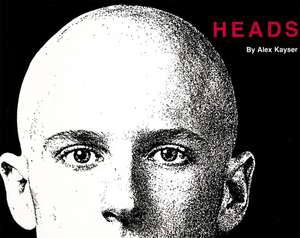
Heads
Fotografii de Alex Kayseren Limba Engleză Paperback – 2 oct 2020
În acest volum fascinant, fotograful de avangardă Alex Kayser ne propune o experiență vizuală brută, care forțează limitele portretisticii tradiționale. Găsim în această carte o explorare aproape chirurgicală a chipului uman, „dezbrăcat” de artificiile sociale precum machiajul sau coafura. Perspectiva curatorului este una de simplificare radicală: prin adunarea a 184 de bărbați și femei a căror singură trăsătură comună este absența părului, Heads devine un studiu despre esența identității. Observăm cum trăsăturile feței, eliberate de „deghizările civilizației”, încep să comunice într-un limbaj nou, pur senzorial. Pe raftul de artă, alături de Humans de Henry Carroll, acest album se distinge prin rigoarea sa conceptuală și concentrarea obsesivă pe un singur element anatomic, transformând scalpul și chipul într-o topografie încărcată de emoție. Structura cărții este una tripartită, facilitând o incursiune graduală în universul autorului: începe cu „The Conversation”, unde Alex Kayser își dezvăluie procesul creativ, continuă cu nucleul vizual „The Heads” și se încheie cu „The Afterword”, un eseu provocator semnat de Richard Howard. Ritmul vizual este alert, dar impune popasuri necesare pentru a analiza texturile pielii și expresiile nefiltrate ale unor subiecți diverși — de la piloți de marină la maeștri bucătari. Spre deosebire de abordarea ludică din Here a Face, There a Face de Arlene Alda, unde chipurile sunt căutate în obiecte cotidiene, Heads confruntă privitorul cu umanitatea în forma sa cea mai vulnerabilă și autentică.
Preț: 120.32 lei
Carte indisponibilă temporar
Specificații
ISBN-10: 0896595242
Pagini: 128
Dimensiuni: 284 x 223 x 12 mm
Greutate: 0.66 kg
Editura: Abbeville Press
De ce să citești această carte
Recomandăm această carte celor pasionați de fotografia antropologică și de studiul fizionomiei umane. Cititorul câștigă o perspectivă inedită asupra diversității, descoperind cum identitatea profesională sau socială pălește în fața trăsăturilor biologice brute. Este un instrument vizual excelent pentru artiști, sculptori sau fotografi care doresc să înțeleagă structura capului uman dincolo de estetica convențională a frumuseții.
Despre autor
Alex Kayser a fost un fotograf elvețian de avangardă, cunoscut pentru abordarea sa conceptuală și minimalistă în portretistică. Cariera sa s-a concentrat pe explorarea limitelor reprezentării umane, adesea prin eliminarea elementelor distractive pentru a sublinia esența subiectului. Lucrările sale sunt caracterizate de o claritate vizuală izbitoare și de o capacitate rară de a transforma observația documentară în artă provocatoare. În volumul Heads, Kayser își demonstrează măiestria de a extrage emoție pură din austeritate, consolidându-și locul în categoria fotografilor celebri care au redefinit limbajul vizual contemporan.
Descriere scurtă
A hat designer, Punk musician, sculptor, fireman, professional rent-a-Buddha, heavyweight boxer, peace movement worker, gourmet chef, United Nations official, dog trainer, chiropractor, sanitation worker, Marine Corps pilot, tire retreader-these and many more: 184 men and women with only one thing in common. They are bald. Unmasked, void of make-up and shorn of hair, stripped of civilized disguise, what does a human face say? And how does it make us feel? Avant-garde photographer Alex Kayser launches us on an odyssey into the emotionally charged topography of the human countenance. Kayser shares the story of his work in a delightfully candid conversation, and National Book Award winner Richard Howard provides a brilliant and provocative afterword.
Notă biografică
Extras
LM: This book consists of one photograph, you said?
AK: Yes, 184 times the same picture. Only the faces change. There is a different person in every shot.
LM: Why doesn't anyone have hair?
AK: Some of them have no hair naturally, but most of them shave their heads daily.
AA: What in the world started you off on a project of photographing bald people?
AK: This book isn't about baldness. It has nothing to do with bald people. It has to do with faces, exposed faces. I wanted to eliminate hair in this series in order to deal solely with physiognomy. Hair would have been quite distracting.
LM: It really works. As a viewer, you go directly into the face, and you get lost in its features. This guy is great. Who is he?
AK: He's the vice president of a big steel company, and the one down here is the fourteen-year-old singer of a New Wave band. The people photographed come from just about every walk of life.
LM: This book is all headshots. Amazing. I never saw anything this sharp, this clear before.
AK: I tried to do an honest, straight series, not faking anything, not flattering, but analytic, if you like.
LM: For me, what makes the pictures so attractive is their directness. You get totally taken in by the subject. Its almost impossible to escape. But why isn't anybody smiling?
AK: Why isn't Michelangelo's David smiling? I tried to do physiognomy studies rather than portraits, which is why I tried to give them all the same neutral expression. Some of my naturally happy models I would ask to stop smiling. Others again I would try to relax. And many would sit down and be just right.
AA: You have enforced such uniformity, headshots framed exactly the same way, shot from the same angle with the same light, all the models without hair. They seem to be identical at first glance, because of their equal abstract quality.
AK: They were designed to work in a group, and not so much as individual pictures. Their identical design was necessary, much as bricks have to be the same size to build a house. If every picture element that you can control is the same, the differences are solely in the faces. Thats why the individual physiognomy and character come through so strongly.
AA: How did you find all these people?
AK: Some I saw on television or in the New York Times. Others I met in the street, at a club, or restaurant. One day, looking through my window, I noticed this nice guy, he's a sanitation man. He was down there with his huge truck, picking up garbage across the street. My assistant ran down after him to say hello and tell him about our project.
LM: What did he say?
AK: He was delighted with the idea of being photographed and came to the studio a few days later during his lunch break. But most of the people in Heads I did not discover myself. My friends and all the other people who frequent my studio during the week always had the greatest ideas and suggestions. They would go: "Oh, you should get my neighbor from the third floor." Or, "My hairdresser has such a beautiful head." And, "You have to get the lawyer of my company." Everybody seemed to know somebody he thought was just right for the series, and I was really amazed to find people so enthusiastic, almost passionate to contribute something to that work. Without them, this book would not be here.
LM: Did you photograph everyone who was sent to you?
AK: Yes. The only requirement was that they have no hair. For the rest, I felt quite comfortable with Warhol’s "everything is beautiful" principle. So I worked with everybody who was recommended to me, and one day I ended up having 250 pictures.
LM: Are they all going to be in the book?
AK: I hoped they would be, but then we had to cut the number down to 184 to make the book work.
AA: How did you decide, then, who was going to be in the book?
AK: This was simply a mathematical decision, and not an aesthetic or even personal one. It was hard, though, since these pictures are all the same in any of their qualities. I felt like I wanted to pick and choose with closed eyes.
LM: But, as an artist and photographer, didn’t you get bored doing the same kind of shot over and over again?
AK: One would think so, but I could still do more. Originally, I had planned to do a series of twelve, maybe twenty heads. But then the response I got from people, their suggestions and introductions, was so overwhelming that I just went on with it. Also, since I was making groups out of the individual pictures, I would always need another particular face to match the one of Duane, Bill, or Annie. Or I was waiting for another black guy with a big beard. Each of the models brought his or her own aura into the picture. So, somehow, when I put the groups together, these different auras became like different colors when you paint or different spices when you cook. Depending on how they are put together, each group turns out to have a very specific feeling of its own. I went on and on. Even when this work started to become routine--and the shooting itself took only ten minutes—meeting with this incredible variety of people remained enormously interesting. Some days you had to be up very early to receive a Wall Street broker at 8 a.m. So, over a small breakfast, you would hear some news from the stock market. Then at 9 a.m. you would shoot this yoga teacher, who has to be out by 10, because he is teaching an 11:30 class at Rikers Island prison. At 3 p.m. a rock musician would show up, playing you a cassette of his groups latest concert, commenting on his work. At 4 you would have an inspector from the New York City Health Department, a man who inspects hospitals. He is very kind and modest and at first does not quite know why I would ask him to model for me. Then at 5 p.m. the actor Harve Presnell, already with some make–up on for tonight’s show (or for me?), would tell me about what it was like playing Daddy Warbucks in Broadway’s Annie 1,600 times…