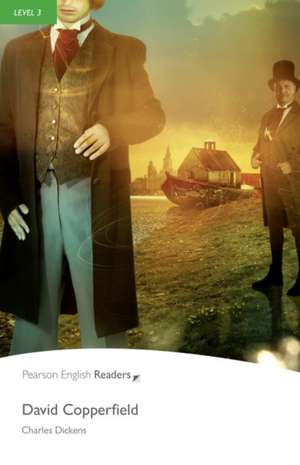
David Copperfield: Penguin Readers
Autor Charles Dickens Editat de Nigel Grimshawen Limba Engleză Paperback – iun 2012
Vezi toate premiile Carte premiată
Lectura romanului David Copperfield se simte ca o întoarcere acasă într-o lume în care, deși suferința este prezentă, bunătatea și perseverența găsesc întotdeauna o cale de exprimare. Atmosfera este una de o melancolie luminoasă, specifică unei retrospecții asupra propriei vieți, în care amintirile dureroase sunt îndulcite de trecerea timpului. Subliniem faptul că aceasta este, poate, cea mai personală operă a lui Charles Dickens, o oglindă fidelă a propriei sale ascensiuni de la munca istovitoare într-o fabrică la statutul de om de litere.
Meritǎ menționat că structura narativă este una de tip bildungsroman, oferind o perspectivă intimă, la prima persoană, asupra transformării unui băiat orfan într-un bărbat cu principii solide. Ritmul este unul așezat, victorian, permițând personajelor precum exuberantul Mr. Micawber sau umilul, dar periculosul Uriah Heep, să prindă viață cu o forță aproape tangibilă. Notăm cu interes cum autorul împletește realismul social dur cu momente de un umor fin și o căldură umană profundă.
Amintește de Great Expectations prin tema ascensiunii sociale și a descoperirii de sine, dar se diferențiază prin tonul mult mai optimist și prin natura sa vădit autobiografică, oferind o fereastră rară către inima autorului. Față de rigoarea istorică din A Tale of Two Cities, acest roman rămâne ancorat în experiența domestică și psihologică, transformând viața obișnuită a unui om într-o epopee a rezilienței. Este o lucrare fundamentală care sintetizează obsesiile lui Dickens: reforma socială, protecția copilului și puterea scrisului de a schimba destine.
Din seria Penguin Readers
-
 Preț: 49.59 lei
 -
 Preț: 49.59 lei
 -
 Preț: 49.59 lei
 -
 Preț: 49.59 lei
 -
 Preț: 49.59 lei
 -
 Preț: 49.59 lei
 -
 Preț: 49.59 lei
 -
 Preț: 49.59 lei
 -
 Preț: 49.59 lei
 -
 Preț: 49.59 lei
 -
 Preț: 49.59 lei
 -
 Preț: 49.59 lei
 -
 Preț: 49.59 lei
 -
 Preț: 49.59 lei
 -
 Preț: 49.59 lei
 -
 Preț: 49.59 lei
 -
 Preț: 49.59 lei
 -
 Preț: 49.59 lei
 -
 Preț: 49.59 lei
 -
 Preț: 49.59 lei
 -
 Preț: 49.59 lei
 -
 Preț: 49.59 lei
 -
 Preț: 49.59 lei
 -
 Preț: 49.59 lei
 -
 Preț: 49.59 lei
 -
 Preț: 49.59 lei
 -
 Preț: 49.59 lei
 -
 Preț: 49.59 lei
 -
 Preț: 49.59 lei
 -
 Preț: 49.59 lei
 -
 Preț: 49.59 lei
 -
 Preț: 49.59 lei
 -
 Preț: 49.59 lei
 -
 Preț: 49.59 lei
 -
 Preț: 49.59 lei
 -
 Preț: 49.59 lei
 -
 Preț: 49.59 lei
 -
 Preț: 49.59 lei
 -
 Preț: 49.59 lei
 -
 Preț: 49.59 lei
 -
 Preț: 49.59 lei
 -
 Preț: 49.59 lei
 -
 Preț: 49.59 lei
 -
 Preț: 49.59 lei
 -
 Preț: 49.59 lei
 -
 Preț: 49.59 lei
 -
 Preț: 49.59 lei
 -
 Preț: 49.59 lei
 -
 Preț: 49.59 lei
Preț: 82.53 lei
Carte indisponibilă temporar
Specificații
ISBN-10: 1447925459
Pagini: 100
Dimensiuni: 136 x 20 x 8 mm
Greutate: 0.11 kg
Ediția:3rd edition.
Editura: Pearson Longman
Seria Penguin Readers
V-ar putea interesa
-
 The White SpiderHeinrich HarrerPreț: 79.55 lei
 -
 Robinson CrusoeDaniel DefoePreț: 28.01 lei
 -
 Great ExpectationsCharles DickensPreț: 28.01 lei
 -
 Tess of the D'UrbervillesThomas HardyPreț: 28.01 lei
 -
 Carve the MarkVeronica RothPreț: 67.02 lei
 -
 The Handmaid's TaleMargaret Atwood-18%Preț: 59.78 lei72.48 lei
 -
 A Year in ProvencePeter Mayle-19%Preț: 63.36 lei78.42 lei
 -
 The Rape of the Lock and Other Major WritingsAlexander Pope-18%Preț: 77.97 lei94.85 lei
 -
 The Penguin Book of Myths and Legends of Ancient EgyptJoyce Tyldesley-30%Preț: 66.21 lei94.27 lei
 -
 The Adventures of Huckleberry FinnMark Twain-26%Preț: 48.77 lei65.63 lei
 -
 -27%Preț: 47.46 lei64.87 lei
 -
 Poetry by HeartJulie Blake-27%Preț: 80.11 lei109.80 lei
 -
 The Greek MythsRobert Graves-16%Preț: 105.47 lei125.86 lei
 -
 The Silence of the LambsThomas HarrisPreț: 63.64 lei
 -
 -24%Preț: 60.93 lei80.40 lei
 -
 I Am the MessengerMarkus ZusakPreț: 77.49 lei
 -
 HannibalThomas HarrisPreț: 66.47 lei
 -
 Great ExpectationsCharles DickensPreț: 51.08 lei
 -
 Preț: 28.66 lei
 -
 Seven Years in TibetHeinrich HarrerPreț: 79.39 lei
 -
 The Complete Short Stories of Ernest HemingwayErnest HemingwayPreț: 135.86 lei
 -
 Return To TibetHeinrich Harrer-16%Preț: 102.70 lei122.12 lei
 -
 Classic Starts®: Moby-DickArthur Pober-27%Preț: 41.03 lei56.23 lei
 -
 UlyssesJames JoycePreț: 41.38 lei
 -
 Oliver TwistCharles DickensPreț: 37.41 lei
 -
 Lord JimJoseph ConradPreț: 28.01 lei
 -
 DublinersJames JoycePreț: 28.01 lei
 -
 Cat's EyeMargaret Atwood-23%Preț: 62.39 lei81.50 lei
 -
 -26%Preț: 58.55 lei79.00 lei
De ce să citești această carte
Recomandăm acest volum oricărui cititor care dorește să exploreze profunzimea literaturii clasice printr-o poveste despre triumful spiritului uman. Veți câștiga nu doar o imagine fidelă a Angliei victoriene, ci și o lecție despre cum trauma poate fi transformată în creativitate. Este lectura ideală pentru cei care caută personaje complexe, cu care pot stabili o conexiune emoțională durabilă, într-o ediție de colecție oferită de Signet Classics.
Despre autor
Charles Dickens (1812–1870) a fost cel mai popular romancier al epocii victoriene și un critic social acerb. Experiențele sale timpurii, inclusiv munca forțată într-o fabrică în timp ce tatăl său era închis pentru datorii, au devenit fundamentul tematic al operelor sale. Jurnalist prolific și apărător al drepturilor copiilor, Dickens a revoluționat literatura prin publicarea în foileton, transformând romane precum The Pickwick Papers în fenomene culturale. David Copperfield rămâne „copilul său favorit”, fiind lucrarea în care și-a turnat cele mai profunde amintiri și aspirații personale.
Descriere scurtă
Descriere
In a preface to this novel, Dickens described David Copperfield as his “favorite child,” and the story has remained among the favorites of Dickens’ readers, too, with the characters of Betsy Trotwood, Mr. Pegotty, Uriah Heep, and Wilkins Micawber as well as David himself becoming part of the fabric of Western culture. This facsimile reprint is of the Household Edition of the Works of Charles Dickens, published in the 1870s; the edition makes the work available again in a form in which tens of thousands of Victorians read it—in two-column format, interspersed with illustrations throughout.
David Copperfield was originally published in nineteen monthly parts between May 1, 1849 and November 1, 1850.* Each part except the last was of roughly the same length; the final installment was approximately twice as long as the others (and sold for 2 shillings, twice the price of previous parts). For the original serial publication, as well as early publication in book form, David Copperfield was illustrated by Hablot Browne (more commonly known as “Phiz”).
Shortly after Dickens’ death in 1870 the British publisher Chapman & Hall began to issue the Household Edition of the Works of Charles Dickens (not to be confused with the American Household Edition of the Works, which appeared in the 1860s). The principal illustrator for the edition was Fred Barnard, and the Dalziel brothers (the leading wood-engravers of the time) created the engravings from Barnard’s illustrations; they described The Household Edition as “by far the most important commission ever placed in our hands by Messrs. Chapman & Hall.” Volumes in The Household Edition began to appear in 1871, and the series was completed in 1879. Dickens’ works appeared in a great many Victorian editions (including numerous pirated ones). Scholars have understandably paid most attention to the earliest publication in serial form; The Household Edition may well have been the most popular form in which the novel appeared, however; the plates for The Household Edition were widely used for other editions as well, and it is certainly arguable that more Victorian readers would have read Dickens’ novels in this form than in any other. In 1911 the populist bibliophile J.A. Hammerton described The Household Edition as “the most important illustrated edition” of Dickens’ works.
This is one of a series from Broadview Press of facsimile editions—editions that provide readers with a direct sense of these works as the Victorians themselves experienced them.
The breaks were as follows: I – May 1849 (chs. 1–3); II – June 1849 (chs. 4–6); III – July 1849 (chs. 7–9); IV – August 1849 (chs. 10–12); V – September 1849 (chs. 13–15); VI – October 1849 (chs. 16–18); VII – November 1849 (chs. 19–21); VIII – December 1849 (chs. 22–24); IX – January 1850 (chs. 25–27); X – February 1850 (chs. 28–31); XI – March 1850 (chs. 32–34); XII – April 1850 (chs. 35–37); XIII – May 1850 (chs. 38–40); XIV – June 1850 (chs. 41–43); XV – July 1850 (chs. 44–46); XVI – August 1850 (chs. 47–50); XVII – September 1850 (chs. 51–53); XVIII – October 1850 (chs. 54–57); XIX-XX – November 1850 (chs. 58–64).
Recenzii
Notă biografică
When the family fortunes improved, Charles went back to school, after which he became an office boy, a freelance reporter and finally an author. With Pickwick Papers (1836-7) he achieved immediate fame; in a few years he was easily the post popular and respected writer of his time. It has been estimated that one out of every ten persons in Victorian England was a Dickens reader. Oliver Twist (1837), Nicholas Nickleby (1838-9) and The Old Curiosity Shop (1840-41) were huge successes. Martin Chuzzlewit (1843-4) was less so, but Dickens followed it with his unforgettable, A Christmas Carol (1843), Bleak House (1852-3), Hard Times (1854) and Little Dorrit (1855-7) reveal his deepening concern for the injustices of British Society. A Tale of Two Cities (1859), Great Expectations (1860-1) and Our Mutual Friend (1864-5) complete his major works.
Dickens’s marriage to Catherine Hoggarth produced ten children but ended in separation in 1858. In that year he began a series of exhausting public readings; his health gradually declined. After putting in a full day’s work at his home at Gads Hill, Kent on June 8, 1870, Dickens suffered a stroke, and he died the following day.
From the Paperback edition.
Extras
I Am Born
Whether I shall turn out to be the hero of my own life, or whether that station will be held by anybody else, these pages must show. To begin my life with the beginning of my life, I record that I was born (as I have been informed and believe) on a Friday, at twelve o'clock at night. It was remarked that the clock began to strike, and I began to cry, simultaneously.
In consideration of the day and hour of my birth, it was declared by the nurse, and by some sage women in the neighbourhood who had taken a lively interest in me several months before there was any possibility of our becoming personally acquainted, first, that I was destined to be unlucky in life; and secondly, that I was privileged to see ghosts and spirits; both these gifts inevitably attaching, as they believed, to all unlucky infants of either gender, born towards the small hours on a Friday night.
I need say nothing here on the first head, because nothing can show better than my history whether that prediction was verified or falsified by the result. On the second branch of the question, I will only remark, that unless I ran through that part of my inheritance while I was still a baby, I have not come into it yet. But I do not at all complain of having been kept out of this property; and if anybody else should be in the present enjoyment of it, he is heartily welcome to keep it.
I was born with a caul, which was advertised for sale, in the newspapers, at the low price of fifteen guineas. Whether sea-going people were short of money about that time, or were short of faith and preferred cork jackets, I don't know; all I know is, that there was but one solitary bidding, and that was from an attorney connected with the bill-broking business, who offered two pounds in cash, and the balance in sherry, but declined to be guaranteed from drowning on any higher bargain. Consequently the advertisement was withdrawn at a dead loss–for as to sherry, my poor dear mother's own sherry was in the market then–and ten years afterwards the caul was put up in a raffle down in our part of the country, to fifty members at half a crown a head, the winner to spend five shillings. I was present myself, and I remember to have felt quite uncomfortable and confused, at a part of myself being disposed of in that way. The caul was won, I recollect, by an old lady with a hand-basket, who, very reluctantly, produced from it the stipulated five shillings, all in halfpence, and twopence halfpenny short–as it took an immense time and a great waste of arithmetic, to endeavour without any effect to prove to her. It is a fact which will be long remembered as remarkable down there, that she was never drowned, but died triumphantly in bed, at ninety-two. I have understood that it was, to the last, her proudest boast, that she never had been on the water in her life, except upon a bridge; and that over her tea (to which she was extremely partial) she, to the last, expressed her indignation at the impiety of mariners and others, who had the presumption to go 'meandering' about the world. It was in vain to represent to her that some conveniences, tea perhaps included, resulted from this objectionable practice. She always returned, with greater emphasis and with an instinctive knowledge of the strength of her objection, 'Let us have no meandering.'
Not to meander myself, at present, I will go back to my birth.
I was born at Blunderstone, in Suffolk, or 'thereby,' as they say in Scotland. I was a posthumous child. My father's eyes had closed upon the light of this world six months, when mine opened on it. There is something strange to me, even now, in the reflection that he never saw me; and something stranger yet in the shadowy remembrance that I have of my first childish associations with his white gravestone in the churchyard, and of the indefinable compassion I used to feel for it lying out alone there in the dark night, when our little parlour was warm and bright with fire and candle, and the doors of our house were–almost cruelly, it seemed to me sometimes–bolted and locked against it.
An aunt of my father's, and consequently a great-aunt of mine, of whom I shall have more to relate by-and-by, was the principal magnate of our family. Miss Trotwood, or Miss Betsey, as my poor mother always called her, when she sufficiently overcame her dread of this formidable personage to mention her at all (which was seldom), had been married to a husband younger than herself, who was very handsome, except in the sense of the homely adage, 'handsome is, that handsome does'–for he was strongly suspected of having beaten Miss Betsey, and even of having once, on a disputed question of supplies, made some hasty but determined arrangements to throw her out of a two pair of stairs' window. These evidences of an incompatibility of temper induced Miss Betsey to pay him off, and effect a separation by mutual consent. He went to India with his capital, and there, according to a wild legend in our family, he was once seen riding on an elephant, in company with a Baboon; but I think it must have been a Baboo–or a Begum. Anyhow, from India tidings of his death reached home, within ten years. How they affected my aunt, nobody knew; for immediately upon the separation she took her maiden name again, bought a cottage in a hamlet on the sea-coast a long way off, established herself there as a single woman with one servant, and was understood to live secluded, ever afterwards, in an inflexible retirement.
My father had once been a favourite of hers, I believe; but she was mortally affronted by his marriage, on the ground that my mother was 'a wax doll.' She had never seen my mother, but she knew her to be not yet twenty. My father and Miss Betsey never met again. He was double my mother's age when he married, and of but a delicate constitution. He died a year afterwards, and, as I have said, six months before I came into the world.
This was the state of matters on the afternoon of, what I may be excused for calling, that eventful and important Friday. I can make no claim, therefore, to have known, at that time, how matters stood; or to have any remembrance, founded on the evidence of my own senses, of what follows.
My mother was sitting by the fire, but poorly in health, and very low in spirits, looking at it through her tears, and desponding heavily about herself and the fatherless little stranger, who was already welcomed by some grosses of prophetic pins in a drawer upstairs, to a world not at all excited on the subject of his arrival; my mother, I say, was sitting by the fire, that bright, windy March afternoon, very timid and sad, and very doubtful of ever coming alive out of the trial that was before her, when, lifting her eyes as she dried them, to the window opposite, she saw a strange lady coming up the garden.
My mother had a sure foreboding at the second glance, that it was Miss Betsey. The setting sun was glowing on the strange lady, over the garden fence, and she came walking up to the door with a fell rigidity of figure and composure of countenance that could have belonged to nobody else.
When she reached the house, she gave another proof of her identity. My father had often hinted that she seldom conducted herself like any ordinary Christian; and now, instead of ringing the bell, she came and looked in at that identical window, pressing the end of her nose against the glass to that extent that my poor dear mother used to say it became perfectly flat and white in a moment.
She gave my mother such a turn, that I have always been convinced I am indebted to Miss Betsey for having been born on a Friday.
My mother had left her chair in her agitation, and gone behind it in the corner. Miss Betsey, looking round the room, slowly and inquiringly, began on the other side, and carried her eyes on, like a Saracen's head in a Dutch clock, until they reached my mother. Then she made a frown and a gesture to my mother, like one who was accustomed to be obeyed, to come and open the door. My mother went.
'Mrs. David Copperfield, I think,' said Miss Betsey; the emphasis referring, perhaps, to my mother's mourning weeds, and her condition.
'Yes,' said my mother, faintly.
'Miss Trotwood,' said the visitor. 'You have heard of her, I dare say?'
My mother answered she had had that pleasure. And she had a disagreeable consciousness of not appearing to imply that it had been an overpowering pleasure.
'Now you see her,' said Miss Betsey. My mother bent her head, and begged her to walk in.
They went into the parlour my mother had come from, the fire in the best room on the other side of the passage not being lighted–not having been lighted, indeed, since my father's funeral; and when they were both seated, and Miss Betsey said nothing, my mother, after vainly trying to restrain herself, began to cry.
'Oh, tut, tut, tut!' said Miss Betsey, in a hurry. 'Don't do that! Come, come!'
My mother couldn't help it notwithstanding, so she cried until she had had her cry out.
'Take off your cap, child,' said Miss Betsey, 'and let me see you.'
My mother was too much afraid of her to refuse compliance with this odd request, if she had any disposition to do so. Therefore she did as she was told, and did it with such nervous hands that her hair (which was luxuriant and beautiful) fell all about her face.
'Why, bless my heart!' exclaimed Miss Betsey. 'You are a very baby!'
My mother was, no doubt, unusually youthful in appearance even for her years; she hung her head, as if it were her fault, poor thing, and said, sobbing, that indeed she was afraid she was but a childish widow, and would be but a childish mother if she lived. In a short pause which ensued, she had a fancy that she felt Miss Betsey touch her hair, and that with no ungentle hand; but, looking at her, in her timid hope, she found that lady sitting with the skirt of her dress tucked up, her hands folded on one knee, and her feet upon the fender, frowning at the fire.
'In the name of Heaven,' said Miss Betsey, suddenly, 'why Rookery?'
'Do you mean the house, ma'am?' asked my mother.
'Why Rookery?' said Miss Betsey. 'Cookery would have been more to the purpose, if you had had any practical ideas of life, either of you.'
'The name was Mr. Copperfield's choice,' returned my mother. 'When he bought the house, he liked to think that there were rooks about it.'
The evening wind made such a disturbance just now, among some tall old elm-trees at the bottom of the garden, that neither my mother nor Miss Betsey could forbear glancing that way. As the elms bent to one another, like giants who were whispering secrets, and after a few seconds of such repose, fell into a violent flurry, tossing their wild arms about, as if their late confidences were really too wicked for their peace of mind, some weather-beaten ragged old rooks'-nests burdening their higher branches, swung like wrecks upon a stormy sea.
'Where are the birds?' asked Miss Betsey.
'The–?' My mother had been thinking of something else.
'The rooks–what has become of them?' asked Miss Betsey.
'There have not been any since we have lived here,' said my mother. 'We thought–Mr. Copperfield thought–it was quite a large rookery; but the nests were very old ones, and the birds have deserted them a long while.'
'David Copperfield all over!' cried Miss Betsey. 'David Copperfield from head to foot! Calls a house a rookery when there's not a rook near it, and takes the birds on trust, because he sees the nests!'
'Mr. Copperfield,' returned my mother, 'is dead, and if you dare to speak unkindly of him to me–'
My poor dear mother, I suppose, had some momentary intention of committing an assault and battery upon my aunt, who could easily have settled her with one hand, even if my mother had been in far better training for such an encounter than she was that evening. But it passed with the action of rising from her chair; and she sat down again very meekly, and fainted.
When she came to herself, or when Miss Betsey had restored her, whichever it was, she found the latter standing at the window. The twilight was by this time shading down into darkness; and dimly as they saw each other, they could not have done that without the aid of the fire.
'Well?' said Miss Betsey, coming back to her chair, as if she had only been taking a casual look at the prospect; 'and when do you expect–'
'I am all in a tremble,' faltered my mother. 'I don't know what's the matter. I shall die, I am sure!'
'No, no, no,' said Miss Betsey. 'Have some tea.'
'Oh dear me, dear me, do you think it will do me any good?' cried my mother in a helpless manner.
'Of course it will,' said Miss Betsey. 'It's nothing but fancy. What do you call your girl?'
'I don't know that it will be a girl, yet, ma'am,' said my mother innocently.
'Bless the baby!' exclaimed Miss Betsey, unconsciously quoting the second sentiment of the pin-cushion in the drawer upstairs, but applying it to my mother instead of me, 'I don't mean that. I mean your servant.'
'Peggotty,' said my mother.
'Peggotty!' repeated Miss Betsey, with some indignation. 'Do you mean to say, child, that any human being has gone into a Christian church, and got herself named Peggotty?'
'It's her surname,' said my mother, faintly. 'Mr. Copperfield called her by it, because her Christian name was the same as mine.'
'Here, Peggotty!' cried Miss Betsey, opening the parlour-door. 'Tea. Your mistress is a little unwell. Don't dawdle.'
Having issued this mandate with as much potentiality as if she had been a recognised authority in the house ever since it had been a house, and having looked out to confront the amazed Peggotty coming along the passage with a candle at the sound of a strange voice, Miss Betsey shut the door again, and sat down as before; with her feet on the fender, the skirt of her dress tucked up, and her hands folded on one knee.
'You were speaking about its being a girl,' said Miss Betsey. 'I have no doubt it will be a girl. I have a presentiment that it must be a girl. Now child, from the moment of the birth of this girl–'
'Perhaps boy,' my mother took the liberty of putting in.
'I tell you I have a presentiment that it must be a girl,' returned Miss Betsey. 'Don't contradict. From the moment of this girl's birth, child, I intend to be her friend. I intend to be her godmother, and I beg you'll call her Betsey Trotwood Copperfield. There must be no mistakes in life with this Betsey Trotwood. There must be no trifling with her affections, poor dear. She must be well brought up, and well guarded from reposing any foolish confidences where they are not deserved. I must make that my care.'
Premii
- Audies Finalist, 2003