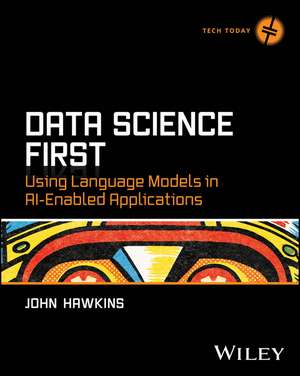
Data Science First
Autor John Hawkinsen Limba Engleză Paperback – 7 apr 2026
Data Science First: Using Language Models in AI-Enabled Applications, by Intersect AI's Chief AI Officer John Hawkins, explains how practicing data scientists can integrate language models in data science workflows without abandoning essential principles of reliability, accuracy, and efficacy. Hawkins offers crystal-clear guidance on when, where, and how data scientists can integrate language models into their existing workflows without exposing themselves or their companies to unnecessary risks.
This guide walks you through strategic design patterns for incorporating language models into real-world data science projects. It avoids strategies and techniques that rely heavily on proprietary tools that are likely to evolve very quickly (or could disappear entirely) in the near future. Instead, the author presents foundational methodologies that will remain valuable regardless of how individual platforms or services change. The book combines sound theory with practical case studies that cover common data science projects in the education, insurance, telecommunications, media and banking industries. Including customer churn analysis, customer complaint routing and document processing, demonstrating how language models can enhance rather than replace traditional data science methods.
You'll find:
- Three chapters providing a solid grounding in the ideas, principles and technologies that are used for data science with language models
- Nine chapters that discuss specific patterns for integrating language models into data science workflows, including semantic vector analysis, few-shot prompting, retrieval-based applications, synthetic data generation and AI agent development
- Real-world case studies discussing applications like fraud detection, customer churn, translation, document classification and sentiment analysis, with concrete business applications
- Comprehensive evaluation methods and testing frameworks are discussed in the context of language model applications in enterprise environments
- Practical code examples and implementation guidance using popular tools like HuggingFace, OpenAI, Google Gemini, as well as more development frameworks like LangChain, and PydanticAI
- Strategic insights for balancing model accuracy, interpretability, and business requirements while avoiding common pitfalls in AI deployment
Preț: 397.97 lei
Preț vechi: 497.46 lei
-20%
Puncte Express: 597
Carte disponibilă
Livrare economică 12-26 noiembrie
Livrare express 28 octombrie-03 noiembrie pentru 46.41 lei
Livrare prin curier în România Termenul estimat este afișat lângă disponibilitate.
Transport gratuit de la 400.00 lei Plată online sau ramburs, în funcție de opțiunile comenzii.
Retur gratuit în 14 zile Comandă securizată și suport în română.
Specificații
ISBN-13: 9781394390472
ISBN-10: 1394390475
Pagini: 368
Dimensiuni: 188 x 235 x 23 mm
Greutate: 0.76 kg
Editura: Wiley
ISBN-10: 1394390475
Pagini: 368
Dimensiuni: 188 x 235 x 23 mm
Greutate: 0.76 kg
Editura: Wiley
Notă biografică
JOHN HAWKINS is the Chief AI Officer at Intersect AI, an organization that builds bespoke AI solutions to solve real workplace problems for companies in industries like insurance, media and healthcare. He leads the company's data science initiatives, working with clients directly to analyze their workflow processes and design people centred AI systems.
Cuprins
Acknowledgments vii
About the Author ix
Introduction 1
Chapter 1: Language Models 5
Chapter 2: Tools and Terminology 31
Chapter 3: Data Science Essentials 59
Chapter 4: Semantic Vectors 87
Chapter 5: Insights and Interpretability 113
Chapter 6: Zero-Shot to Few-Shot Prompting 143
Chapter 7: Labeling and Feature Engineering 167
Chapter 8: Synthetic Data Generation 201
Chapter 9: Retrieval Applications 237
Chapter 10: Code as Language 265
Chapter 11: Automated Analytics 291
Chapter 12: Agentic AI 317
Index 347
About the Author ix
Introduction 1
Chapter 1: Language Models 5
Chapter 2: Tools and Terminology 31
Chapter 3: Data Science Essentials 59
Chapter 4: Semantic Vectors 87
Chapter 5: Insights and Interpretability 113
Chapter 6: Zero-Shot to Few-Shot Prompting 143
Chapter 7: Labeling and Feature Engineering 167
Chapter 8: Synthetic Data Generation 201
Chapter 9: Retrieval Applications 237
Chapter 10: Code as Language 265
Chapter 11: Automated Analytics 291
Chapter 12: Agentic AI 317
Index 347