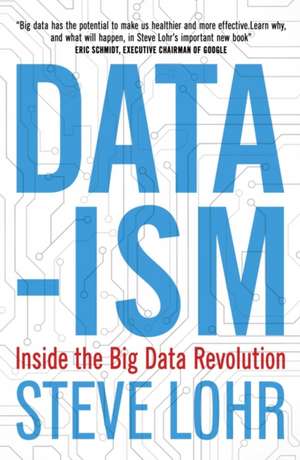
Data-ism
Autor Steve Lohren Limba Engleză Paperback – 4 feb 2016
| Toate formatele și edițiile | Preț | Express |
|---|---|---|
| Paperback (2) | 68.94 lei 3-5 săpt. | +10.74 lei 6-12 zile |
| Oneworld Publications – 4 feb 2016 | 68.94 lei 3-5 săpt. | +10.74 lei 6-12 zile |
| Harper Collins Publishers – 14 feb 2017 | 85.97 lei Precomandă | |
| Hardback (1) | 154.89 lei 3-5 săpt. | |
| Harpercollins – 10 mar 2015 | 154.89 lei 3-5 săpt. |
Preț: 68.94 lei
Puncte Express: 103
Preț estimativ în valută:
12.18€ • 13.97$ • 10.57£
12.18€ • 13.97$ • 10.57£
Carte disponibilă
Livrare economică 23 aprilie-07 mai
Livrare express 08-14 aprilie pentru 20.73 lei
Specificații
ISBN-13: 9781780748368
ISBN-10: 1780748361
Pagini: 256
Dimensiuni: 129 x 197 x 30 mm
Greutate: 0.24 kg
Editura: Oneworld Publications
ISBN-10: 1780748361
Pagini: 256
Dimensiuni: 129 x 197 x 30 mm
Greutate: 0.24 kg
Editura: Oneworld Publications
V-ar putea interesa
-
 On the EdgeNate SilverPreț: 104.11 lei
 -
 Big Data: A Very Short IntroductionDawn E. Holmes-37%Preț: 45.53 lei72.24 lei
 -
 The Infinite AlphabetCésar A. HidalgoPreț: 182.18 lei
 -
 Data Is Everybody's BusinessBarbara H. WixomPreț: 125.11 lei
 -
 Sensemaking: What Makes Human Intelligence Essential in the Age of the AlgorithmChristian Madsbjerg-28%Preț: 63.40 lei88.40 lei
 -
 Preț: 406.07 lei
 -
 Winning with DataTomasz TunguzPreț: 129.77 lei
 -
 Fail Fast, Learn FasterRandy BeanPreț: 157.94 lei
 -
 The Sea We Swim inFrank RosePreț: 111.89 lei
 -
 Storytelling with DataCole Nussbaumer KnaflicPreț: 238.46 lei
 -
 Age of Invisible MachinesRobb WilsonPreț: 137.10 lei
 -
 -32%Preț: 78.98 lei116.46 leiRecomandat
 -
 Preț: 137.54 lei
 -
 Big Data: Does Size Matter?Timandra Harkness-42%Preț: 55.01 lei94.22 lei
 -
 Big Data: The Essential Guide to Work, Life and Learning in the Age of InsightViktor Mayer-Schonberger-28%Preț: 63.81 lei88.66 lei
 -
 Reinventing Capitalism in the Age of Big DataViktor Mayer-Schonberger-28%Preț: 64.14 lei88.83 lei
 -
 Big DataBrian CleggPreț: 61.94 lei
 -
 Data CultureAlex VailPreț: 102.96 lei
 -
 Preț: 133.10 lei
Notă biografică
FROM NY TIMES WEBSITE
Steve Lohr reports on technology, business and economics. He was a foreign correspondent for The Times for a decade and served brief stints as an editor, before covering technology, starting in the early 1990s.
In 2013, he was part of the team awarded the Pulitzer Prize for Explanatory Reporting ¿for its penetrating look into business practices by Apple and other technology companies that illustrates the darker side of a changing global economy for workers and consumers.¿
He has written for magazines including The New York Times Magazine, The Atlantic Monthly and The Washington Monthly. He is the author of a history of computer programming, ¿Go To: The Story of the Math Majors, Bridge Players, Engineers, Chess Wizards, Maverick Scientists and Iconoclasts ¿ The Programmers Who Created the Software Revolution¿ (Basic Books, 2001; paperback, 2002).
Steve Lohr reports on technology, business and economics. He was a foreign correspondent for The Times for a decade and served brief stints as an editor, before covering technology, starting in the early 1990s.
In 2013, he was part of the team awarded the Pulitzer Prize for Explanatory Reporting ¿for its penetrating look into business practices by Apple and other technology companies that illustrates the darker side of a changing global economy for workers and consumers.¿
He has written for magazines including The New York Times Magazine, The Atlantic Monthly and The Washington Monthly. He is the author of a history of computer programming, ¿Go To: The Story of the Math Majors, Bridge Players, Engineers, Chess Wizards, Maverick Scientists and Iconoclasts ¿ The Programmers Who Created the Software Revolution¿ (Basic Books, 2001; paperback, 2002).
Textul de pe ultima copertă
By one estimate, 90 percent of all of the data in history was created in the last two years. In 2014, International Data Corporation calculated the data universe at 4.4 zettabytes, or 4.4 trillion gigabytes. That much information, in volume, could fill enough slender iPad Air tablets to create a stack two-thirds of the way to the moon. Now, that's Big Data.
Coal, iron ore, and oil were the key productive assets that fueled the Industrial Revolution. The vital raw material of today's information economy is data.
In Data-ism, New York Times reporter Steve Lohr explains how big-data technology is ushering in a revolution in proportions that promise to be the basis of the next wave of efficiency and innovation across the economy. But more is at work here than technology. Big data is also the vehicle for a point of view, or philosophy, about how decisions will be—and perhaps should be—made in the future. Lohr investigates the benefits of data while also examining its dark side.
Data-ism is about this next phase, in which vast Internet-scale data sets are used for discovery and prediction in virtually every field. It shows how this new revolution will change decision making—by relying more on data and analysis, and less on intuition and experience—and transform the nature of leadership and management. Focusing on young entrepreneurs at the forefront of data science as well as on giant companies such as IBM that are making big bets on data science for the future of their businesses, Data-ism is a field guide to what is ahead, explaining how individuals and institutions will need to exploit, protect, and manage data to stay competitive in the coming years. With rich examples of how the rise of big data is affecting everyday life, Data-ism also raises provocative questions about policy and practice that have wide implications for everyone.
The age of data-ism is here. But are we ready to handle its consequences, good and bad?
Coal, iron ore, and oil were the key productive assets that fueled the Industrial Revolution. The vital raw material of today's information economy is data.
In Data-ism, New York Times reporter Steve Lohr explains how big-data technology is ushering in a revolution in proportions that promise to be the basis of the next wave of efficiency and innovation across the economy. But more is at work here than technology. Big data is also the vehicle for a point of view, or philosophy, about how decisions will be—and perhaps should be—made in the future. Lohr investigates the benefits of data while also examining its dark side.
Data-ism is about this next phase, in which vast Internet-scale data sets are used for discovery and prediction in virtually every field. It shows how this new revolution will change decision making—by relying more on data and analysis, and less on intuition and experience—and transform the nature of leadership and management. Focusing on young entrepreneurs at the forefront of data science as well as on giant companies such as IBM that are making big bets on data science for the future of their businesses, Data-ism is a field guide to what is ahead, explaining how individuals and institutions will need to exploit, protect, and manage data to stay competitive in the coming years. With rich examples of how the rise of big data is affecting everyday life, Data-ism also raises provocative questions about policy and practice that have wide implications for everyone.
The age of data-ism is here. But are we ready to handle its consequences, good and bad?
Recenzii
“In this accessible introduction to a complex topic, Lohr offers insight valuable to both businesses and everyday people.” — Publishers Weekly
“Transformative” — Vanity Fair
“Big data has the potential to make us healthier and more effective. Learn why, and what will happen, in Steve Lohr’s important new book.” — Eric Schmidt, executive chairman of Google
Chock full of anecdotes, insights, and behind-the-scenes profiles of modern-day data gods such as Cloudera’s Jeff Hammerbacher and IBM’s Michael Haydock, Data-Ism is a must-read for understanding Big Data’s impact on society and in your own life. — Oren Etzioni, CEO, Allen Institute For Artificial Intelligence
“The digitization of business has created staggering amounts of data and unprecedented opportunities for data-driven decision-making. If you want to understand this new territory, Steve Lohr is the trusted, insightful guide you need.” — Erik Brynjolfsson, co-author of The Second Machine Age: Work, Progress and Prosperity in a Time of Brilliant Technologies.
“Steve Lohr lays out the promise, the personalities, and the perils of big data in an entertaining and enlightening book.” — Hal Varian, chief economist at Google
“If you want to understand where our world is headed, you need to read this book. It goes beneath the surface of Big Data to provide a penetrating view of the people exploring the edges of how to extract more value from the data.” — John Hagel, Co-Chairman, Center for the Edge
“Transformative” — Vanity Fair
“Big data has the potential to make us healthier and more effective. Learn why, and what will happen, in Steve Lohr’s important new book.” — Eric Schmidt, executive chairman of Google
Chock full of anecdotes, insights, and behind-the-scenes profiles of modern-day data gods such as Cloudera’s Jeff Hammerbacher and IBM’s Michael Haydock, Data-Ism is a must-read for understanding Big Data’s impact on society and in your own life. — Oren Etzioni, CEO, Allen Institute For Artificial Intelligence
“The digitization of business has created staggering amounts of data and unprecedented opportunities for data-driven decision-making. If you want to understand this new territory, Steve Lohr is the trusted, insightful guide you need.” — Erik Brynjolfsson, co-author of The Second Machine Age: Work, Progress and Prosperity in a Time of Brilliant Technologies.
“Steve Lohr lays out the promise, the personalities, and the perils of big data in an entertaining and enlightening book.” — Hal Varian, chief economist at Google
“If you want to understand where our world is headed, you need to read this book. It goes beneath the surface of Big Data to provide a penetrating view of the people exploring the edges of how to extract more value from the data.” — John Hagel, Co-Chairman, Center for the Edge