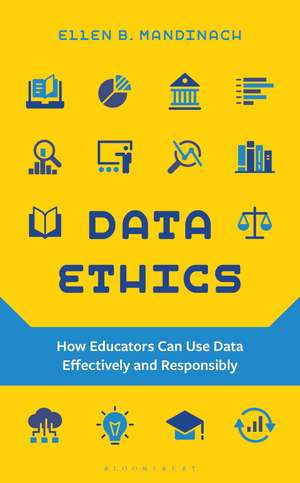
Data Ethics: How Educators Can Use Data Effectively and Responsibly
Autor Ellen B. Mandinachen Limba Engleză Hardback – 19 feb 2026
Preț: 471.64 lei
Preț vechi: 643.07 lei
-27%
Puncte Express: 707
Carte disponibilă
Livrare economică 20 octombrie-03 noiembrie
Livrare prin curier în România Termenul estimat este afișat lângă disponibilitate.
Transport gratuit pentru acest produs Plată online sau ramburs, în funcție de opțiunile comenzii.
Retur gratuit în 14 zile Comandă securizată și suport în română.
Specificații
ISBN-13: 9798216376316
Pagini: 216
Dimensiuni: 152 x 232 x 18 mm
Greutate: 0.46 kg
Editura: Bloomsbury Publishing
Colecția Bloomsbury Academic
Locul publicării:New York, United States
Pagini: 216
Dimensiuni: 152 x 232 x 18 mm
Greutate: 0.46 kg
Editura: Bloomsbury Publishing
Colecția Bloomsbury Academic
Locul publicării:New York, United States
Cuprins
Acknowledgments
Preface
1 An Introduction: Why Data Ethics?
2 Defining Data Ethics-It is More than Just Data Privacy
3 Artificial Intelligence: Implications for Data Ethics
4 A User's Guide to the Scenarios
5 First Set of Scenarios
6 Second Set of Scenarios
7 Change is Systemic-The Roles of Organizations and Agencies
8 What Needs to Happen-Actionable Next Steps: A Recap
References
Index
Preface
1 An Introduction: Why Data Ethics?
2 Defining Data Ethics-It is More than Just Data Privacy
3 Artificial Intelligence: Implications for Data Ethics
4 A User's Guide to the Scenarios
5 First Set of Scenarios
6 Second Set of Scenarios
7 Change is Systemic-The Roles of Organizations and Agencies
8 What Needs to Happen-Actionable Next Steps: A Recap
References
Index
Recenzii
In an era where data-driven decision making has become central to education - al practice, Ellen Mandinach delivers a groundbreaking work that moves beyond technical data skills to address the critical question of how we should use data responsibly. Data Ethics brilliantly demonstrates that effective data use isn't just about having the right numbers. It's about using data appropriately to serve all students equitably. Mandinach's comprehensive framework, built around transparency and consequences, provides educators with practical tools to navigate the complex ethical dilemmas they face daily. From preventing unintended harm to students to resisting accountability pressures that compromise educational integrity, this book offers both theoretical grounding and real-world scenarios that make abstract concepts immediately applicable.
"When educators find themselves-by virtue of an expanding tech infrastructure able to access voluminous amounts of student-specific data and information, discussions about ethical practice must be central to their work. Ethical, healthy data cultures don't just happen-they are built. Ellen Mandinach has written a book that will spark critical conversations educators need to have about how ethical data use necessarily intersects with fast-evolving legal, political, and policy issues.
"When educators find themselves-by virtue of an expanding tech infrastructure able to access voluminous amounts of student-specific data and information, discussions about ethical practice must be central to their work. Ethical, healthy data cultures don't just happen-they are built. Ellen Mandinach has written a book that will spark critical conversations educators need to have about how ethical data use necessarily intersects with fast-evolving legal, political, and policy issues.
Notă biografică
Ellen B. Mandinach is a Senior Research Scientist and a leading expert in the area of data-driven decision making at the classroom, district, and state levels. Her work over the past 20 years has focused on understanding how educators are using data to inform practice. She has written and spoken widely on the topic, and has served on a number of technical working groups and advisory boards on data use. She first developed the construct data literacy for teachers and now culturally responsive data literacy. Dr. Mandinach is working with schools of education, teacher preparation programs, professional organizations, and state and local education agencies to help them integrate culturally responsive data literacy and data ethics into their work. Most recently, she is helping to build the data infrastructure at the Nevada Department of Education and in districts throughout Vermont. She is developing materials on data privacy and data ethics for educator preparation and in-service training to help educators use data effectively and responsibly. Dr. Mandinach has authored dozens of publications for academic journals, technical reports, and seven books. She has guest edited several special issues of journals, including Teachers College Record, Studies in Educational Evaluation, and Teaching and Teacher Education. She was an author on the IES Practice Guide, Using Student Achievement Data to Support Instructional Decision Making. Recent books, Data Literacy for Educators: Making It Count in Teacher Preparation and Practice and Transforming Teaching and Learning Through Data-Driven Decision Making, are volumes that help educators to make better use of data. Her most recent book, The Ethical Use of Data in Education: Promoting Responsible Policies and Practice, focuses on data ethics in education. She has regularly presented at international, national, and regional conferences on education and psychology. She received the 2015 Paul D. Hood Award for Distinguished Contribution to the Field from WestEd. She has served as the President of the American Psychological Association's Division of Educational Psychology. She created the Data-Driven Decision Making in Education Special Interest Group of the American Educational Research Association and served as its first chair. She is a Fellow of APA and AERA. She received an AB in psychology from Smith College and a Ph.D. in educational psychology from Stanford University.