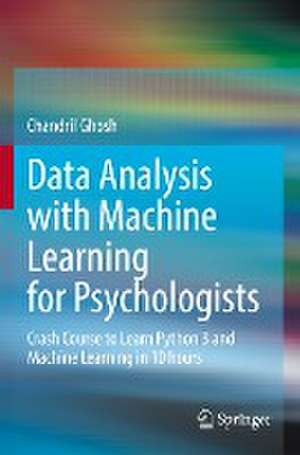
Data Analysis with Machine Learning for Psychologists
Autor Chandril Ghoshen Limba Engleză Paperback – 19 oct 2023
While there are plenty of books covering data science, rarely, if ever, books in the market address the need of social science students with no computer science background. They are typically written by engineers or computer scientists for people of their discipline. As a result, often such books are filled with technical jargon and examples irrelevant to psychological studies or projects. In contrast, this book was written by a psychologist in a simple, easy-to-understand way that is brief and accessible. The aim for this book was to make the learning experience on this topic as smooth as possible for psychology students/researchers with no background in programming or data science.
Completing this book will also open up an enormous amount of possibilities for quantitative researchers in psychological science, as it will enable them to explore newer types of research questions.
Preț: 369.10 lei
Puncte Express: 554
Carte tipărită la comandă
Livrare economică 08-22 octombrie
Livrare prin curier în România Termenul estimat este afișat lângă disponibilitate.
Transport gratuit de la 400.00 lei Plată online sau ramburs, în funcție de opțiunile comenzii.
Retur gratuit în 14 zile Comandă securizată și suport în română.
Specificații
ISBN-13: 9783031146367
ISBN-10: 3031146360
Pagini: 176
Ilustrații: XIII, 161 p. 121 illus., 113 illus. in color.
Dimensiuni: 155 x 235 x 10 mm
Greutate: 0.28 kg
Ediția:1st ed. 2022
Editura: Springer
Locul publicării:Cham, Switzerland
ISBN-10: 3031146360
Pagini: 176
Ilustrații: XIII, 161 p. 121 illus., 113 illus. in color.
Dimensiuni: 155 x 235 x 10 mm
Greutate: 0.28 kg
Ediția:1st ed. 2022
Editura: Springer
Locul publicării:Cham, Switzerland
Cuprins
Introduction.- Step 1:Python Programming.- Step 2:Data Pre-Processing.- Step 3: Data Analysis with Machine Learning.- End Note.
Python Programming.- Step 2:Data Pre-Processing.- Step 3: Data Analysis with Machine Learning.- End Note. Python Programming.- Step 2:Data Pre-Processing.- Step 3: Data Analysis with Machine Learning.- End Note. Python Programming.- Step 2:Data Pre-Processing.- Step 3: Data Analysis with Machine Learning.- End Note. Python Programming.- Step 2:Data Pre-Processing.- Step 3: Data Analysis with Machine Learning.- End Note. Python Programming.- Step 2:Data Pre-Processing.- Step 3: Data Analysis with Machine Learning.- End Note. Python Programming.- Step 2:Data Pre-Processing.- Step 3: Data Analysis with Machine Learning.- End Note. Python Programming.- Step 2:Data Pre-Processing.- Step 3: Data Analysis with Machine Learning.- End Note. Python Programming.- Step 2:Data Pre-Processing.- Step 3: Data Analysis with Machine Learning.- End Note. Python Programming.- Step 2:Data Pre-Processing.- Step 3: Data Analysis with Machine Learning.- End Note. Python Programming.- Step 2:Data Pre-Processing.- Step 3: Data Analysis with Machine Learning.- End Note. Python Programming.- Step 2:Data Pre-Processing.- Step 3: Data Analysis with Machine Learning.- End Note. Python Programming.- Step 2:Data Pre-Processing.- Step 3: Data Analysis with Machine Learning.- End Note. Python Programming.- Step 2:Data Pre-Processing.- Step 3: Data Analysis with Machine Learning.- End Note. Python Programming.- Step 2:Data Pre-Processing.- Step 3: Data Analysis with Machine Learning.- End Note. Python Programming.- Step 2:Data Pre-Processing.- Step 3: Data Analysis with Machine Learning.- End Note. Python Programming.- Step 2:Data Pre-Processing.- Step 3: Data Analysis with Machine Learning.- End Note. Python Programming.- Step 2:Data Pre-Processing.- Step 3: Data Analysis with Machine Learning.- End Note. Notă biografică
Dr Chandril Ghosh is a UK-based chartered psychologist and is currently working as the Lecturer in Clinical/Counselling Psychology at the Bath Spa University. He completed his BSc in Psychology (honours) and MSc in Clinical Psychology from India. After completing his MSc, Ghosh began to study machine learning and python programming through books and online materials on the subject. He had no background or prior experience with coding or computer science back then. During his doctoral studies, he utilised his knowledge on the subject to employ machine learning techniques to explore psychopathology. Around the same time, he was hired multiple times to design and deliver a crash course on python 3 and machine learning for postgraduate students at the Queen’s University Belfast. Furthermore, he also runs online courses on the subject outside the University, and gets students from about 56 countries. This book is a product of an accumulation of his hundreds of hours of teaching and feedback from students with social science backgrounds.
Textul de pe ultima copertă
The power of data drives the digital economy of the 21st century. It has been argued that data is as vital a resource as oil was during the industrial revolution. An upward trend in the number of research publications using machine learning in some of the top journals in combination with an increasing number of academic recruiters within psychology asking for Python knowledge from applicants indicates a growing demand for these skills in the market.
While there are plenty of books covering data science, rarely, if ever, books in the market address the need of social science students with no computer science background. They are typically written by engineers or computer scientists for people of their discipline. As a result, often such books are filled with technical jargon and examples irrelevant to psychological studies or projects. In contrast, this book was written by a psychologist in a simple, easy-to-understand way that is brief and accessible. The aim for this book was to make the learning experience on this topic as smooth as possible for psychology students/researchers with no background in programming or data science.
Completing this book will also open up an enormous amount of possibilities for quantitative researchers in psychological science, as it will enable them to explore newer types of research questions.
While there are plenty of books covering data science, rarely, if ever, books in the market address the need of social science students with no computer science background. They are typically written by engineers or computer scientists for people of their discipline. As a result, often such books are filled with technical jargon and examples irrelevant to psychological studies or projects. In contrast, this book was written by a psychologist in a simple, easy-to-understand way that is brief and accessible. The aim for this book was to make the learning experience on this topic as smooth as possible for psychology students/researchers with no background in programming or data science.
Completing this book will also open up an enormous amount of possibilities for quantitative researchers in psychological science, as it will enable them to explore newer types of research questions.
Caracteristici
Teaches readers how to use Python 3 and Machine Learning for Data Analysis from scratch Useful for Quantitative Psychologists and students who do not have a computer science background Avoids confusing jargon, offering an easily digestible approach to complex systems