Cantitate/Preț
Produs

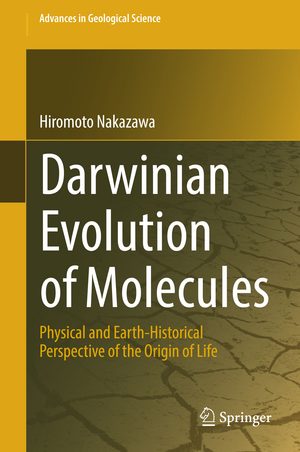
Darwinian Evolution of Molecules: Advances in Geological Science

Autor Hiromoto Nakazawa
en Limba Engleză Hardback – 22 iun 2018

În lucrarea Darwinian Evolution of Molecules, autorul Hiromoto Nakazawa propune o metodologie interdisciplinară riguroasă pentru a răspunde la întrebările fundamentale despre geneza vieții. Structura volumului este organizată progresiv, începând cu o reevaluare a conceptului de „Pământ dinamic” și continuând cu o analiză a perspectivei fizice asupra evoluției. Credem că forța acestui text rezidă în fundamentul său termodinamic: autorul demonstrează cum scăderea temperaturii pe Pământul timpuriu a dus la reducerea entropiei, forțând ordonarea elementelor ușoare în molecule organice complexe. Spre deosebire de abordările pur biologice, Hiromoto Nakazawa utilizează legile fizicii pentru a argumenta că viața nu este un accident, ci o consecință inevitabilă a proceselor istorice planetare.

Materialul este sistematizat în opt capitole care ghidează cititorul de la experimentul Miller-Urey către etapele finale ale evoluției moleculare în regiuni subterane adânci. Această ediție publicată de Springer în seria Advances in Geological Science extinde cadrul propus de The Origin and the Evolution of Life Based on a Novel Philosophy cu date noi din cercetările experimentale recente ale grupului autorului. Dacă lucrări precum The Molecular Origins of Life asamblau un puzzle multidisciplinar, Darwinian Evolution of Molecules oferă un fir roșu teoretic unificat, legând direct geologia de biochimia ereditară prin conceptul de selecție naturală aplicat la nivel molecular. Apreciem în mod deosebit modul în care autorul reușește să mențină un ton științific echilibrat, făcând ipoteza verificabilă prin experimente și referințe bibliografice solide, oferind în final un arbore filogenetic original al elementelor ușoare.
Citește tot Restrânge

Din seria Advances in Geological Science

Preț: 70212 lei

Preț vechi: 85624 lei
-18%

Puncte Express: 1053

Carte disponibilă

Livrare economică 12-26 mai


Specificații

ISBN-13: 9789811087233
ISBN-10: 9811087237
Pagini: 160
Ilustrații: XIV, 143 p. 40 illus., 1 illus. in color.
Dimensiuni: 160 x 241 x 14 mm
Greutate: 0.44 kg
Ediția:1st edition 2018
Editura: Springer
Colecția Advances in Geological Science
Seria Advances in Geological Science

Locul publicării:Singapore, Singapore

De ce să citești această carte

Recomandăm această carte cercetătorilor și studenților care doresc să înțeleagă originea vieții dincolo de speculațiile teoretice. Cititorul câștigă o perspectivă fizico-chimică clară asupra modului în care materia neînsuflețită a dobândit ordine și metabolism. Este o resursă esențială pentru cei care caută o explicație bazată pe termodinamică și geologie, oferind argumente solide pentru inevitabilitatea apariției sistemelor vii într-un univers care tinde spre organizare moleculară.


Despre autor

Hiromoto Nakazawa este un cercetător recunoscut în domeniul științelor naturii, cu o activitate focalizată pe intersecția dintre geologie, chimie și fizică. Expertiza sa în studiul materialelor terestre l-a condus spre dezvoltarea unor ipoteze inovatoare privind evoluția moleculară. Prin activitatea sa în cadrul unor grupuri de cercetare academice, acesta a contribuit cu numeroase rapoarte experimentale publicate în jurnale de specialitate, consolidând legătura dintre procesele geodinamice ale Pământului și apariția primelor forme de viață. Această lucrare reprezintă sinteza cercetărilor sale asupra termodinamicii sistemelor deschise.


Descriere scurtă

On the basis of thermodynamic considerations and the Earth’s historical processes, this book argues the physical inevitability of life’s generation and evolution, i.e., Why did life generate? Why does life evolve? Following an introduction to the problem, the hypothesis “Darwinian Evolution of Molecules” is proposed, which explains how, when, and where life was instigated through successive chemical reactions and the survival of selected molecules. The individual processes described are all scientifically reasonable, being verifiable by experiment. The hypothesis is supported by extensive reference to the scientific literature published in academic journals, including some experimental reports from the author’s own research group. The readers of this book will learn that the decreasing temperature of the early Earth led to a reduction in its entropy, inducing the Earth’s materials to order, which entailed ordering of the light elements as organic molecules with subsequent further ordering (i.e., evolution) to systems that can be considered alive (i.e., life). Researchers and students, as well as the non-academic audience, interested in the interdisciplinary problem of the origin of life will find suggestions and possible approaches to the scientific and conceptual problems they may be facing.

Cuprins

Preface.- The Dynamic Earth: A Recent Concept Necessary for the Study of the Origin of Life.- Why did Life Generate? Why does Life Evolve? Physical Perspective of the Origin of Life.- What is the Ultimate Ancestor? Evidence from Fossils and Gene Analyses.- “Miller-Urey Experiment” in the Recent Picture of the Early Earth.- Origin of Organic Molecules and Natural Selection of Bioorganic Molecules.- Molecular Evolution in Deep Subterranean Regions.- The last stage of molecular evolution to the birth of life: Individuals, metabolism, and heredity.- Summary: The Evolutionary Phylogenetic Tree of the Earth’s Light Elements. 


Notă biografică

Hiromoto Nakazawa is an emeritus fellow at the National Institute for Materials Science, Japan, and a fellow of the Japan Geoscience Union. He is also a former chairman of The Clay Science Society of Japan (2001–2002).  He devoted most of his research time to X-ray crystallography while at the National Institute for Research in Inorganic Materials (NIRIM), Japan. As a materials scientist, he has been awarded the Crystallographic Society of Japan Prize (1978) for the identification and study of new superstructures of iron sulfides using X-ray diffraction and high-resolution electron microscopy. He was also awarded the Medal of Honor with Purple Ribbon as well as several other prizes for his invention of the scanning X-ray microscope using the X-ray guide tube (2000). His curiosity regarding the origin of life from his student days brought him to the study of clay minerals as materials at the interface between the inorganic and organic realms during his tenure as a managing researcher at NIRIM (1985–2000).  While a professor at Tohoku University, Japan (2001), he commenced his experimental studies of the origin of life together with his students and subsequently proposed a new scenario for the origin of life on the Earth based on their recent results (2006, 2014). In 2011, he received the Order of the Sacred Treasure, Gold Rays with Neck Ribbon.

Caracteristici

Presents a step-by-step argument based on thermodynamics and facts of the Earth’s history to help the reader to find an answer to the fundamental question: Why did life appear on the Earth? Employs “the Darwinian evolution of molecules” model to facilitate a knowledge of when, where, and how life appeared on the Earth Enhances the reader’s understanding with the generous use of illustrations, including a phylogenetic tree illustrating “the Darwinian evolution of molecules” model