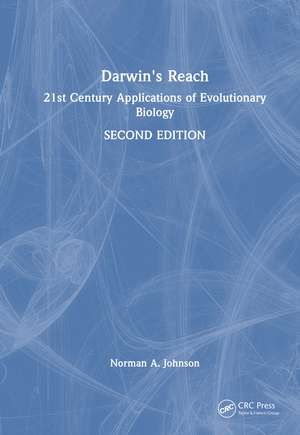
Darwin's Reach: 21st Century Applications of Evolutionary Biology
Autor Norman A. Johnsonen Limba Engleză Hardback – 24 aug 2026
Preț: 1448.62 lei
Preț vechi: 1766.61 lei
-18% Nou
Puncte Express: 2173
Carte tipărită la comandă
Livrare economică 09-23 decembrie
Livrare prin curier în România Termenul estimat este afișat lângă disponibilitate.
Transport gratuit pentru acest produs Plată online sau ramburs, în funcție de opțiunile comenzii.
Retur gratuit în 14 zile Comandă securizată și suport în română.
Specificații
ISBN-13: 9781032885452
ISBN-10: 1032885459
Pagini: 392
Ilustrații: 70
Dimensiuni: 178 x 254 mm
Greutate: 0.89 kg
Ediția:2
Editura: CRC Press
Colecția CRC Press
ISBN-10: 1032885459
Pagini: 392
Ilustrații: 70
Dimensiuni: 178 x 254 mm
Greutate: 0.89 kg
Ediția:2
Editura: CRC Press
Colecția CRC Press
Public țintă
General, Postgraduate, Professional Practice & Development, Professional Reference, and Undergraduate AdvancedCuprins
Chapter 1 – Paging Dr. Darwin
Chapter 2 – Going Viral: Evolution and Viral Diseases
Chapter 3 – The First Six Years of Covid: Its Origins and Its Continuing Evolution
Chapter 4 – Avian Flu
Chapter 5 – Vectors of Disease
Chapter 6 – Mismatch – Are We Stuck With our Past
Chapter 7 – From Genetic Mapping to Personalized Medicine
Chapter 8 – Darwin Meets the Emperor of all Maladies
Chapter 9 – Human Life History
Chapter 10 – Darwin at the Farm
Chapter 11 – Managing Agriculture
Chapter 12 – Buccaneers of Buzz : Bee and Pollination Services
Chapter 13 – Darwinian Meat
Chapter 14 – The Biodiversity Crisis
Chapter 15 – Challenges in the Oceans
Chapter 16 - Challenges in the City
Chapter 17 – Challenges from Invasive Species
Chapter 18 – The Sequence on the Stand
Chapter 19 – Darwinian Security
Chapter 20 – Human Genetic Diversity and the Non-Existence of Biological Races
Notă biografică
Norman A. Johnson is an evolutionary geneticist at the University of Massachusetts Amherst. He who received his doctoral degree from the University of Rochester and was a postdoctoral fellow at the University of Chicago. Johnson has also taught at the University of Chicago, the University of Texas at Arlington, and Hampshire College. Most of his research has been on the genetics and evolution of why hybrids between species are often sterile or inviable. Other research interests include the evolution of sex chromosomes, the evolution of extremely large dietary niches in insects, conflict between different parts of the genome, and the interplay between the relaxation of selection and the loss of traits.
In addition to Darwin’s Reach, Johnson wrote Darwinian Detectives: Revealing the Natural History of Genes and Genomes (Oxford University Press, 2007). This book examines how biologists infer the action of natural selection and other evolutionary processes from DNA sequence information. He also co‑edited (with Jason Somarelli) Cancer Through the Lens of Evolution and Ecology (CRC Press, 2024). Dr. Johnson has been active in science communication and outreach; notably, he co‑led the National Evolutionary Synthesis Center working group on communicating the relevance of human evolution.
In addition to Darwin’s Reach, Johnson wrote Darwinian Detectives: Revealing the Natural History of Genes and Genomes (Oxford University Press, 2007). This book examines how biologists infer the action of natural selection and other evolutionary processes from DNA sequence information. He also co‑edited (with Jason Somarelli) Cancer Through the Lens of Evolution and Ecology (CRC Press, 2024). Dr. Johnson has been active in science communication and outreach; notably, he co‑led the National Evolutionary Synthesis Center working group on communicating the relevance of human evolution.
Descriere
The application of evolutionary biology addresses a wide range of practical problems in medicine, agriculture, the environment, and society. This book is about applied evolution. Although applied evolution has existed, unrecognized, for a very long time, today’s version has a much wider scope.
Recenzii
In Darwin’s Reach, Norman Johnson takes Dobzhansky’s assertion that ‘nothing in biology makes sense outside the light of evolution’ to a new level. This remarkable book demonstrates how an evolutionary ‘lens’ can deepen our understanding of critical issues. With compelling prose and masterful scientific storytelling, Johnson shows exactly how powerfully evolution can illuminate and transform a remarkably wide range of human concerns, disciplines and domains. An invaluable resource for students, teachers, and anyone interested in gaining a deeper understanding of the human experience–past, present and future.
— B. Natterson-Horowitz, MD, Harvard Medical School
Darwin’s Reach is an intellectual tour de force that synthesizes findings about evolution from numerous fields and concretely shows how insights from pest management can help us manage invasive species as well as invasive cancers, antibiotic resistance, and much, much more. Norman Johnson is not only an eloquent tour guide who clearly unpacks complex evolutionary principles, experiments, and insights, but he’s also a public relations expert showing us how and why evolution matters to us all. This is a must read for anyone interested in evolutionary medicine, sustainable agriculture, the biodiversity crisis, and, more generally, in the intellectual challenges of applying scientific knowledge.
— Daniel T. Blumstein, University of California Los Angeles
"… the manifold areas of applied evolutionary biology have not been comprehensively described until now. Norman A. Johnson, at the University of Massachusetts – Amherst, has stepped up to the challenge…
Johnson starts with present-day issues, such as phage therapy, in which selection for phage resistance in pathogenic bacteria may reduce their resistance to antibiotics providing an opportunity to introduce natural selection and costs of adaptation. The chapter "Going Viral" treats viral epidemics, focusing on the SARS-Cov-2 pandemic and illustrating the use of phylogenetic inference in tracing the spread of such epidemics….
Johnson has done a real service in his well- researched (with about 900 literature citations) review of a very diverse, sprawling subject. He has written a fine book, a remarkably comprehensive survey of an important dimension of evolutionary biology. "
Douglas Futuyma in Evolution, 2023
"Johnson undertakes a wide variety of topics… including evolutionary medicine, pandemics like COVID-19 and HIV/AIDS, mosquito-borne diseases, personalized medicine, cancer, agriculture, biodiversity, and invasive species. He concludes with a few chapters on evolution and society, including genetic analysis in criminal investigations, warfare, and the non-existence of human biological races…I would not hesitate to suggest it as supplementary reading for interested undergraduates. It should provide useful insights for evolutionary biologists, geneticists and health professionals. "
— Michael A. Goldman In Evolution, Medicine, and Public Health, 2023.
— B. Natterson-Horowitz, MD, Harvard Medical School
Darwin’s Reach is an intellectual tour de force that synthesizes findings about evolution from numerous fields and concretely shows how insights from pest management can help us manage invasive species as well as invasive cancers, antibiotic resistance, and much, much more. Norman Johnson is not only an eloquent tour guide who clearly unpacks complex evolutionary principles, experiments, and insights, but he’s also a public relations expert showing us how and why evolution matters to us all. This is a must read for anyone interested in evolutionary medicine, sustainable agriculture, the biodiversity crisis, and, more generally, in the intellectual challenges of applying scientific knowledge.
— Daniel T. Blumstein, University of California Los Angeles
"… the manifold areas of applied evolutionary biology have not been comprehensively described until now. Norman A. Johnson, at the University of Massachusetts – Amherst, has stepped up to the challenge…
Johnson starts with present-day issues, such as phage therapy, in which selection for phage resistance in pathogenic bacteria may reduce their resistance to antibiotics providing an opportunity to introduce natural selection and costs of adaptation. The chapter "Going Viral" treats viral epidemics, focusing on the SARS-Cov-2 pandemic and illustrating the use of phylogenetic inference in tracing the spread of such epidemics….
Johnson has done a real service in his well- researched (with about 900 literature citations) review of a very diverse, sprawling subject. He has written a fine book, a remarkably comprehensive survey of an important dimension of evolutionary biology. "
Douglas Futuyma in Evolution, 2023
"Johnson undertakes a wide variety of topics… including evolutionary medicine, pandemics like COVID-19 and HIV/AIDS, mosquito-borne diseases, personalized medicine, cancer, agriculture, biodiversity, and invasive species. He concludes with a few chapters on evolution and society, including genetic analysis in criminal investigations, warfare, and the non-existence of human biological races…I would not hesitate to suggest it as supplementary reading for interested undergraduates. It should provide useful insights for evolutionary biologists, geneticists and health professionals. "
— Michael A. Goldman In Evolution, Medicine, and Public Health, 2023.