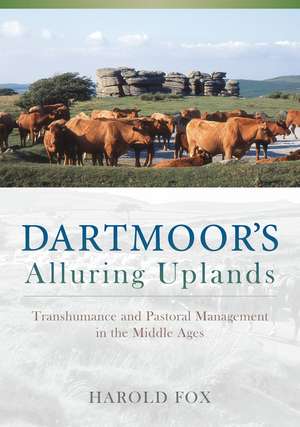
Dartmoor's Alluring Uplands: Transhumance and Pastoral Management in the Middle Ages
Autor Harold Fox Editat de Matthew Tompkins, Christopher Dyeren Limba Engleză Paperback – 30 apr 2012
This book describes, for the first time, the social organization and farming practices associated with that annual transfer of livestock. It presents evidence for a previously unsuspected Anglo-Saxon period of transhumance, by which the cattle's lowland owners moved with their animals and lived temporarily on the moor every summer.
Preț: 350.65 lei
Puncte Express: 526
Carte tipărită la comandă
Livrare economică 26 noiembrie-10 decembrie
Livrare prin curier în România Termenul estimat este afișat lângă disponibilitate.
Transport gratuit de la 400.00 lei Plată online sau ramburs, în funcție de opțiunile comenzii.
Retur gratuit în 14 zile Comandă securizată și suport în română.
Specificații
ISBN-13: 9780859898652
ISBN-10: 0859898652
Pagini: 320
Ilustrații: 20 color plates, 5 halftones, 7 tables, 45 drawings
Dimensiuni: 178 x 248 x 23 mm
Greutate: 0.64 kg
Editura: UNIVERSITY OF EXETER PRESS
Colecția University of Exeter Press
ISBN-10: 0859898652
Pagini: 320
Ilustrații: 20 color plates, 5 halftones, 7 tables, 45 drawings
Dimensiuni: 178 x 248 x 23 mm
Greutate: 0.64 kg
Editura: UNIVERSITY OF EXETER PRESS
Colecția University of Exeter Press
V-ar putea interesa
-
 Scotland: An Oxford Archaeological GuideAnna Ritchie-19%Preț: 283.12 lei350.07 lei
 -
 Preț: 322.73 lei
 -
 -18%Preț: 370.87 lei449.96 lei
 -
 Making a Living in the Middle Ages: The People of Britain 850–1520Christopher DyerPreț: 158.94 lei
 -
 Preț: 366.69 lei
 -
 Preț: 384.23 lei
 -
 Mesolithic EuropeGeoff Bailey-11%Preț: 450.44 lei506.12 lei
 -
 The Ancient IndusRita P. WrightPreț: 298.17 lei
 -
 The Palaeolithic Settlement of AsiaRobin DennellPreț: 465.96 lei
 -
 The Classic MayaStephen D. HoustonPreț: 255.27 lei
 -
 Becoming HumanIain MorleyPreț: 363.89 lei
 -
 The Terracotta ArmyJohn ManPreț: 93.92 lei
 -
 Visiting the PastGillian HovellPreț: 127.95 lei
 -
 Ancient nets and fishing gear : a first approach : proceedings of the International Workshop on Nets and Fishing Gear in Classical Antiquity, Cádiz, November 15-17, 2007International Workshop on Nets and Fishing Gear in Classical AntiquityPreț: 363.39 lei
Notă biografică
The late Harold Fox was born and brought up in South Devon, and was Professor of Social and Landscape History at the Centre for English Local History, University of Leicester. He was a recognised authority on late-medieval landscape, agrarian and social history, particularly in the South-West and Midlands, and had served as president of the Medieval Settlement Research Group, chairman of the Society for Landscape Studies, vice-president of the English Place-Names Society and president of the Devon History Society. Sadly he died before completing the final stages of this book, but two colleagues from the University of Leicester's Centre for English Local History have brought it to the point of publication. Matthew Tompkins is Honorary Visiting Fellow at the Centre for English Local History, University of Leicester. Christopher Dyer is Emeritus Professor at the Centre for English Local History, University of Leicester.
Cuprins
List of Colour Plates
List of Figures
List of Tables
Editors' Acknowledgements
Abbreviations
Introduction by Christopher Dyer and Matthew Tompkins
1. Definitions and limitations
Defining Dartmoor's resources
Dartmoor and its parts
Transhumance and its types
Limitations of this book
2. The red tides: impersonal transhumance and the central moor
The central moor: ownership and commoners
Distances travelled and middlemen
Pastoral management: the herdsman's year
Livestock: numbers and types
3. The red tides: impersonal transhumance and the outer moors
Ownership and commoners
Pastoral management: drifts, structures, strays
Perambulation and dispute resolution
Order and disorder: outer moors and the central moor
4. Personal transhumance: distant detachments
Cockington and Dewdon
Ipplepen, Abbotskerswell and their links
Detached parts of the hundreds of Exminster, Wonford and Kerswell
Kenton with Heatree
Paignton and its parts
Lifton and Sourton
Northlew, Venn and Lettaford
Tavistock and Cudlipp
Bickleigh and Sheepstor
The significance of the detachments
5. Personal transhumance: archaeology, topography, place-names and history
Archaeology and topography
Place-names and history: economy and society
6. Domesday Book and beyond: the transition from personal to impersonal transhumance
The role of colonists
The role of lords
The role of the Crown
7. Dartmoor and beyond
Droveways
Pastoral husbandry
The implications of transhumance for lowland farming
Conclusion by Christopher Dyer and Matthew Tompkins
Notes
Bibliography
Index
List of Figures
List of Tables
Editors' Acknowledgements
Abbreviations
Introduction by Christopher Dyer and Matthew Tompkins
1. Definitions and limitations
Defining Dartmoor's resources
Dartmoor and its parts
Transhumance and its types
Limitations of this book
2. The red tides: impersonal transhumance and the central moor
The central moor: ownership and commoners
Distances travelled and middlemen
Pastoral management: the herdsman's year
Livestock: numbers and types
3. The red tides: impersonal transhumance and the outer moors
Ownership and commoners
Pastoral management: drifts, structures, strays
Perambulation and dispute resolution
Order and disorder: outer moors and the central moor
4. Personal transhumance: distant detachments
Cockington and Dewdon
Ipplepen, Abbotskerswell and their links
Detached parts of the hundreds of Exminster, Wonford and Kerswell
Kenton with Heatree
Paignton and its parts
Lifton and Sourton
Northlew, Venn and Lettaford
Tavistock and Cudlipp
Bickleigh and Sheepstor
The significance of the detachments
5. Personal transhumance: archaeology, topography, place-names and history
Archaeology and topography
Place-names and history: economy and society
6. Domesday Book and beyond: the transition from personal to impersonal transhumance
The role of colonists
The role of lords
The role of the Crown
7. Dartmoor and beyond
Droveways
Pastoral husbandry
The implications of transhumance for lowland farming
Conclusion by Christopher Dyer and Matthew Tompkins
Notes
Bibliography
Index
Recenzii
"His affection for its community meant he wrote more for pragmatic Devonshire people and practical historians than for outsiders with romanticised views of Dartmoor.
He wished to encourage and support local farmers by preparing an authoritative account of their history, regarding them as the wisest of Dartmoor’s ecologists, defending customs and grazings developed over many generations. The Moor, marginal to many, is in Fox’s hands in Devon’s enormous pool of available common pasture. . . . Harold Fox, in his final work, encourages all with an interest in our historic landscape to acknowledge the possibility that their own local patterns, colours and character were shaped by accommodation and servicing of seasonal movements of people and livestock…"