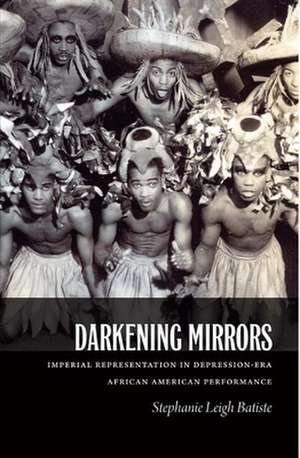
Darkening Mirrors
Autor Stephanie Leigh Batisteen Limba Engleză Paperback – 6 ian 2012
Recomandăm Darkening Mirrors pentru rigoarea cu care Stephanie Leigh Batiste investighează un paradox istoric: modul în care artiștii afro-americani au utilizat limbajul imperialismului american pentru a-și revendica cetățenia și modernitatea în timpul Marii Depresiuni. Metodologia autoarei se bazează pe analiza performanței — de la operă și balet la comedii și western-uri — demonstrând cum asumarea unor roluri care implicau exotismul sau orientalismul a servit, în mod surprinzător, ca instrument de împuternicire diasporică. Structura volumului urmărește o progresie tematică clară. Primele capitole explorează succesul „Negro” în contextul expansiunii moderne, trecând apoi spre analize de caz aplicate, precum spectacolul The "Swing" Mikado. Remarcăm capitolul dedicat metodologiilor antropologice în opera lui Dunham, care oferă o perspectivă necesară asupra modului în care corpul negru a fost teoretizat și expus. Volumul extinde cadrul propus de Performing Race and Erasure de Shannon Rose Riley cu date noi din perioada interbelică, concentrându-se pe modul în care identitatea națională a fost negociată prin intermediul culturii populare, nu doar prin protest direct. În timp ce Babylon Girls de Jayna Brown se concentrează pe stilul și mișcarea femeilor afro-americane în spectacolele de varietăți, Batiste lărgește contextul, analizând complicitatea și rezistența în fața discursului imperialist global. Cu 35 de ilustrații care susțin argumentele vizuale, lucrarea publicată de Duke University Press reprezintă o contribuție esențială la studiile etnice, oferind nuanțe noi procesului de formare a subiectivității afro-americane.
Preț: 291.14 lei
Carte tipărită la comandă
Livrare economică 08-22 decembrie
Specificații
ISBN-10: 082234923X
Pagini: 352
Ilustrații: 35 illustrations
Dimensiuni: 150 x 234 x 23 mm
Greutate: 0.59 kg
Editura: Duke University Press
V-ar putea interesa
-
 Trouble in MindLeon F. LitwackPreț: 153.81 lei
 -
 Preț: 151.46 lei
 -
 -15%Preț: 561.20 lei660.24 lei
 -
 Preț: 156.60 lei
 -
 Preț: 140.24 lei
 -
 The River Flows OnWalter C. RuckerPreț: 208.04 lei
 -
 The HerndonsCarole MerrittPreț: 303.64 lei
 -
 The Last DarkyLouis Chude-SokeiPreț: 259.40 lei
 -
 Conversations with Richard WrightRichard Nathaniel WrightPreț: 230.26 lei
 -
 Conversations with Amiri BarakaImamu Amiri BarakaPreț: 242.31 lei
 -
 Conversations with Toni MorrisonToni MorrisonPreț: 243.63 lei
 -
 Without SanctuaryJames Allen-15%Preț: 438.67 lei516.08 lei
De ce să citești această carte
Această monografie este esențială pentru cercetătorii în studii culturale și istoria teatrului. Cititorul câștigă o înțelegere profundă a modului în care artele spectacolului au servit ca spațiu de negociere politică pentru o populație segregată. Este o recomandare certă pentru cei interesați de intersecția dintre rasă, imperialism și identitate națională în America secolului XX, oferind o analiză critică a complexității puterii.
Descriere scurtă
Recenzii
Darkening Mirrors is a powerful argument that during the 1930s, African American popular performers took part in US imperial and nationalist projects even as they resisted the dominant cultures racism. In vivid, illuminating readings of films and stage showsfrom The Swing Mikado and the Federal Theater Projects voodoo Macbeth to Katherine Dunhams concert ballet LAgYaStephanie Leigh Batiste makes her case stick, and she makes it sting. At the same time, she writes beautifully about how black Americans asserted the genius of African and Afro-diasporic arts on the national and transnational scene. - Joseph Roach, Yale University
"Documents African-Americans' participation in U.S. Cultural imperialism on stage and screen; productions discussed include the Federal Theater Project's "voodoo" Macbeth." - Chronicle of Higher Education, March 19th 2012
Cuprins
Prologue xi
Acknowledgments xix
Introduction 1
1. "Harlem Rides the Range": Expansion, Modernity, and Negro Success 27
2. Epaulets and Leaf Skirts, Warriors, and Subversives: Exoticism in the Performance of the Haitian Revolution 70
3. Prisms of Imperial Gaze: Swinging the Negro Mikado 115
4. Lens/Body: Anthropology's Methodologies and Spaces of Reflection in Dunham's Diaspora 165
5. Ethnographic Refraction: Exoticism and Diasporic Sisterhood in The Devil's Daughter 201
6. No Storm in the Weather: Domestic Bliss and African American Performance 228
Epilogue 256
Notes 261
Bibliography 299
Index 317