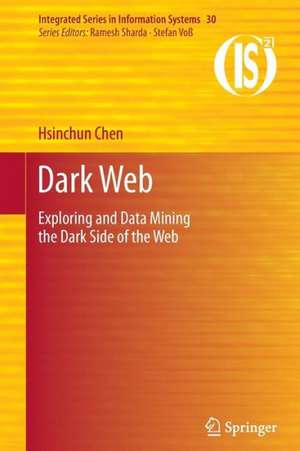
Dark Web: Integrated Series in Information Systems, cartea 30
Autor Hsinchun Chenen Limba Engleză Paperback – 3 mar 2014
This monograph aims to provide an overview of the Dark Web landscape, suggest a systematic, computational approach to understanding the problems, and illustrate with selected techniques, methods, and case studies developed by the University of Arizona AI Lab Dark Web team members. This work aims to provide an interdisciplinary and understandable monograph about Dark Web research along three dimensions: methodological issues in Dark Web research; database and computational techniques to support information collection and data mining; and legal, social, privacy, and data confidentiality challenges and approaches. It will bring useful knowledge to scientists, security professionals, counterterrorism experts, and policy makers. The monograph can also serve as a reference material or textbook in graduate level courses related to information security, information policy, information assurance, information systems, terrorism, and public policy.
Din seria Integrated Series in Information Systems
- 15%
 Preț: 650.40 lei
- 20%
 Preț: 957.38 lei
- 20%
 Preț: 1312.53 lei
-
 Preț: 374.37 lei
- 15%
 Preț: 682.47 lei
- 18%
 Preț: 841.91 lei
- 20%
 Preț: 1435.43 lei
-
 Preț: 384.04 lei
- 15%
 Preț: 720.01 lei
- 18%
 Preț: 726.77 lei
- 15%
 Preț: 692.14 lei
-
 Preț: 408.17 lei
- 15%
 Preț: 666.74 lei
- 18%
 Preț: 987.83 lei
- 5%
 Preț: 1286.27 lei
- 15%
 Preț: 620.41 lei
- 15%
 Preț: 620.73 lei
- 20%
 Preț: 1243.16 lei
- 39%
 Preț: 1108.59 lei
- 20%
 Preț: 641.08 lei
- 5%
 Preț: 1740.44 lei
- 18%
 Preț: 938.03 lei
- 15%
 Preț: 670.56 lei
- 20%
 Preț: 674.04 lei
- 20%
 Preț: 667.83 lei
- 18%
 Preț: 992.26 lei
- 15%
 Preț: 666.56 lei
- 15%
 Preț: 669.81 lei
- 18%
 Preț: 1045.80 lei
- 20%
 Preț: 677.79 lei
Preț: 1001.03 lei
Preț vechi: 1251.29 lei
-20%
Puncte Express: 1502
Carte tipărită la comandă
Livrare economică 17-31 decembrie
Livrare prin curier în România Termenul estimat este afișat lângă disponibilitate.
Transport gratuit pentru acest produs Plată online sau ramburs, în funcție de opțiunile comenzii.
Retur gratuit în 14 zile Comandă securizată și suport în română.
Specificații
ISBN-13: 9781489992864
ISBN-10: 1489992863
Pagini: 480
Ilustrații: XXVI, 454 p.
Dimensiuni: 155 x 235 x 26 mm
Greutate: 0.72 kg
Ediția:2012
Editura: Springer
Colecția Integrated Series in Information Systems
Seria Integrated Series in Information Systems
Locul publicării:New York, NY, United States
ISBN-10: 1489992863
Pagini: 480
Ilustrații: XXVI, 454 p.
Dimensiuni: 155 x 235 x 26 mm
Greutate: 0.72 kg
Ediția:2012
Editura: Springer
Colecția Integrated Series in Information Systems
Seria Integrated Series in Information Systems
Locul publicării:New York, NY, United States
V-ar putea interesa
-
 Fancy Bear Goes PhishingScott Shapiro-30%Preț: 66.08 lei94.18 lei
-
 Analyzing and Securing Social NetworksBhavani Thuraisingham-20%Preț: 403.13 lei503.92 lei
-
 -38%Preț: 398.93 lei646.62 lei
-
 -20%Preț: 222.84 lei278.55 lei
-
 -20%Preț: 136.16 lei170.21 lei
-
 Preț: 125.23 lei
-
 -18%Preț: 100.43 lei122.26 leiRecomandat
-
 The Dark Forest Theory of the InternetBogna KoniorPreț: 87.49 lei
-
 -34%Preț: 263.80 lei398.05 lei
-
 The Darkest WebEileen Ormsby-20%Preț: 93.85 lei117.32 lei
-
 The Hour of the PredatorGiuliano Da EmpoliPreț: 91.08 lei
-
 Preț: 154.36 lei
-
 -27%Preț: 67.78 lei92.76 lei
-
 Web, Artificial Intelligence and Network ApplicationsLeonard Barolli-20%Preț: 1255.62 lei1569.53 lei
-
 Decoding AntisemitismMatthias J. BeckerPreț: 330.39 lei
-
 -20%Preț: 399.09 lei498.86 lei
-
 Data Analysis and Risk Modelling for Terrorism Prevention:Raphael Röttinger-20%Preț: 109.56 lei136.95 lei
-
 -20%Preț: 418.84 lei523.54 lei
Public țintă
ResearchCuprins
Chapter 1. Dark Web Research Overview.- Chapter 2. Intelligence and Security Informatics (ISI): Research Framework.- Chapter 3. Terrorism Informatics.- Chapter 4. Forum Spidering.- Chapter 5. Link and Content Analysis.- Chapter 6. Dark Network Analysis.- Chapter 7. Interactional Coherence Analysis.- Chapter 8. Dark Web Attribute System.- Chapter 9. Authorship Analysis.- Chapter 10. Sentiment Analysis.- Chapter 11. Affect Analysis.- Chapter 12. Cybergate Visualization.- Chapter 13. Dark Web Forum Portal.- Chapter 14. Jihadi Video Analysis.- Chapter 15. Extremist Youtube Videos.- Chapter 16. Improvised Explosive Devices (IED) on Dark Web.- Chapter 17. Weapons of Mass Destruction (WMD) on Dark Web.- Chapter 18. Bioterrorism Knowledge Mapping.- Chapter 19. Women's Forums on the Dark Web.- Chapter 20. U.S. Domestic Extremist Groups.- Chapter 21. International Falun Gong Movement on the Web.- Chapter 22. Botnets and Cyber Criminals.
Recenzii
From the reviews:
“Chen’s 450-page monograph is a very detailed (yet understandable), up-to-date account of research into one very specific area of Web research. … the book can be interesting reading for academicians, researchers, and students at universities … . It is also recommended for researchers in security-related disciplines. … the book should also interest security specialists in the industry, especially those dealing with IT-related issues … . Overall, the book presents a wealth of research results on an important subject, in a consistent way.” (P. Navrat, ACM Computing Reviews, October, 2012)
“Chen’s 450-page monograph is a very detailed (yet understandable), up-to-date account of research into one very specific area of Web research. … the book can be interesting reading for academicians, researchers, and students at universities … . It is also recommended for researchers in security-related disciplines. … the book should also interest security specialists in the industry, especially those dealing with IT-related issues … . Overall, the book presents a wealth of research results on an important subject, in a consistent way.” (P. Navrat, ACM Computing Reviews, October, 2012)
Textul de pe ultima copertă
The University of Arizona Artificial Intelligence Lab (AI Lab) Dark Web project is a long-term scientific research program that aims to study and understand the international terrorism (Jihadist) phenomena via a computational, data-centric approach. We aim to collect "ALL" web content generated by international terrorist groups, including web sites, forums, chat rooms, blogs, social networking sites, videos, virtual world, etc. We have developed various multilingual data mining, text mining, and web mining techniques to perform link analysis, content analysis, web metrics (technical sophistication) analysis, sentiment analysis, authorship analysis, and video analysis in our research. The approaches and methods developed in this project contribute to advancing the field of Intelligence and Security Informatics (ISI). Such advances will help related stakeholders to perform terrorism research and facilitate international security and peace.
This monograph aims to provide an overview of the Dark Web landscape, suggest a systematic, computational approach to understanding the problems, and illustrate with selected techniques, methods, and case studies developed by the University of Arizona AI Lab Dark Web team members. This work aims to provide an interdisciplinary and understandable monograph about Dark Web research along three dimensions: methodological issues in Dark Web research; database and computational techniques to support information collection and data mining; and legal, social, privacy, and data confidentiality challenges and approaches. It will bring useful knowledge to scientists, security professionals, counterterrorism experts, and policy makers. The monograph can also serve as a reference material or textbook in graduate level courses related to information security, information policy, information assurance, information systems, terrorism, and public policy.
This monograph aims to provide an overview of the Dark Web landscape, suggest a systematic, computational approach to understanding the problems, and illustrate with selected techniques, methods, and case studies developed by the University of Arizona AI Lab Dark Web team members. This work aims to provide an interdisciplinary and understandable monograph about Dark Web research along three dimensions: methodological issues in Dark Web research; database and computational techniques to support information collection and data mining; and legal, social, privacy, and data confidentiality challenges and approaches. It will bring useful knowledge to scientists, security professionals, counterterrorism experts, and policy makers. The monograph can also serve as a reference material or textbook in graduate level courses related to information security, information policy, information assurance, information systems, terrorism, and public policy.
Caracteristici
Examines and explains every aspect of an important ongoing research program in terrorism informatics Interdisciplinary perspective looks at three dimensions: methodological issues, database and computational techniques, and legal, social and privacy challenges Hsinchun Chen is a worldwide leader in data mining research and a prolific Springer author?
Notă biografică
Dr. Hsinchun Chen is McClelland Professor of Management Information Systems (MIS) at the Eller College of Management of the University of Arizona. He received the Ph.D. degree in Information Systems from New York University in 1989, MBA in Finance from SUNY-Buffalo in 1985, and BS in Management Science from the National Chiao-Tung University in Taiwan. Dr. Chen is a Fellow of IEEE and AAAS. He received the IEEE Computer Society Technical Achievement Award in 2006. He is author of 20 books and more than 150 SCI journal articles covering knowledge management, digital library, homeland security, Web computing, and biomedical informatics in leading information technology publications. He serves on ten editorial boards, including: Journal of the American Society for Information Science and Technology, ACM Transactions on Information Systems, ACM Journal on Educational Resources in Computing, IEEE Transactions on Systems, Man, and Cybernetics, International Journal of Digital Library, and Decision Support Systems. He has served as a Scientific Advisor/Counselor of National Library of Medicine (USA), Academia Sinica (Taiwan), and National Library of China (China).
Dr. Mihail C. Roco is the Senior Advisor for Nanotechnology at the National Science Foundation (NSF) and a key architect of the National Nanotechnology Initiative. Dr. Roco is the founding Chair of the U.S. National Science and Technology Council's Subcommittee on Nanoscale Science, Engineering and Technology (NSET), and leads the Nanotechnology Group of the International Risk Governance Council. Prior to joining the National Science Foundation, he was Professor of mechanical and chemical engineering. Dr. Roco is credited with thirteen patents, and has contributed over two hundred articles and sixteen books. Dr. Roco is a corresponding member of the Swiss Academy of Engineering Sciences and member of the International Risk Governance Council. He is aFellow of ASME, Fellow of AIChE and Fellow of the Institute of Physics, and was elected as Engineer of the Year by the U.S. Society of Professional Engineers and NSF in 1999 and again in 2004. He was awarded the National Materials Advancement Award from the Federation of Materials Societies in 2007 "as the individual most responsible for support and investment in nanotechnology by government, industry, and academia worldwide".