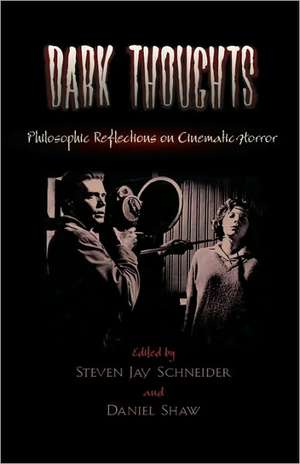
Dark Thoughts: Philosophic Reflections on Cinematic Horror
Editat de Steven Jay Schneider, Daniel Shawen Limba Engleză Hardback – 16 sep 2003
This is a collection of highly engaging and provocative essays by top scholars in the increasingly interrelated fields of Philosophy, Film Studies, and Communication Arts that deal with the epistemology, aesthetics, ethics, metaphysics, and genre dynamics of horror cinema past and present. Contributors include Curtis Bowman, Noël Carroll, Elizabeth Cowie, Angela Curran, Cynthia Freeland, Michael Grant, Matt Hills, Deborah Knight, George McKnight, Ken Mogg, Aaron Smuts, Robert C. Solomon, and J.P. Telotte.
Over the past several years, one of the hottest topics in the realm of philosophical aesthetics has been cinematic horror. The emotional effects it has on audiences, the mysterious metaphysics of its impossible beings, the controversial ethics of its violent contents-these are just a few of the concerns to have drawn the attention of scholars and students alike. . .not to mention the genre's legions of fans. Since the publication of Noël Carroll's groundbreaking study, The Philosophy of Horror; or, Paradoxes of the Heart (1990), and including most recently Cynthia Freeland's The Naked and the Undead: Evil and the Appeal of Horror (2000), a plethora of articles have been authored by seemingly normal philosophers about the decidedly abnormal activities of the antagonists of fright flicks.
Preț: 530.24 lei
Preț vechi: 768.48 lei
-31%
Puncte Express: 795
Carte tipărită la comandă
Livrare economică 21 noiembrie-05 decembrie
Livrare prin curier în România Termenul estimat este afișat lângă disponibilitate.
Transport gratuit pentru acest produs Plată online sau ramburs, în funcție de opțiunile comenzii.
Retur gratuit în 14 zile Comandă securizată și suport în română.
Specificații
ISBN-13: 9780810847927
ISBN-10: 0810847922
Pagini: 306
Dimensiuni: 149 x 227 x 21 mm
Greutate: 0.45 kg
Ediția:New.
Editura: Bloomsbury Publishing
Colecția Scarecrow Press
Locul publicării:New York, United States
ISBN-10: 0810847922
Pagini: 306
Dimensiuni: 149 x 227 x 21 mm
Greutate: 0.45 kg
Ediția:New.
Editura: Bloomsbury Publishing
Colecția Scarecrow Press
Locul publicării:New York, United States
V-ar putea interesa
-
 An EducationNick HornbyPreț: 114.39 lei
 -
 -23%Preț: 211.11 lei272.87 lei
 -
 French Cinema: A Student's GuidePhil Powrie-16%Preț: 243.11 lei287.83 lei
 -
 Bright Boulevards, Bold DreamsDonald BoglePreț: 137.18 lei
 -
 Joe's Palace' and 'Capturing Mary'Stephen Poliakoff-17%Preț: 176.72 lei213.38 lei
 -
 -25%Preț: 628.53 lei833.61 lei
 -
 The Films of Steven SpielbergCharles L. P. Silet-33%Preț: 384.81 lei578.01 lei
 -
 Vampire LoversGavin Baddeley-28%Preț: 90.72 lei125.53 lei
 -
 John WayneAissa WaynePreț: 143.67 lei
 -
 -28%Preț: 112.33 lei155.20 lei
 -
 Art & FearDavid BaylesPreț: 72.06 lei
 -
 Shawshank RedemptionFrank DarabontPreț: 123.45 lei
 -
 Digital and Other Virtualities: Renegotiating the ImageAntony Bryant-25%Preț: 182.93 lei244.00 lei
 -
 Hunting the Dark Knight: Twenty-First Century BatmanWill Brooker-21%Preț: 158.86 lei200.85 lei
 -
 Save the Cat! Goes to the MoviesBlake SnyderPreț: 116.69 lei
Cuprins
Chapter 1 Acknowledgments
Chapter 2 Introduction
Part 3 Horror, Tragedy, and Pleasure
Chapter 4 The General Theory of Horrific Appeal
Chapter 5 The Mastery of Hannibal Lecter
Chapter 6 The Livid Nightmare: Trauma, Anxiety, and the Ethical Aesthetics of Horror
Chapter 7 Aristotelian Reflections on Horror and Tragedy in An American Werewolf in London and The Sixth Sense
Part 8 Horror's Philosopher-Auteurs
Chapter 9 Heidegger, the Uncanny, and Jacques Tourneur's Horror Films
Chapter 10 Hitchcock Made Only One Horror Film: Matters of Time, Space, Causality, and the Schopenhauerian Will
Chapter 11 What You Can't See Can Hurt You: Of Invisible and Hollow Men
Part 12 Philosophical (Horror) Investigations
Chapter 13 On the Question of the Horror Film
Chapter 14 An Event-Based Definition of Art-Horror
Chapter 15 Haunting the House From Within: Disbelief Mitigation and Spatial Experience
Chapter 16 Murder as Art/ The Art of Murder: Aestheticizing Violence in Modern Cinematic Horror
Part 17 Horror and Reality
Chapter 18 The Slasher's Blood Lust
Chapter 19 American Psycho: Horror, Satire, Aesthetics, and Identification
Chapter 20 Real Horror
Part 21 Bibliography
Chapter 22 Index
Chapter 23 About the Contributors
Chapter 2 Introduction
Part 3 Horror, Tragedy, and Pleasure
Chapter 4 The General Theory of Horrific Appeal
Chapter 5 The Mastery of Hannibal Lecter
Chapter 6 The Livid Nightmare: Trauma, Anxiety, and the Ethical Aesthetics of Horror
Chapter 7 Aristotelian Reflections on Horror and Tragedy in An American Werewolf in London and The Sixth Sense
Part 8 Horror's Philosopher-Auteurs
Chapter 9 Heidegger, the Uncanny, and Jacques Tourneur's Horror Films
Chapter 10 Hitchcock Made Only One Horror Film: Matters of Time, Space, Causality, and the Schopenhauerian Will
Chapter 11 What You Can't See Can Hurt You: Of Invisible and Hollow Men
Part 12 Philosophical (Horror) Investigations
Chapter 13 On the Question of the Horror Film
Chapter 14 An Event-Based Definition of Art-Horror
Chapter 15 Haunting the House From Within: Disbelief Mitigation and Spatial Experience
Chapter 16 Murder as Art/ The Art of Murder: Aestheticizing Violence in Modern Cinematic Horror
Part 17 Horror and Reality
Chapter 18 The Slasher's Blood Lust
Chapter 19 American Psycho: Horror, Satire, Aesthetics, and Identification
Chapter 20 Real Horror
Part 21 Bibliography
Chapter 22 Index
Chapter 23 About the Contributors
Recenzii
This philosophical collection provides an interesting perspective on the film horror genre that would prove beneficial for cinema studies, film history, and film genre courses. Recommended.
...a collection of essays on the philosophic underpinnings of films like Texas Chainsaw Massacre, Henry: Portrait of a Serial Killer, and An American Werewolf in London...
The horror film is a fascinating genre from many perspectives, not least of them the philosophical. For those interested in a philosophical approach to horror, read this book! In Dark Thoughts, the editors gather together a remarkable set of essays by philosophers and film scholars, among them well-known names and relative newcomers. Along the way, Dark Thoughts explores the major issues raised by the horror film, and it does so from diverse perspectives. The approaches range from the psychoanalytic to the cognitive, from Nietsche and Heidegger to Carroll and Freeland. This is a welcome and useful addition to the literature on the horror film.
If you look at cinema through a philosophic prism however, and agree Schneider and Shaw's introductory contention that horror cinema is "simply a natural extension of a philosopher's inclination to wonder," then you will find the issues reiase by Carroll and those who follow in his footsteps, enlightening.
With this important collection in hand, you can stop whistling in the dark and start thinking seriously about scary movies. Why do we voluntarily watch films that shock, frighten, and horrify? Why do we actually like Hannibal Lecter and other monsters andmonstrosities? What defines the horror movie as a genre? What are its connections to tragedy? The essays in this book draw insightfully on classic sources including Plato, Aristotle, Hume, Schopenhauer, Nietzsche, Freud, and Heidegger to answer these andother terrifying questions. In addition, all the major contemporary theorists in the philosophy of horror are represented, including Noël Carroll, Cynthia Freeland, and Robert Solomon The resulting fusion of classic and contemporary insight is this unique and enlightening volume, Dark Thoughts.
...a collection of essays on the philosophic underpinnings of films like Texas Chainsaw Massacre, Henry: Portrait of a Serial Killer, and An American Werewolf in London...
The horror film is a fascinating genre from many perspectives, not least of them the philosophical. For those interested in a philosophical approach to horror, read this book! In Dark Thoughts, the editors gather together a remarkable set of essays by philosophers and film scholars, among them well-known names and relative newcomers. Along the way, Dark Thoughts explores the major issues raised by the horror film, and it does so from diverse perspectives. The approaches range from the psychoanalytic to the cognitive, from Nietsche and Heidegger to Carroll and Freeland. This is a welcome and useful addition to the literature on the horror film.
If you look at cinema through a philosophic prism however, and agree Schneider and Shaw's introductory contention that horror cinema is "simply a natural extension of a philosopher's inclination to wonder," then you will find the issues reiase by Carroll and those who follow in his footsteps, enlightening.
With this important collection in hand, you can stop whistling in the dark and start thinking seriously about scary movies. Why do we voluntarily watch films that shock, frighten, and horrify? Why do we actually like Hannibal Lecter and other monsters andmonstrosities? What defines the horror movie as a genre? What are its connections to tragedy? The essays in this book draw insightfully on classic sources including Plato, Aristotle, Hume, Schopenhauer, Nietzsche, Freud, and Heidegger to answer these andother terrifying questions. In addition, all the major contemporary theorists in the philosophy of horror are represented, including Noël Carroll, Cynthia Freeland, and Robert Solomon The resulting fusion of classic and contemporary insight is this unique and enlightening volume, Dark Thoughts.