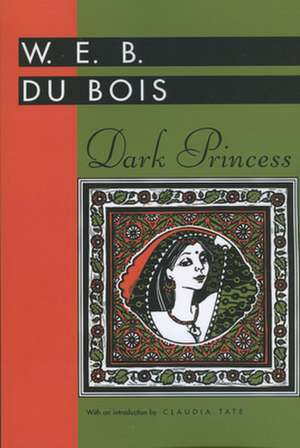
Dark Princess: Banner Books
Autor W. E. B. Du Bois Claudia Tateen Limba Engleză Paperback – 31 mar 1995


Preț: 269.20 lei
Puncte Express: 404
Carte tipărită la comandă
Livrare economică 19 noiembrie-03 decembrie
Livrare prin curier în România Termenul estimat este afișat lângă disponibilitate.
Transport gratuit de la 400.00 lei Plată online sau ramburs, în funcție de opțiunile comenzii.
Retur gratuit în 14 zile Comandă securizată și suport în română.
Specificații
ISBN-13: 9780878057658
ISBN-10: 087805765X
Pagini: 344
Dimensiuni: 155 x 230 x 22 mm
Greutate: 0.52 kg
Ediția:Reissue
Editura: University Press of Mississippi
Seria Banner Books
ISBN-10: 087805765X
Pagini: 344
Dimensiuni: 155 x 230 x 22 mm
Greutate: 0.52 kg
Ediția:Reissue
Editura: University Press of Mississippi
Seria Banner Books
V-ar putea interesa
-
 To Kill a MockingbirdHarper Lee-19%Preț: 52.19 lei64.56 lei
 -
 From Man to Man or Perhaps Only—Olive Schreiner-17%Preț: 66.83 lei80.43 lei
 -
 If He Hollers, Let Him GoChester HimesPreț: 71.83 lei
 -
 The Souls of Black FolkW. E. B. DuBoisPreț: 40.84 lei
 -
 The Chinaberry TreeJessie Redmon FausetPreț: 108.51 lei
 -
 The Marrow of TraditionCharles W. ChesnuttPreț: 46.64 lei
 -
 The New NegroMartha H PattersonPreț: 266.48 lei
 -
 The Accidental MalayKarina Robles Bahrin-34%Preț: 47.01 lei71.02 lei
 -
 Great Black HopeRob Franklin-18%Preț: 89.08 lei108.46 lei
 -
 From Superman to ManJ. A. RogersPreț: 52.51 lei
 -
 The Fire in the FlintWalter White F-31%Preț: 79.43 lei115.05 lei
 -
 The Memoirs of Robert and Mabel WilliamsRobert F. WilliamsPreț: 246.53 lei
 -
 Becoming Lunsford LaneCraig Thompson FriendPreț: 232.35 lei
 -
 Preț: 69.51 lei
 -
 Sky Full of Elephants: A NovelCebo Campbell-18%Preț: 59.78 lei72.69 leiRecomandat
 -
 NegrolandMargo JeffersonPreț: 77.42 lei
 -
 The Man Who Cried I AmJohn A. WilliamsPreț: 109.92 lei
 -
 This is Not AmericaTomiwa OwoladePreț: 79.03 lei
 -
 Eye of the MonkeyKrisztina Tóth-18%Preț: 89.16 lei108.98 lei
 -
 Some of My Best FriendsTajja IsenPreț: 94.65 lei
Textul de pe ultima copertă
The problem of "the color line", W. E. B. Du Bois's ever-present polemical theme, is at the core of this novel of sensual love, radical politics, and the quest for racial justice. Originally published in 1928, Dark Princess has a fantastical storyline, heavy with propagandist overtones. Du Bois depicts 1920s America as a racist nation primed for radical protest and terrorism. Matthew Townes, the protagonist, is a medical student expelled because his race bars him from the required course in obstetrics in a white hospital. Self-exiled in Berlin after his political idealism is corrupted, Townes falls in love with Princess Kautilya, daughter of a maharajah, and joins her international team in which people of color unite against white imperialism.
Notă biografică
W. E. B. Du Bois (1868-1963) was an African American sociologist, historian, civil rights activist, and socialist. Born in Massachusetts, he was raised in Great Barrington, an integrated community. He studied at the University of Berlin and at Harvard, where he became the first African American scholar to earn a doctorate. He worked as a professor at Atlanta University, a historically black institution, and was one of the leaders of the Niagara Movement, which advocated for equal rights and opposed Booker T. Washington's Atlanta compromise. In 1909, he cofounded the NAACP and served for years as the editor of its official magazine The Crisis. In addition to his activism against lynching, Jim Crow laws, and other forms of discrimination and segregation, Du Bois authored such influential works as The Souls of Black Folk (1903) and Black Reconstruction in America (1935). A lifelong opponent of racism and a committed pacifist, Du Bois advocated for socialism as a means of replacing racial capitalism in America and around the world. In the 1920s, he used his role at The Crisis to support the artists of the Harlem Renaissance and sought to emphasize the role of African Americans in shaping American society in his book The Gift of Black Folk (1924).