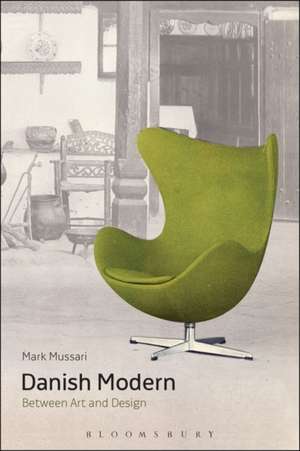
Danish Modern: Between Art and Design
Autor Mark Mussarien Limba Engleză Paperback – 16 iun 2016
Preț: 186.60 lei
Preț vechi: 223.69 lei
-17%
Puncte Express: 280
Carte tipărită la comandă
Livrare economică 16-30 noiembrie
Livrare prin curier în România Termenul estimat este afișat lângă disponibilitate.
Transport gratuit de la 400.00 lei Plată online sau ramburs, în funcție de opțiunile comenzii.
Retur gratuit în 14 zile Comandă securizată și suport în română.
Specificații
ISBN-13: 9781474223720
ISBN-10: 1474223729
Pagini: 208
Ilustrații: 33 bw illus
Dimensiuni: 152 x 232 x 14 mm
Greutate: 0.36 kg
Editura: Bloomsbury Publishing
Colecția Bloomsbury Academic
Locul publicării:London, United Kingdom
ISBN-10: 1474223729
Pagini: 208
Ilustrații: 33 bw illus
Dimensiuni: 152 x 232 x 14 mm
Greutate: 0.36 kg
Editura: Bloomsbury Publishing
Colecția Bloomsbury Academic
Locul publicării:London, United Kingdom
V-ar putea interesa
-
 Preț: 131.81 lei
 -
 -19%Preț: 258.85 lei320.02 lei
 -
 Sussex ModernismHope WolfPreț: 319.01 lei
 -
 An Illustrated Guide to Furniture HistoryJoclyn M. OatsPreț: 338.55 lei
 -
 Mid-Century Modern FurnitureDominic Bradbury-16%Preț: 409.23 lei484.49 lei
 -
 The Sources of Modern Architecture and DesignNikolaus Pevsner-19%Preț: 110.37 lei135.89 lei
 -
 Cuban Mid-Century DesignAbel Gonzalez Fernandez-8%Preț: 411.32 lei447.09 lei
 -
 Bauhaus 1919-1933Leah Dickerman-8%Preț: 411.01 lei446.75 lei
 -
 -21%Preț: 306.34 lei388.73 lei
 -
 American Furniture Designers: 1900-2020Oscar P. Fitzgerald-30%Preț: 587.38 lei834.64 lei
 -
 Modern Scandinavian DesignCharlotte Fiell-23%Preț: 491.91 lei635.62 lei
 -
 -24%Preț: 594.87 lei780.15 lei
 -
 Jens QuistgaardStig Guldberg-21%Preț: 461.96 lei581.46 lei
 -
 Mid-Century Modern DesignersDominic Bradbury-11%Preț: 526.31 lei591.35 lei
 -
 History of Modern Design Second EditionDavid Raizman-23%Preț: 276.32 lei358.01 lei
 -
 Preț: 224.23 lei
 -
 The Designs of Arne JacobsenThomas Dickson-8%Preț: 401.35 lei436.25 lei
 -
 Design of the 20th CenturyCharlotte & Peter FiellPreț: 195.74 lei
 -
 Arne Jacobsen: Designing DenmarkKatrine Stenum PoulsenPreț: 455.63 lei
 -
 Archetypes: Essential Works of Danish DesignMichael Sheridan-15%Preț: 271.43 lei320.39 lei
Cuprins
Introduction: Subject and Object
Chapter 1: A History of Ideas: Constructing Danish Modern
Chapter 2: Tradition and / or Modernism: Kaare Klint and Poul Henningsen
Chapter 3: On Chairness: Platonics and Tectonics
Chapter 4: Sculpting Articulations: Finn Juhl in 1949
Chapter 5: Weaving Abstractions: Vibeke Klint and Lis Ahlmann
Chapter 6: Hegelian Reading: Designing Community in the SAS Royal Hotel
Chapter 7: The Happening: Making Modern Contemporary (Again)
Chapter 8: Minimal Connections: Design as Art / Art as Design
Chapter 9: Thematizing Danish Modern: the Arts of Denmark Exhibition
Chapter 10: Viking Bracelets and Steampunk Eggs: Invariance or Timelessness?
Conclusions
Bibliography
Index
Chapter 1: A History of Ideas: Constructing Danish Modern
Chapter 2: Tradition and / or Modernism: Kaare Klint and Poul Henningsen
Chapter 3: On Chairness: Platonics and Tectonics
Chapter 4: Sculpting Articulations: Finn Juhl in 1949
Chapter 5: Weaving Abstractions: Vibeke Klint and Lis Ahlmann
Chapter 6: Hegelian Reading: Designing Community in the SAS Royal Hotel
Chapter 7: The Happening: Making Modern Contemporary (Again)
Chapter 8: Minimal Connections: Design as Art / Art as Design
Chapter 9: Thematizing Danish Modern: the Arts of Denmark Exhibition
Chapter 10: Viking Bracelets and Steampunk Eggs: Invariance or Timelessness?
Conclusions
Bibliography
Index
Recenzii
Mark Mussari has sucessfully created an invaluable resource for understanding the foundation for the growth of modernist design in Denmark and its interaction with international tendencies. It functions as a superb overview of the ways in which Danish design developed in the important interwar and postwar years and it is an excellent textbook for teachers and students in universities, academies and design schools additionally a fine introduction for readers with an interest in Danish design and its impact on and relationship with international Modernism.
Mussari's wonderful book will get all kinds of readers, from students to scholars to those who adore living with good design, to reevaluate their preconceptions about Danish design. Through a sophisticated historical lens that engages with theory and design practice, Mussari's Danish Modern is a revelation!
Considering contemporary receptions and radical, historical changes , Mussari delivers a rich account of Danish Modern beyond the praise of its 'timelessness'. Through their Danish writings, he positions such diverse designers as Henningsen, Juhl and Mogensen in an intricate exploration of aesthetics, ideologies and promotion as ongoing tensions in Danish design culture.
Mussari's wonderful book will get all kinds of readers, from students to scholars to those who adore living with good design, to reevaluate their preconceptions about Danish design. Through a sophisticated historical lens that engages with theory and design practice, Mussari's Danish Modern is a revelation!
Considering contemporary receptions and radical, historical changes , Mussari delivers a rich account of Danish Modern beyond the praise of its 'timelessness'. Through their Danish writings, he positions such diverse designers as Henningsen, Juhl and Mogensen in an intricate exploration of aesthetics, ideologies and promotion as ongoing tensions in Danish design culture.